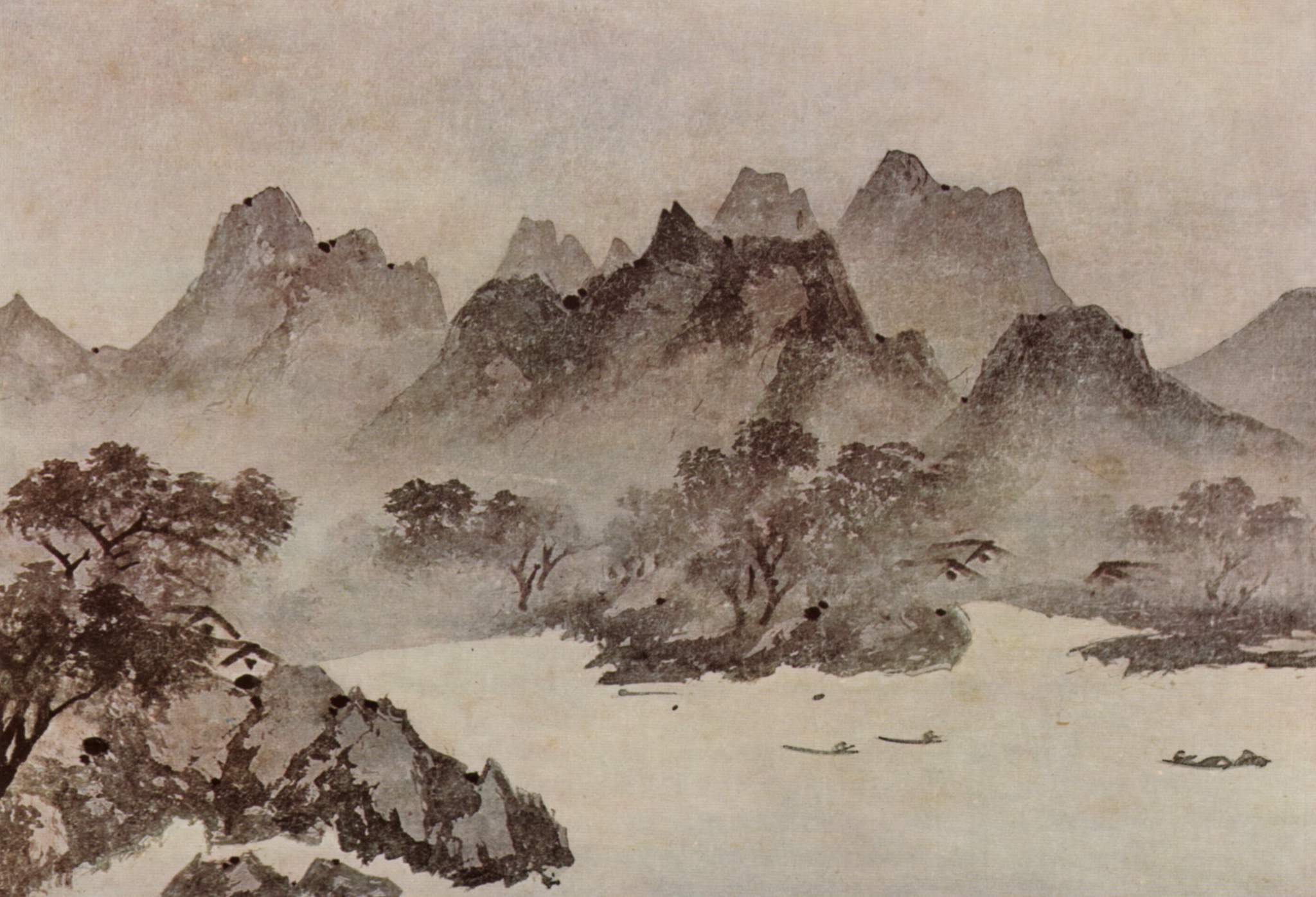
Why Muqi matters
Muqi, also written Muxi and known in Japan as Mokkei, is one of the most influential painters in the history of Chan, or Zen, Buddhist ink painting. A thirteenth century Southern Song monk whose surviving output is tiny, he became, centuries after his death, the single most revered Chinese painter in Japanese art history, shaping how ink painting, spontaneity, and everyday subject matter were understood in Japan for generations. For collectors and researchers, he represents a category apart from the modern and contemporary market: a historical figure whose importance rests on museum and temple custodianship rather than on an active auction record.
- Nationality
- Chinese (Southern Song dynasty)
- Media
- Ink painting, Chan Buddhist painting
- Movement
- Chan (Zen) Buddhist painting, Southern Song dynasty
- Education
- No documented formal schooling. Traditionally described as a disciple of the Chan master Wuzhun Shifan (1177 to 1249) in Hangzhou, though recent scholarship questions how securely this relationship is documented.
- Signature motifs
- Everyday subjects such as persimmons and chestnuts, Spontaneous untutored-looking ink brushwork, Xiao and Xiang River landscapes
By the numbers
- DeceasedStatus13th-century Chan monk-painter; exact death date unknown
- c. 1265 to 1269Documented active periodSigned and dated surviving works
- Six Persimmons and Chestnuts recognized as Important Cultural PropertiesCultural property statusGovernment of Japan; exact designation year not confirmed in sources reviewed
- NoneCommercial representationHistorical artist; works held by temples and museums
Selected works
Click any work to view it full screen.
Biography
Muqi was a Chan Buddhist monk and painter active in the mid to late thirteenth century, toward the end of the Southern Song dynasty. His personal surname is thought to have been Xue. Muqi, sometimes romanized Muxi, functioned as an art name, or hao, while Fachang was his monastic, or Dharma, name. He is recorded as a native of Sichuan and later worked in the Southern Song capital of Lin'an, present day Hangzhou.
Traditional accounts describe him as a disciple of the eminent Chan master Wuzhun Shifan (1177 to 1249) and associate him with Liutong Monastery near Hangzhou's West Lake. Recent doctoral research has questioned how securely this master and disciple relationship, his residence at Liutong, and even his traditional identification as a native of Sichuan are documented in contemporary texts. No school, degree, or dated course of study is documented for him in the modern sense; what education he had was religious and artistic training within a monastic setting.
His birth is placed in the early thirteenth century, commonly given as around 1210, though sources vary across a range of roughly 1200 to 1220. His most securely dated surviving works cluster around 1265 to 1269. He died sometime between 1264 and 1294, during the Zhiyuan era, most likely in Hangzhou, but no source records an exact death date. His reputation among Chinese connoisseurs in the Yuan, Ming, and Qing periods was often lukewarm or dismissive; his standing as one of the most important painters in the Chan tradition developed later, above all in Japan, where his paintings entered temple and shogunal collections and became foundational to Japanese ink painting.
Critical reception
Scholars and museums consistently treat Muqi as a foundational figure in Chan, or Zen, painting. The Kyoto National Museum describes him as probably one of the most important Chinese painters to influence the development of Japanese ink painting. The Asian Art Museum in San Francisco has written that in medieval and early modern Japan Muqi was regarded with an almost unparalleled respect, so much so that a mode of brushwork was given the honorific name priest's style, or osho yo, and that few painters in Japan escaped his influence. His two most famous surviving paintings, Six Persimmons and Chestnuts, held at Daitokuji Ryokoin in Kyoto, are reported by museum sources to have been designated Important Cultural Properties by the Japanese government, though the exact year of that designation was not confirmed in the sources reviewed here, and the two works are now widely described by Western scholars as preeminent examples of Zen art. His is an unusual case among historical painters in that his critical standing rose sharply after his death and largely outside his country of origin.
Market
Muqi predates the modern art market by many centuries, and there is no gallery, dealer, or estate that represents him today. His works, where they survive, are held almost entirely by temples, national museums, and a handful of Western institutions rather than traded privately. No verified all time auction record for Muqi could be confirmed for this profile. A 2008 Sotheby's Hong Kong sale, Two Song Treasures from a Japanese Collection, listed a work attributed to Muqi as lot 2602, but no confirmed hammer price for that lot is available in the sources reviewed. Broader surveys of record prices for Chinese and Asian art at auction, which credit artists such as Qi Baishi and Wu Bin with the highest results in those categories, do not identify any Muqi sale among them.
Selected exhibitions
| Years | Exhibition | Venues |
|---|---|---|
| 2020 | Muqi Fachang and Related Painters | Kyoto National Museum, Kyoto |
| 2023 | The Heart of Zen: International Debut of Six Persimmons and Chestnuts | Asian Art Museum, San Francisco |
| 2019 | The Chinese Painter Muqi in Japanese Culture | Asian Art Museum, San Francisco |
| 2019 | Six Persimmons and Chestnuts, on loan from Daitokuji Ryokoin | Miho Museum, Shiga Prefecture |
| since c. 1600s | Permanent temple holding of Six Persimmons and Chestnuts | Daitokuji Ryokoin, Kyoto |
Museum collections
- Daitokuji Ryokoin, Kyoto
- Kyoto National Museum, Kyoto
- Hatakeyama Memorial Museum of Fine Art / Ebara Hatakeyama Museum of Art, Tokyo
- Nezu Museum, Tokyo
- The Palace Museum, Beijing
- National Palace Museum, Taipei
- Yale University Art Gallery, New Haven
- Cleveland Museum of Art, Cleveland
- Metropolitan Museum of Art, New York
Authentication and provenance
No catalogue raisonne.
No catalogue raisonne exists for Muqi. Attribution rests on signatures, seals, temple and imperial provenance records such as the Ashikaga shogunate's historical catalog, and scholarly connoisseurship. Recent research has questioned parts of his traditional biography, including his supposed teacher and monastery, so some long-repeated claims are treated with caution by specialists.
Primary reference: https://en.wikipedia.org/wiki/Muqi
What collectors should know
There is no active commercial market to track for Muqi in the way there is for a modern or contemporary artist. His attributed works are extremely rare, are concentrated in temple and museum collections such as Daitokuji Ryokoin, the Kyoto National Museum, the Palace Museum in Beijing, the National Palace Museum in Taipei, and the Metropolitan Museum of Art, and rarely if ever change hands. Because no catalogue raisonne exists, attribution depends on signatures, seals, provenance records such as the Ashikaga shogunate's historical catalog, and scholarly connoisseurship. Even parts of his traditional biography, including his supposed teacher and monastery, have been questioned by recent research. Anyone encountering a work offered as by Muqi should treat attribution and provenance, not price history, as the central question.
Further reading and resources
Data current as of 2026-07-16.

