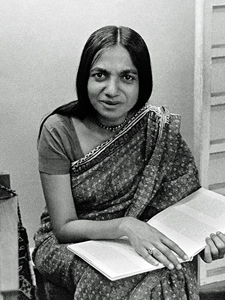
Why Nasreen Mohamedi matters
Nasreen Mohamedi is regarded as one of the most important abstract artists to emerge from post-independence India, a pioneer of line-based, geometric abstraction at a moment when Indian art was dominated by figuration and narrative content. Her international profile rose sharply after her inclusion in Documenta 12 in 2007, and the museum retrospectives that followed, at the Kiran Nadar Museum of Art, Tate Liverpool, the Museo Reina Sofia, and the Metropolitan Museum of Art, have cemented her as a canonical figure in global postwar abstraction. For collectors, she represents a case where deep institutional validation has arrived well ahead of a still-thin and only recently maturing auction market.
- Nationality
- Indian
- Media
- Drawing, Painting, Photography
- Movement
- Indian Modernism, Geometric abstraction
- Education
- St Martin's School of Art (now Central Saint Martins), London, 1954 to 1957; private atelier of Monsieur Guillard, Paris, on scholarship, 1961 to 1963
- Signature motifs
- Line-based abstraction, Grid and geometric composition
- Representation
- Talwar Gallery, Chatterjee & Lal
By the numbers
- USD 482,600Auction highUntitled, Sotheby's, 2024
- The Met Breuer, 2016Major retrospectiveNew York
- Documenta 12, 2007International breakthroughKassel, Germany
- Talwar Gallery; Chatterjee & LalRepresented byNew York/New Delhi; Mumbai
Biography
Nasreen Mohamedi was born in 1937 in Karachi, then part of British India and now in Pakistan. At around age seventeen she went to London to study at St Martin's School of Art, London, between 1954 and 1957. She returned to India and, between 1959 and 1961, held studio space at the Bhulabhai Desai Institute in Bombay, a hub for the city's postwar avant-garde, where she also held her first solo exhibition in 1961. From 1961 to 1963 she studied on a scholarship in Paris, working at the private atelier of a Monsieur Guillard and training in printmaking.
Through the 1960s, 70s, and 80s she exhibited steadily in Bombay and Delhi, showing at venues including the Jehangir Art Gallery, the Lalit Kala Akademi, and Gallery Chemould. For much of her later career she taught at the Faculty of Fine Arts at the Maharaja Sayajirao University in Baroda, where her mature, minimal, grid-based drawings developed. Her health declined over the 1980s due to a progressive neurological disorder; published accounts describe it variously as Parkinson's disease or Huntington's chorea, reflecting a lack of consensus in the biographical record rather than a documented single diagnosis. She died in 1990 at the age of 53; sources place her death in either Kihim or Baroda, India, and do not agree on an exact date.
Critical reception
Critical and curatorial attention to Mohamedi has grown substantially since her posthumous rediscovery began in earnest with the 2005 retrospective at the Drawing Center in New York and accelerated after her inclusion in Documenta 12 in 2007. Subsequent retrospectives at the Kiran Nadar Museum of Art, Tate Liverpool, the Museo Reina Sofia, and the Metropolitan Museum of Art's Met Breuer have positioned her as a central figure in the history of global abstraction rather than a regional footnote. Coverage in The New York Times, including writing by critic Roberta Smith, has tracked this reassessment. The critical throughline is a recognition that her spare, ruled compositions, drawn from architecture, landscape, and the desert, carry a rigor and originality that were underrecognized in her lifetime.
Market
Mohamedi's auction market is small relative to her institutional stature. The best-documented result to date is Untitled, which sold for USD 482,600 at Sotheby's in 2024; the exact sale date and location could not be independently confirmed from public sources. Indian market reports from April 2024 describe a separate Untitled work reportedly reaching about INR 12.65 crore, or roughly USD 1.3 million, which would exceed the Sotheby's figure, but no source found names the auction house for that sale, so it is treated here with lower confidence rather than as the headline record. Auction supply for her work remains thin in any given year, so any single result should be read with caution.
Top auction results
| Work | Price | Sale |
|---|---|---|
| Untitled (2024) | USD 482,600 | Sotheby's |
Selected exhibitions
| Years | Exhibition | Venues |
|---|---|---|
| 1961 | Inaugural solo exhibition | Gallery 59, Bhulabhai Desai Institute, Mumbai |
| 2005 | Nasreen Mohamedi | The Drawing Center, New York |
| 2007 | Documenta 12 | Kassel, Germany |
| 2013 | Nasreen Mohamedi | Kiran Nadar Museum of Art, New Delhi |
| 2014 | Nasreen Mohamedi | Tate Liverpool |
| 2015 | Nasreen Mohamedi | Museo Nacional Centro de Arte Reina Sofia, Madrid |
| 2016 | Nasreen Mohamedi | The Metropolitan Museum of Art (Met Breuer), New York |
| 2020 to 2021 | Pull with a Direction | Talwar Gallery, New York |
Museum collections
- Metropolitan Museum of Art, New York
- Museum of Modern Art, New York
- Art Institute of Chicago
- Kiran Nadar Museum of Art, New Delhi
- Queensland Art Gallery / Gallery of Modern Art, Brisbane
Authentication and provenance
No catalogue raisonne.
No published catalogue raisonne or certificate-of-authenticity program has been identified for the artist. Talwar Gallery and Chatterjee & Lal, both of which mount exhibitions of her work, are the primary points of reference for provenance and attribution questions.
Primary reference: https://www.talwargallery.com/artists/nasreen-mohamedi
What collectors should know
Mohamedi's market sits well behind her institutional recognition. There is no published catalogue raisonne, so collectors should rely on provenance history and on the two galleries most active with her estate, Talwar Gallery and Chatterjee & Lal, for attribution questions. Auction supply is thin and prices have been rising but remain modest by the standards of an artist with this level of museum support, which means individual results can move a great deal on the specific work, its condition, and its exhibition history rather than tracing a smooth trend line. The gap between her museum standing and her market size is itself the main thing to watch.
Further reading and resources
Data current as of 2026-07-11.

