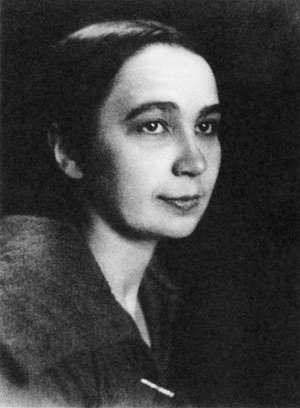
Why Natalia Goncharova matters
Natalia Goncharova was one of the most versatile and influential figures of the Russian avant-garde, moving fluidly between painting, sculpture, book illustration, and stage design over a career that spanned Moscow, wartime Europe, and emigre Paris. She co-invented Rayonism with her lifelong partner Mikhail Larionov, helped define Russian Neo-Primitivism, and became one of the most sought-after set and costume designers for Sergei Diaghilev's Ballets Russes. For a collector, she matters on two registers at once: as a foundational figure in early twentieth-century modernism validated by major museum retrospectives, and as, at points in the mid-2000s, one of the highest-priced female artists at auction, a market position built on a small, historically important body of work rather than steady, high-volume trading.
- Born
- 1881-07-03, Nagaevo, Tula Governorate, Russian Empire
- Nationality
- Russian
- Media
- Painting, Costume and set design, Printmaking
- Movement
- Russian avant-garde, Rayonism, Neo-Primitivism
- Education
- Fourth Women's Gymnasium, Moscow, graduated 1898; Moscow School of Painting, Sculpture and Architecture, 1901 to 1909, studied sculpture under Pavel Trubetskoi, left without a diploma after being denied one for exhibiting work deemed 'decadent'
- Signature motifs
- Neo-Primitivist peasant and religious imagery, Rayonist abstraction, Ballets Russes costume and set design
By the numbers
- USD 9.8MAuction highPicking Apples, Christie's, 2007
- 1881 to 1962LifespanBorn Tula Governorate, Russian Empire; died Paris, France
- 2019 to 2020Major retrospectiveTate Modern, London
- RayonismCo-foundedWith Mikhail Larionov
Biography
Natalia Sergeevna Goncharova was born in 1881 in Nagaevo, a village in Tula Governorate in the Russian Empire. Sources give her exact birth date as either 21 June (Old Style) or 3 July (New Style) 1881, a discrepancy consistent with the Julian to Gregorian calendar conversion common in Russian records of the period. Her family moved to Moscow when she was young, and she graduated from the Fourth Women's Gymnasium there in 1898.
She enrolled at the Moscow School of Painting, Sculpture and Architecture around 1901 to study sculpture under Pavel Trubetskoi, exhibiting in major Russian salons by 1903 and receiving a silver medal for sculpture. She left the school in 1909 without a diploma, after being denied one for exhibiting work deemed "decadent," and shifted her focus decisively toward painting.
Goncharova became a central figure in the Moscow avant-garde, exhibiting with the Jack of Diamonds group in 1910, then breaking away with Mikhail Larionov, her lifelong partner, to help found the more radical Donkey's Tail group, which showed in 1912, and to exhibit in The Target in 1913. That same year, a solo retrospective of more than 700 works at an art salon on Bolshaya Dmitrovka Street in Moscow established her as a leading figure of Russian modernism. With Larionov, she developed Rayonism, an abstract style built from intersecting rays of color and light.
Sergei Diaghilev commissioned her to design sets and costumes for the Ballets Russes beginning with Le Coq d'Or in 1914, drawing her toward Western Europe. She left Russia permanently and eventually settled in Paris in 1921, where she continued to paint, design for the stage, and exhibit until her death on 17 October 1962. She is reported to have been buried at the Ivry Cemetery, Ivry-sur-Seine, outside Paris.
Critical reception
Goncharova has long been treated by major institutions as a foundational figure of the Russian avant-garde rather than a peripheral one. Tate frames her as a pioneer of the movement, and her rapid rise, from a 1910 debut with Jack of Diamonds to a roughly 700-work solo retrospective in Moscow by 1913, was read at the time as evidence of exceptional range across sculpture, painting, and later stage design. Sergei Diaghilev, who commissioned her Ballets Russes designs, is reported to have praised her stage work as unusually poetic and rich in colour. After a long mid-century gap, a 1961 Arts Council of Great Britain retrospective paired with Larionov renewed attention to her work in the West, and twenty-first-century retrospectives, including Tate Modern's 2019 to 2020 survey and a companion exhibition at the Palazzo Strozzi in Florence, reasserted her as one of the movement's central and most versatile figures.
Market
Goncharova's market is thin in volume but historically high in price. Her most widely cited auction result is Picking Apples (Sbor yablok, 1909), which sold at Christie's on 18 June 2007 for approximately USD 9.8 million, reported at the time as a record price for a work by a female artist at auction. Other significant results include Street in Moscow (1909), which sold for USD 6,354,500 at Sotheby's New York in 2011, and Espagnole (1916), reported at approximately EUR 6,538,470 in a 2010 sale, though secondary market summaries do not consistently attribute that sale to a single auction house or exact date. Given the scarcity of fully documented, primary-source sale records for her market, these figures should be read as the best currently available rather than an audited ranking.
Top auction results
| Work | Price | Sale |
|---|---|---|
| Picking Apples (Sbor yablok) (1909) | USD 9,800,000 | Christie's, London, 2007-06-18 |
Selected exhibitions
| Years | Exhibition | Venues |
|---|---|---|
| 1910 | Jack of Diamonds | Moscow |
| 1912 | The Donkey's Tail | Moscow |
| 1913 | The Target | Moscow |
| 1913 | First solo retrospective | Art Salon, Bolshaya Dmitrovka Street, Moscow |
| 1961 | Goncharova and Larionov retrospective | Arts Council of Great Britain, touring UK |
| 2019 | Natalia Goncharova | Palazzo Strozzi, Florence |
| 2019 to 2020 | Natalia Goncharova | Tate Modern, London |
Museum collections
- State Tretyakov Gallery, Moscow
- Museum of Modern Art, New York
- Solomon R. Guggenheim Museum, New York
- Tate, London
Awards and honors
- Silver medal for sculpture, Moscow School of Painting, Sculpture and Architecture (1904)
Authentication and provenance
No catalogue raisonne.
No published catalogue raisonne is confirmed for Goncharova as of this writing. Attribution and authentication currently rely on provenance research, exhibition history, and expert connoisseurship rather than a single settled reference catalogue.
Primary reference: https://www.tate.org.uk/art/artists/natalia-goncharova-1186
What collectors should know
No catalogue raisonne for Goncharova is confirmed as published, and this profile could not confirm a current representing gallery or estate; provenance research, exhibition history, and expert connoisseurship carry more weight than they would for an artist with a settled catalogue and an active gallery program. Basic biographical facts, including her exact birth date, are recorded slightly differently across major sources, a reminder of how much early twentieth-century Russian documentation still requires cross-checking source by source. Her auction history is dominated by a small number of very high-value sales rather than a deep, continuous trading record, so any single result, including her reported 2007 auction high, should be read as a data point from a thin market rather than a stable trend line.
Further reading and resources
Data current as of 2026-07-09.

