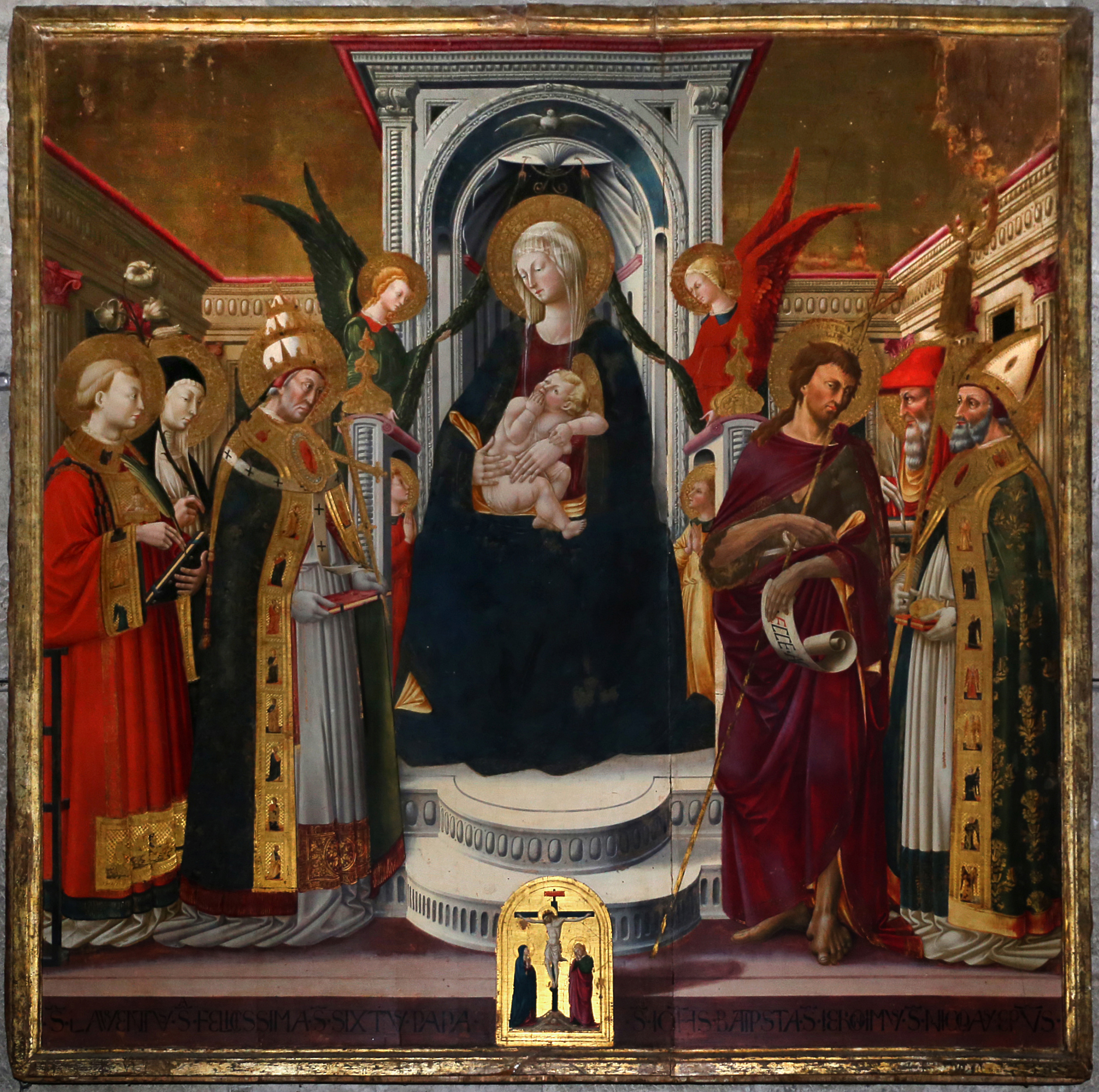
Why Neri di Bicci matters
Neri di Bicci was one of the most prolific painters in fifteenth-century Florence, running a large workshop that supplied altarpieces, devotional panels, and frescoes to churches and confraternities across Tuscany for roughly four decades. His importance to art history rests less on stylistic innovation than on documentation: his own workshop ledger, the Ricordanze, is among the most detailed surviving records of how a Renaissance painting business actually operated. For collectors, he represents a rare, relatively accessible entry point into Florentine Quattrocento panel painting, at price levels far below those of his more celebrated contemporaries.
- Nationality
- Italian
- Media
- Panel painting, Fresco
- Movement
- Italian Renaissance, Florentine School
- Education
- Trained in the workshop of his father, the painter Bicci di Lorenzo, in Florence. Joined the Compagnia di San Luca, the Florentine painters' confraternity, in 1434. No formal school or degree is documented.
- Signature motifs
- Gold-ground altarpieces, Madonna and Child compositions, Coronation of the Virgin subjects
By the numbers
- CHF 78,000 (approx. USD 82,000)Auction highThe Ascension of Christ, Koller Auktionen, Zurich; exact sale date not published in the available source record
- Florence, 1434 to 1492ActiveJoined the Compagnia di San Luca in 1434; last known dated altarpiece 1482
- Ricordanze, 1453 to 1475Workshop diaryHeld in the Uffizi library, Florence
- None publishedCatalogue raisonne
Selected works
Click any work to view it full screen.
Biography
Neri di Bicci was born in Florence, most sources place the year at 1418, though some give 1419. He was the third generation of a family of painters: his grandfather was Lorenzo di Bicci and his father was Bicci di Lorenzo, and Neri trained in his father's workshop from childhood. In 1434 he was admitted to the Compagnia di San Luca, the Florentine painters' confraternity, marking his recognized professional status.
When his father's health declined around 1446 and Bicci di Lorenzo died in 1452, Neri took over the family workshop, which by then was one of the busiest in Florence. From 1453 to 1475 he kept the Ricordanze, a workshop diary recording commissions, subjects, prices, patrons, and the assistants who worked under him. The manuscript, now held in the Uffizi library in Florence, remains a primary source for historians studying the economics and practice of Renaissance workshop painting.
Over his career Neri produced altarpieces and devotional panels for churches, hospitals, and confraternities throughout Florence and Tuscany, including a documented commission for San Miniato in 1452 and what is generally cited as his last dated altarpiece, from 1482, now in the Pinacoteca Nazionale in Siena. He died in Florence. The best-supported scholarly sources, including the Dizionario Biografico degli Italiani and structured reference datasets, give his death date as 4 January 1492, at about age 74; some earlier literature instead gives 1491, reflecting the absence of a death record beyond that point rather than a documented later date.
Critical reception
No signed, verbatim critical assessment of Neri di Bicci from a major named critic in a major outlet could be confirmed for this profile, so none is quoted here. In the scholarly literature, he is treated primarily as a workshop master whose significance lies in productivity and documentation rather than pictorial innovation: he ran one of the largest and most commercially active painting workshops in Quattrocento Florence, and his Ricordanze is widely cited by historians as a uniquely detailed window into how a Renaissance bottega priced, staffed, and delivered commissions. Assessments of his paintings themselves tend to note a competent, formulaic style suited to steady ecclesiastical demand, in contrast to more experimental Florentine contemporaries of the same decades.
Market
Neri di Bicci's market is thin and largely confined to Old Master specialist sales, reflecting both his historical distance and the uneven survival and attribution of his large workshop output. The best-documented auction result is The Ascension of Christ, a tempera-on-panel work with gold ground dated to around 1475 to 1480, which sold for CHF 78,000 including premium (approximately USD 82,000 in comparable exchange terms) at Koller Auktionen in Zurich; the exact sale date is not published in the available source record. Other lots attributed to him have appeared at Sotheby's, Christie's, Dorotheum, Cambi, and Wannenes with estimates ranging from about USD 15,000 to as high as several hundred thousand euros, but published, confirmed hammer prices for those lots could not be verified.
Top auction results
| Work | Price | Sale |
|---|---|---|
| The Ascension of Christ (Christi Himmelfahrt) | USD 82,000 (CHF 78,000) | Koller Auktionen, Zurich |
Selected exhibitions
| Years | Exhibition | Venues |
|---|---|---|
| 1452 | Documented altarpiece commission | Diocesan Museum of Sacred Art, San Miniato, Tuscany |
| 1453 to 1475 | Ricordanze, workshop commission ledger | Uffizi Library, Florence |
| c. 1470 to 1475 | Coronation of the Virgin with Angels and Four Saints | Museum of Fine Arts, Boston |
| 1482 | Last known dated altarpiece | Pinacoteca Nazionale, Siena |
| 15th century, dispersed since | Altarpiece wing panels from a single dismembered commission | Galleria dell'Accademia, Florence, and Allen Memorial Art Museum, Oberlin College (companion wings; the center panel is at the Museum of Fine Arts, Boston) |
Museum collections
- Museum of Fine Arts, Boston
- Metropolitan Museum of Art, New York
- Galleria dell'Accademia, Florence
- Uffizi Library, Florence (holds the artist's Ricordanze manuscript)
- Detroit Institute of Arts
- Yale University Art Gallery
- Pinacoteca Nazionale, Siena
Authentication and provenance
No catalogue raisonne.
No catalogue raisonne of Neri di Bicci's work has been published. The primary documentary source is his own Ricordanze, a workshop ledger kept from 1453 to 1475 and held in the Uffizi library in Florence, which records commissions, prices, patrons, and assistants. Beyond that record, attribution and dating rely on connoisseurship, archival research, and comparison across his large workshop output.
Primary reference: https://www.treccani.it/enciclopedia/neri-di-bicci_(Dizionario-Biografico)/
What collectors should know
There is no catalogue raisonne of Neri di Bicci's work, and the main documentary anchor, the Ricordanze, describes his commissions rather than certifying individual surviving panels, so attribution and dating rely heavily on connoisseurship and archival cross-referencing. His large workshop produced work of uneven quality and with variable levels of studio assistance, which is a significant driver of price dispersion at auction. Confirmed sale results are scarce, the CHF 78,000 result at Koller is the only fully documented high-water mark identified here, so published estimates at other houses should be treated as indicative rather than as evidence of realized value. His paintings are widely dispersed across major museum collections in Europe and North America, which supports long-term scholarly interest even though the auction market for his work remains small and irregular.
Further reading and resources
Data current as of 2026-07-16.

