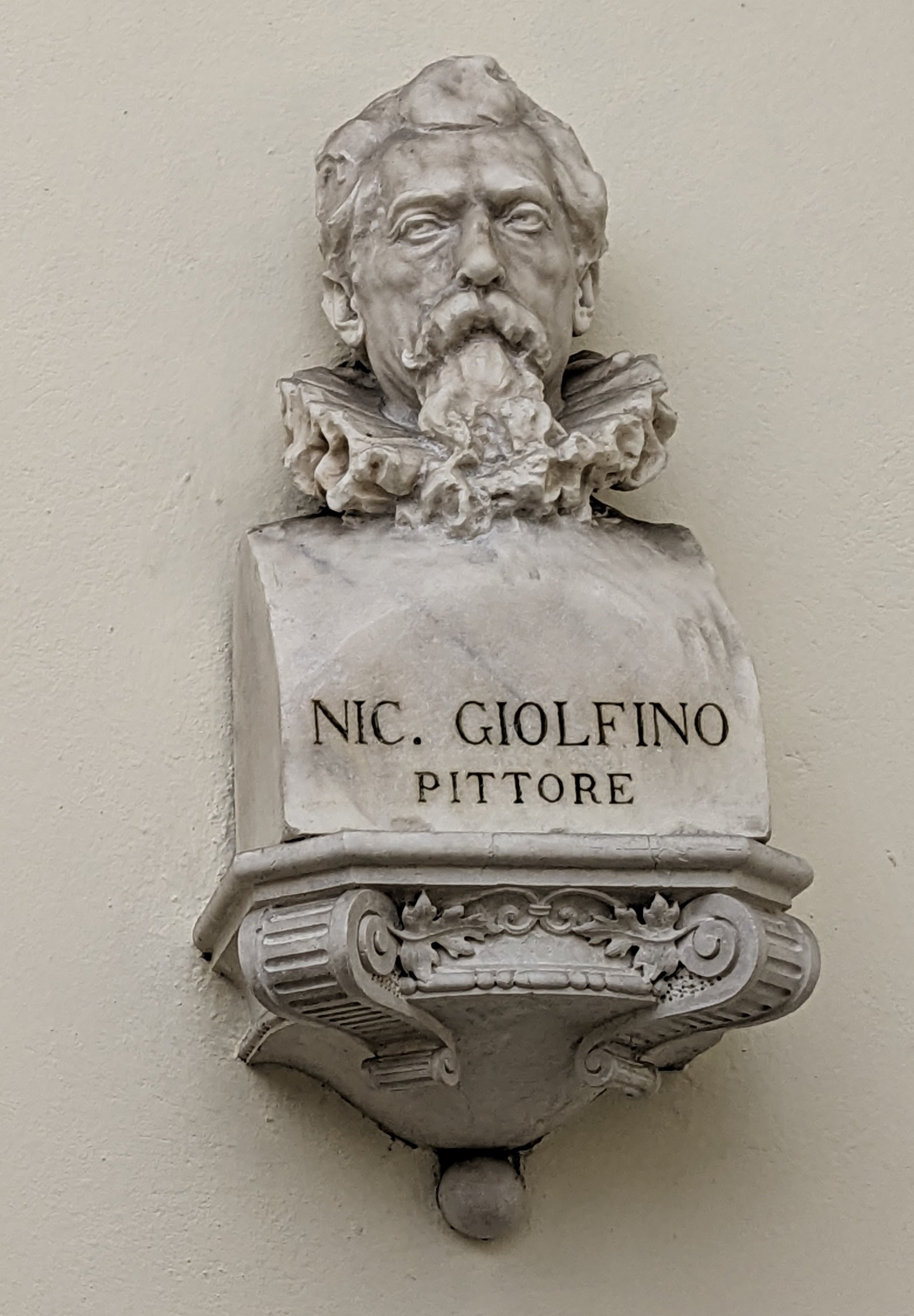
Why Niccolo Giolfino matters
Niccolo Giolfino was one of the leading painters of Verona in the first half of the sixteenth century, and his surviving frescoes, altarpieces, and drawings now anchor the Renaissance holdings of institutions from the Louvre to the Metropolitan Museum of Art. For a collector, he represents a category distinct from the modern and contemporary market entirely: a well-documented Old Master whose supply is fixed by history rather than by a living studio, whose attribution depends on archival and scholarly research rather than a foundation or estate, and whose market activity is thin and occasional by nature.
- Nationality
- Italian
- Media
- Painting, Fresco
- Movement
- Renaissance, Veronese school
- Education
- Trained as a youth in his family's woodcarving workshop in Verona, then apprenticed from 1492 in the workshop of the painter and miniaturist Liberale da Verona
- Signature motifs
- Religious narrative painting, Allegorical figures
By the numbers
- Verona, c.1476 to 1555ActivePainter of the Veronese school
- Liberale da VeronaTrained underApprenticeship from 1492
- 6+ institutionsMuseum collectionsLouvre, Met, Princeton, Berlin, and Verona among them
- None publishedCatalogue raisonneAttribution relies on archival and stylistic scholarship
Selected works
Click any work to view it full screen.
Biography
Niccolo Giolfino was born in Verona in 1476, into a family of woodcarvers, and began his training in that family workshop, learning to define form in a sculptural, still Gothic-inflected manner. In 1492 he entered the workshop of the painter and miniaturist Liberale da Verona, where he trained alongside Giovanni Francesco Caroto, among others. Some earlier historians proposed that Giolfino also studied with or befriended Andrea Mantegna, but modern scholarship treats this as an unproven hypothesis rather than a documented fact.
Giolfino spent his career working in and around Verona. He painted a fresco cycle in the Chapel of the Cross at the church of San Bernardino between roughly 1500 and 1522, and also produced frescoes for Santa Maria in Organo, alongside easel paintings, allegorical drawings, and a body of small narrative and mythological panels now dispersed among museums in Europe and the United States. Some later sources also credit him with cartographic work in his later years.
Giolfino died in Verona in 1555. The precise calendar date of his death is not recorded, but a document cited by the UniCredit Art Collection shows he signed a topographical drawing of the Valverde area near Porta Nuova on 3 May 1555, and that when the drawing was delivered about a month later, his son-in-law reported that the artist had already died. The year 1555 is agreed across standard reference sources, none of which give an exact day or month of death.
Critical reception
Giolfino is treated in the standard art-historical literature, including the Web Gallery of Art, as a significant figure of the Veronese school, valued for large-scale fresco cycles and narrative altarpieces that carried a somewhat Gothic, sculptural sense of form into the sixteenth century. Scholars have moved away from older claims linking him directly to Andrea Mantegna, favoring instead his documented training under Liberale da Verona and his place among the Caroto generation of Veronese painters. No exact, attributable quotation from a named critic in a major outlet could be verified for this profile; his reputation rests on museum curatorial scholarship and institutional collection records rather than press criticism, consistent with his status as a sixteenth-century painter.
Market
Giolfino's market is that of a historical Old Master rather than a modern or contemporary artist: supply is fixed, sales are infrequent, and no catalogue raisonne exists to anchor attribution. The highest price identified in available market data is about USD 100,800, for a pair of panels, The Murder of the Magus Smerdis and The Coronation of Darius, tracked to Sotheby's New York in May 2021 against an estimate of USD 80,000 to 120,000; the exact day of sale is not documented in the source database, and because the figure derives from a single aggregator rather than a house-published result, it should be treated as provisional rather than a fully confirmed all-time record. Other tracked results are more modest, including Saint Roch in a Landscape, a Town Beyond, which sold at Christie's London for GBP 12,500 in July 2018, and a Madonna with Child carried at Wannenes Art Auctions with an estimate in the range of EUR 20,000 to 30,000.
Top auction results
| Work | Price | Sale |
|---|---|---|
| The Murder of the Magus Smerdis; The Coronation of Darius: A Pair (2021) | USD 100,800 (USD 100,800 (estimate USD 80,000 to 120,000)) | Sotheby's, New York |
| Saint Roch in a Landscape, a Town Beyond (2018) | GBP 12,500 | Christie's, London |
Selected exhibitions
| Years | Exhibition | Venues |
|---|---|---|
| 1500 to 1522 | Fresco cycle, Chapel of the Cross | Church of San Bernardino, Verona |
| n.d. | Narrative fresco cycle | Santa Maria in Organo, Verona |
| c.1510 | Madonna and Child | Museo di Castelvecchio, Verona |
| 1917 | The Arrest of Christ, acquired (Frederick C. Hewitt Fund) | The Metropolitan Museum of Art, New York |
| 1935 | Chiomara and the Centurion, donated | Princeton University Art Museum |
Museum collections
- Musee du Louvre, Paris
- Gemaldegalerie, Staatliche Museen zu Berlin
- Princeton University Art Museum
- Philadelphia Museum of Art
- The Metropolitan Museum of Art, New York
- Museo di Castelvecchio, Verona
Authentication and provenance
No catalogue raisonne.
No catalogue raisonne of Giolfino's work has been published. Attribution rests on archival documents and museum curatorial and stylistic scholarship (Web Gallery of Art and UniCredit Art Collection, among others); some paintings remain debated between the artist's own hand and his workshop.
Primary reference: https://en.wikipedia.org/wiki/Niccol%C3%B2_Giolfino
What collectors should know
There is no catalogue raisonne and no estate or gallery representation for Giolfino; attribution depends on archival documentation, provenance, and comparison with securely documented works in museum collections such as the Louvre, the Metropolitan Museum of Art, and the Museo di Castelvecchio in Verona. Auction appearances are infrequent and estimates modest by Old Master standards, and the highest circulating "record price" figure comes from a single market aggregator rather than a house-confirmed sale, so it should be treated with caution rather than as a settled benchmark. Collectors should expect any Giolfino acquisition to turn on connoisseurship and documented provenance rather than on a liquid trading history.
Further reading and resources
Data current as of 2026-07-18.

