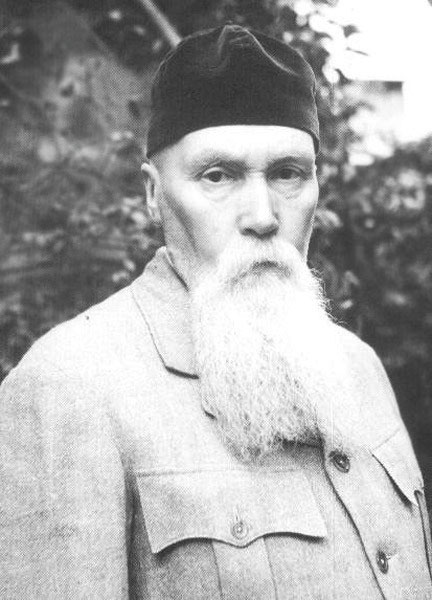
Why Nicholas Roerich matters
Nicholas Roerich (1874 to 1947) was one of the most prolific and unusual figures to move through European and Asian art history: a Russian-trained painter, archaeologist, and philosopher who produced an estimated 7,000 paintings and spent his final two decades painting the Himalayas from a home in the Kullu Valley of India. His market rests less on gallery promotion than on a century of museum stewardship, and on the enduring reach of the Roerich Pact, the 1935 international treaty for the protection of cultural heritage that he helped bring into being. For collectors, he is a case study in a market built on institutional memory rather than a living dealer network.
- Born
- 1874-10-09, Saint Petersburg, Russia
- Nationality
- Russian
- Media
- Painting, Stage and costume design
- Movement
- Symbolism
- Education
- Imperial Academy of Arts, St. Petersburg, title of "artist" 1897; St. Petersburg University, law degree 1898
- Signature motifs
- Himalayan landscapes, Mystical and spiritual symbolism
- Representation
- No commercial gallery representation documented; principal institutional steward is the Nicholas Roerich Museum, New York
By the numbers
- GBP 7.88MAuction highMadonna Laboris, Bonhams London, 2013 (approx. USD 12.1M)
- ~7,000 paintingsEstimated outputper Wikipedia and museum biographies
- Signed 1935Roerich PactWhite House cultural-heritage protection treaty
- No commercial galleryRepresented byPrincipal steward: Nicholas Roerich Museum, New York
Selected works
Click any work to view it full screen.
Biography
Roerich was born on 9 October 1874 in Saint Petersburg, Russia. In 1893, following a compromise with his father, he enrolled simultaneously at the Imperial Academy of Arts and in the law faculty of St. Petersburg University, receiving the title of "artist" from the Academy in 1897 and a law degree from the university in 1898. He married Helena Shaposhnikova in 1901; the couple had two sons, George and Svetoslav Roerich, both of whom went on to their own scholarly and artistic careers.
Roerich's paintings, many built from tempera and rich, saturated color, moved from early Russian historical and folkloric subjects toward the mystical and religious imagery that came to define his mature work, and were shown internationally in Paris, New York, and London over the following decades. He founded the Master Institute of United Arts and the International Art Centre "Corona Mundi" in New York, and was active in archaeology and cultural preservation across Central Asia. That preservation work culminated on 15 April 1935 in the signing of the Roerich Pact at the White House, an international treaty for the protection of artistic and scientific institutions and historic monuments that remains in force. He was nominated for the Nobel Peace Prize by the University of Paris in 1929, and received further nominations in 1932 and 1935, though he did not win the award.
Roerich settled with his family in Naggar, in the Kullu Valley of what is now Himachal Pradesh, India, where the Himalayas became his central subject. He died there on 13 December 1947, and his ashes were buried on a slope facing the mountains he had painted for two decades.
Critical reception
Named critical commentary on Roerich in major outlets is not documented in the available record. What is well attested is the institutional and historical arc of his reputation: early recognition at the Imperial Academy of Arts in St. Petersburg, international exhibitions in Paris, New York, and London that built his reputation as an artist bridging Russian, Central Asian, and Indian subjects, and a later reputation increasingly tied to his role as a peace and cultural-heritage advocate through the Roerich Pact. Museum programming, including two exhibitions at the Oglethorpe University Museum of Art in 1985 and 1993 and ongoing institutional attention from the Nicholas Roerich Museum, the Art Museum Riga Bourse, and other international venues, has kept his work in circulation primarily as a subject of cultural and spiritual history rather than through contemporary market criticism.
Market
Roerich's market is thin at the very top and wide in range beneath it, a reflection of an output measured in the thousands of works across very different periods and subjects. His auction record is Madonna Laboris, which sold for GBP 7,881,250 (approximately USD 12.1 million) at Bonhams in London on 5 June 2013, at the time the highest price recorded for a Russian work of art in a dedicated Russian art sale. Results well below that level are common: Mulbekh (1925) sold for USD 156,000 at Sotheby's online in 2024, and Entrance sold for GBP 65,240 at Roseberys, both far from the 2013 high. There is no evidence of a commercial gallery currently representing Roerich or his estate; the market instead runs through auction houses, with the Nicholas Roerich Museum in New York functioning as the primary institutional reference point for his work.
Top auction results
| Work | Price | Sale |
|---|---|---|
| Madonna Laboris (Proceedings of the Mother of God) (1931) | USD 12,100,000 (GBP 7,881,250) | Bonhams, London, 2013-06-05 |
Selected exhibitions
| Years | Exhibition | Venues |
|---|---|---|
| 1985 | First Nicholas Roerich exhibition | Oglethorpe University Museum of Art, Atlanta |
| 1993 | Nicholas Roerich: Messenger of Beauty | Oglethorpe University Museum of Art, Atlanta |
| 1930 to 1940 | Works sent from India to the Latvian Roerich Society | Riga, Latvia (now Art Museum Riga Bourse) |
| 2023 | Roerich paintings exhibited | Rowe Gallery, J. Murrey Atkins Library, UNC Charlotte |
| Ongoing | Permanent collection display | Nicholas Roerich Museum, New York |
Museum collections
- Nicholas Roerich Museum, New York
- Art Museum Riga Bourse, Riga (Latvian Roerich Society Collection)
Awards and honors
- Title of "artist," Imperial Academy of Arts, St. Petersburg (1897)
- Roerich Pact signed at the White House (cultural-heritage protection treaty) (1935)
- Nobel Peace Prize nomination, University of Paris (further nominations in 1932 and 1935) (1929)
Authentication and provenance
No catalogue raisonne.
No catalogue raisonne or certificate-of-authenticity program has been confirmed. Given an output estimated at roughly 7,000 paintings across sharply different periods, works are generally checked against institutional holdings and provenance records at institutions such as the Nicholas Roerich Museum and against auction-house specialist review.
Primary reference: https://www.roerich.org/roerich-biography.php
What collectors should know
No catalogue raisonne has been confirmed for Roerich, and no certificate-of-authenticity program has been documented. Given an output estimated at roughly 7,000 paintings across sharply different periods, provenance research and comparison against known institutional holdings, such as the Nicholas Roerich Museum in New York and the Latvian Roerich Society collection in Riga, matter more than they would for an artist with a settled scholarly catalogue. Auction results for his work vary enormously by period and subject, from tens of thousands of pounds to the multimillion-pound record set in 2013, so any single result should be read against the specific work's period, subject, and exhibition history rather than treated as a market-wide benchmark.
Further reading and resources
Data current as of 2026-07-09.

