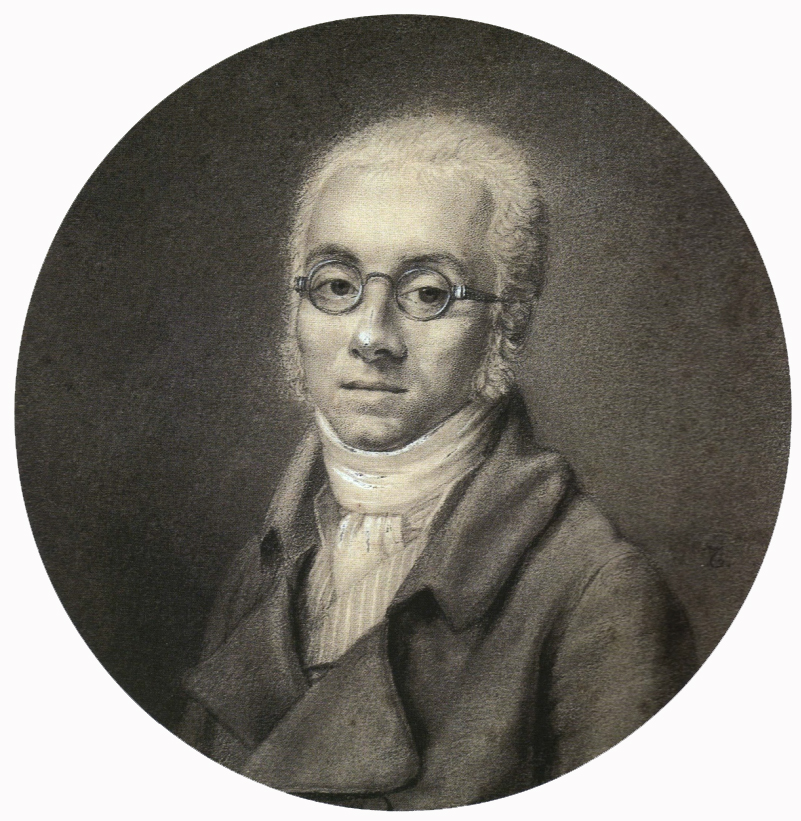
Why Nicolas-Antoine Taunay matters
Nicolas-Antoine Taunay was one of the leading French landscape and history painters of the Revolutionary and Napoleonic periods, an academician who rose to the presidency of the Institut de France's fine arts class and then, late in his career, helped found the academic tradition of landscape painting in Brazil. For collectors, he matters as an institutionally documented Old Master whose surviving output is anchored in major public collections rather than in a single, thinly traded auction market.
- Born
- 1755-02-10, Paris, France
- Nationality
- French
- Media
- Painting
- Movement
- Neoclassicism
- Education
- Studio training in Paris under Nicolas-Bernard Lepicie, Nicolas-Guy Brenet, and Francesco Casanova, beginning about 1768 at roughly age thirteen per Britannica and Brazilian archival sources (one English-language source instead gives entry to the Ecole des Beaux-Arts at about age fifteen, circa 1770); agree, Academie royale de peinture et de sculpture, 1784; pensionnaire, Academie de France a Rome, 1784 to 1787.
- Signature motifs
- Italianate and pastoral landscape, Napoleonic historical scenes, Brazilian landscape views
- Representation
- No current gallery or estate representation identified; works are held by museums and sold through auction houses
By the numbers
- 1768 to 1824Active yearsParis, Rome, and Rio de Janeiro
- Multiple institutionsMuseum collectionsIncludes the Louvre and the Met
- President, Classe des Beaux-ArtsInstitut de France1814
- No active gallery representationRepresented byHistorical artist; market is museum and auction based
Selected works
Click any work to view it full screen.
Biography
Nicolas-Antoine Taunay was born in Paris in February 1755, most sources giving 10 February, though a small number of otherwise reliable references give 11 February. He began studying painting around 1768, at about age thirteen according to Britannica and Brazilian archival sources, training in Paris under the history painters Nicolas-Bernard Lepicie and Nicolas-Guy Brenet before moving to the studio of the landscape and battle painter Francesco Casanova. One English-language reference instead places his entry to the Ecole des Beaux-Arts at about age fifteen, around 1770, a detail this profile treats as less well supported than the 1768 starting date.
In 1784 Taunay was named agree of the Academie royale de peinture et de sculpture and won a three-year scholarship as a pensionnaire of the Academie de France a Rome, where he studied at the Palazzo Mancini from 1784 to 1787. Back in Paris, he built a career exhibiting at the official Salons, winning a second-class prize in 1791 and a second-class prize in history painting in 1798, the year the French state purchased one of his canvases. He became one of the painters favored by Napoleon Bonaparte, producing large historical compositions on Napoleonic subjects, and is credited in secondary sources with a gold medal at the Salon of 1804. In 1795 he was elected a member of the Institut de France, rising to vice president of its Classe des Beaux-Arts in 1813 and to its presidency in 1814.
In 1816, at the invitation of Joachim Lebreton, Taunay joined the French Artistic Mission to Brazil and settled in Rio de Janeiro with his family. He served as professor of landscape painting at the newly founded royal academy there, now the Museu Nacional de Belas Artes, painting Brazilian landscapes and court portraits alongside his teaching until his return to France in 1821. He died in Paris on 20 March 1830.
Critical reception
Taunay's contemporaries regarded him as one of the most respected painters in Paris, and later writers are credited with reviving scholarly interest in his smaller-scale landscapes well after his death, though this profile could not independently verify a specific attributed quotation from that later reappraisal. His reputation rested on two distinct bodies of work: large Napoleonic and Revolutionary historical scenes that made him one of the emperor's favored painters, and more intimate pastoral and Italianate landscapes and genre scenes. His later career in Brazil, where he trained the next generation of academy painters, is now generally credited with helping establish the country's first formal landscape painting tradition.
Market
Taunay's market is that of a documented Old Master rather than a modern or contemporary artist: works surface periodically at European auction houses, including Christie's, Sotheby's, and Dorotheum. The best-documented results found in this review are in the tens of thousands of euros, with a painting titled Lavandieres reported at about EUR 44,100 at Christie's, well short of six figures. As of this review, no single confirmed all-time auction record, complete with price, currency, house, and sale date, could be verified from public sources; one art database cites a 2026 sale of a work titled Couple of shepherds in a landscape near a pond as the artist's current record year, but without a published price or venue, that claim is noted here only as unconfirmed. There is no evidence of active gallery or estate representation; the market instead runs through museum deaccessions, private collections, and the secondary auction trade, with a scholarly reference to a 2003 catalogue raisonne by Claudine Lebrun-Jouve, though that reference itself has not been independently corroborated.
Selected exhibitions
| Years | Exhibition | Venues |
|---|---|---|
| 1777 to 1778 | Salon de la Jeunesse | Place Dauphine, Paris |
| 1782 | Salon de la Correspondance | Paris |
| 1787 | Salon de Paris | Academie royale de peinture et de sculpture, Paris |
| 1791 | Salon de Paris | Paris (second-class prize) |
| 1798 | Salon de Paris | Paris (second-class prize in history painting; one work purchased by the French state) |
| 1804 | Salon de Paris | Paris (gold medal) |
| 1816 to 1821 | French Artistic Mission to Brazil | Royal Academy of Arts, Rio de Janeiro (professor of landscape painting) |
| 1824 | Salon de Paris | Paris; depicted among honored artists in Francois-Joseph Heim's Charles X distribuant des recompenses aux artistes |
Museum collections
- Musee du Louvre, Paris
- The Metropolitan Museum of Art, New York
- Museu Nacional de Belas Artes, Rio de Janeiro
Awards and honors
- Agree, Academie royale de peinture et de sculpture, Paris (1784)
- Elected member, Institut de France (1795)
- Gold medal, Salon de Paris (1804)
- Vice president, Classe des Beaux-Arts, Institut de France (1813)
- President, Classe des Beaux-Arts, Institut de France (1814)
Authentication and provenance
No catalogue raisonne.
No independently confirmed catalogue raisonne or certificate-of-authenticity program exists for Taunay. Some scholarship references a 2003 catalogue raisonne by Claudine Lebrun-Jouve, but this could not be corroborated by a second source in this review. Attribution is handled through museum curatorial departments and auction house provenance research.
Primary reference: https://en.wikipedia.org/wiki/Nicolas-Antoine_Taunay
What collectors should know
Because Taunay died nearly two centuries ago and no confirmed catalogue raisonne could be independently verified, provenance research and museum curatorial opinion carry unusual weight in authenticating any given work. There is no current gallery or estate representation, so acquisitions run through auction houses and private dealers rather than a single controlled channel. Collectors should also treat any cited "record price" with caution until it can be traced to a named auction house, sale date, and currency, since the only recent record reference found in this review lacked those details.
Further reading and resources
Data current as of 2026-07-18.

