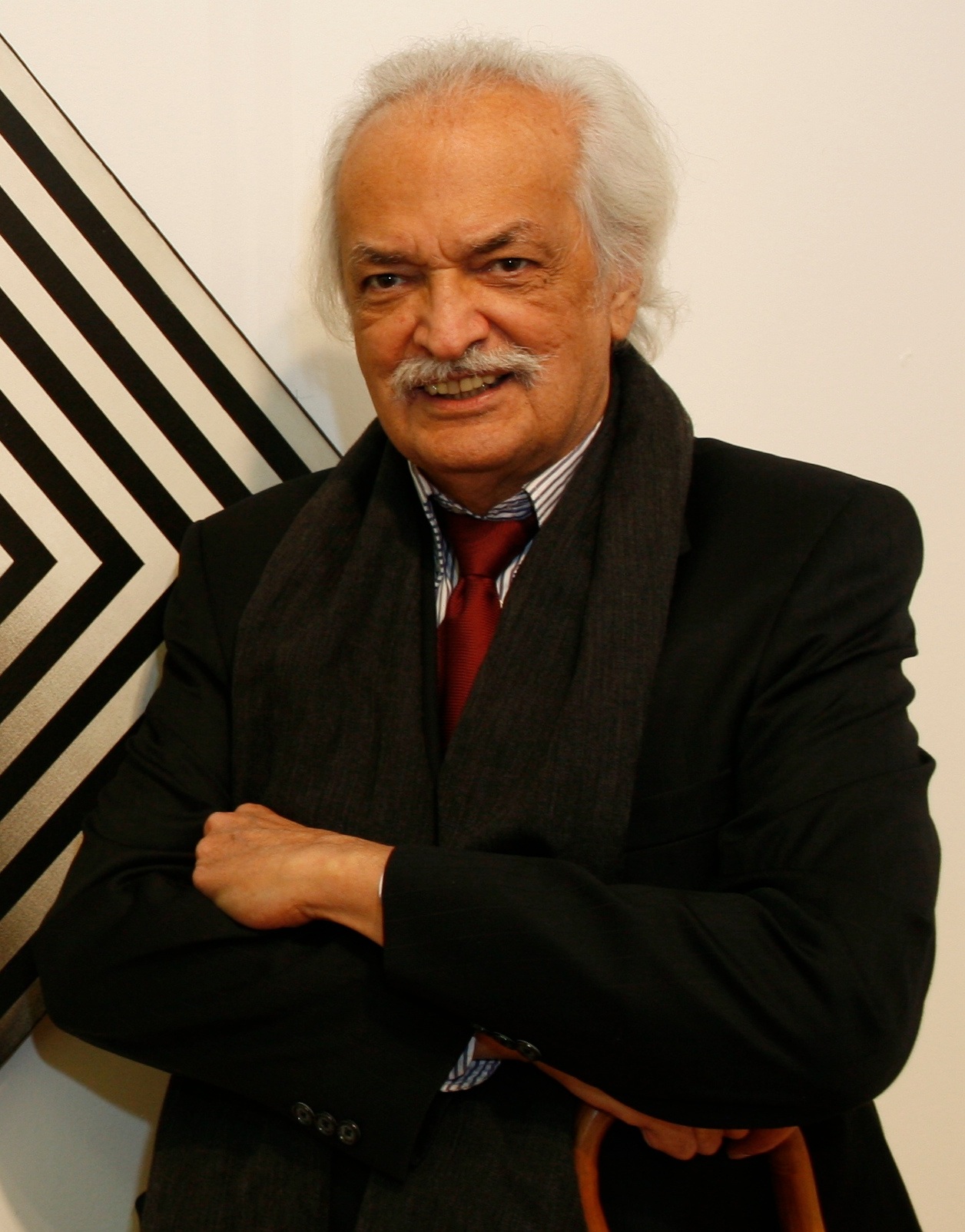
Why Omar Rayo matters
Omar Rayo is one of the central figures of Colombian modern art and one of Latin America's principal contributors to Op Art and geometric abstraction. He is best known for graphic works that combine hard-edged geometric composition with illusionistic, trompe l'oeil renderings of everyday objects such as cords and hardware, a language he built through decades of printmaking, painting, and sculpture. For a collector, his significance rests on deep, long-standing museum placement across the Americas and on a fixed, closed body of work, since the artist died in 2010 and his estate is centrally managed.
- Born
- 1928-01-20, Roldanillo, Valle del Cauca, Colombia
- Nationality
- Colombian
- Media
- Painting, Printmaking, Sculpture
- Movement
- Op Art, Geometric abstraction
- Education
- Correspondence course in drawing, Academia Zier, Buenos Aires, early 1940s; graphic art and intaglio studies in Mexico City under an OAS fellowship, 1959 to 1960
- Signature motifs
- Trompe l'oeil intaglio reliefs of everyday objects, Geometric optical abstraction
- Representation
- Leon Tovar Gallery (estate worldwide), Galeria Duque Arango
By the numbers
- USD 125,000Auction highOla-Zen I, Christie's, November 2017
- International Prize, 1971Sao Paulo Biennial
- 1981Museo Rayo foundedRoldanillo, Colombia; artist-founded museum
- Leon Tovar Gallery (estate); Galeria Duque ArangoRepresented by
Selected works
Click any work to view it full screen.
Biography
Omar Rayo Reyes was born on January 20, 1928, in Roldanillo, Valle del Cauca, Colombia. He began his artistic life as a caricaturist and illustrator, and his most clearly documented formal training was a correspondence course in drawing at the Academia Zier in Buenos Aires, taken as a teenager in the early 1940s. Institutional biographies describe him as largely self-taught; claims in some popular accounts that he also studied at a fine-arts academy in Bogota are not corroborated by the more institutional references and are treated here with caution. In 1959 he received a fellowship from the Organization of American States to study graphic art in Mexico City, where over the following year he mastered intaglio printmaking, the technique that became central to his mature style.
Through the 1960s Rayo developed his signature approach: dense, optically active geometric fields paired with illusionistic reliefs of ordinary objects, rope, hooks, and hardware rendered with sculptural precision on flat paper. He won a prize at the XIX Salon Nacional de Artistas de Colombia in 1966 and first prize at the Salon Nacional de Artistas de Colombia in 1970, and in 1971 he received the International Prize at the Bienal de Sao Paulo, one of the most prestigious awards available to a Latin American artist of his generation. His work was shown in solo exhibitions at the Museo de Arte Moderno in Bogota and Rio de Janeiro, the Museo de Bellas Artes in Caracas, El Museo del Barrio and the Museum of Contemporary Hispanic Art in New York, and, in 1994, in a major survey at the Museo del Palacio de Bellas Artes in Mexico City.
In 1981, Rayo founded the Museo Rayo de Dibujo y Grabado Latinoamericano in his hometown of Roldanillo, an institution dedicated to Latin American drawing and printmaking that today holds the largest concentration of his own work alongside pieces by other regional artists. He continued to exhibit internationally into his final years and was named a Gran Oficial of Colombia's Order of Boyaca in 1994. Rayo died on June 7, 2010, of a heart attack, at the age of 82. Major encyclopedic sources place his death in Palmira, Valle del Cauca, while some press accounts point instead to Cali or to his hometown of Roldanillo; the department and country of death, Valle del Cauca, Colombia, are not in dispute.
Critical reception
Rayo is consistently described in critical and institutional writing as a master of geometric and optical art in Colombia, a figure whose precise, mathematically grounded compositions place him alongside the leading Latin American practitioners of Op Art. Institutional recognition followed a similar arc: prizes at Colombia's national salons in the 1960s, the International Prize at the 1971 Sao Paulo Biennial, and museum surveys in Bogota, Rio de Janeiro, and Mexico City through the 1970s, 80s, and 90s, culminating in a posthumous retrospective at the Museo Nacional de Colombia in 2015.
Market
Rayo's auction market is modest in scale relative to his museum standing. The highest publicly documented auction price for his work is USD 125,000, paid for the painting Ola-Zen I at Christie's in November 2017; the exact sale date and city within that month are not confirmed in available records. An earlier work, Kumo XV, sold for USD 56,250 at Christie's New York in November 2010. His estate is represented worldwide by Leon Tovar Gallery, with Galeria Duque Arango also active in the market for his work.
Top auction results
| Work | Price | Sale |
|---|---|---|
| Ola-Zen I (2017) | USD 125,000 | Christie's |
Selected exhibitions
| Years | Exhibition | Venues |
|---|---|---|
| 2015 | Retrospective | Museo Nacional de Colombia, Bogota |
| 1994 | 20 anos, 100 obras: Omar Rayo | Museo del Palacio de Bellas Artes, Mexico City |
| 1987 | Solo exhibition | Museum of Contemporary Hispanic Art, New York |
| 1980 | Solo exhibition | El Museo del Barrio, New York |
| 1974 | Solo exhibition | Museo de Arte Moderno, Bogota |
| 1972 | Solo exhibition | Museu de Arte Moderna, Rio de Janeiro |
| 1971 | International Prize exhibition | Bienal de Sao Paulo, Brazil |
| 1968 | Solo exhibition | Museo de Bellas Artes, Caracas |
Museum collections
- Museo Rayo, Roldanillo, Colombia
Awards and honors
- International Prize, Bienal de Sao Paulo (1971)
- First Prize, Salon Nacional de Artistas de Colombia (1970)
- Prize, XIX Salon Nacional de Artistas de Colombia (1966)
- Order of Boyaca, rank of Gran Oficial (Government of Colombia) (1994)
- OAS Fellowship for study in Mexico City (1959)
Authentication and provenance
No catalogue raisonne.
No published catalogue raisonne has been confirmed for the artist. The estate is represented worldwide by Leon Tovar Gallery, and the Museo Rayo in Roldanillo, Colombia, which the artist founded, holds and classifies the largest body of his work.
Primary reference: https://www.leontovargallery.com/artists/66-omar-rayo/biography/
What collectors should know
Rayo's market is thin at auction, with a comparatively small and irregular record of public sales, so any single result should be read with caution rather than treated as a stable index of value. No catalogue raisonne has been confirmed as published, which places added weight on the estate, now represented by Leon Tovar Gallery, and on the Museo Rayo in Roldanillo, which holds and studies the largest body of his work, as reference points for provenance. His documented museum association through the Museo Rayo, alongside his salon and biennial honors, is the strongest signal of long-term institutional standing for a collector evaluating his work today.
Further reading and resources
Data current as of 2026-07-16.

