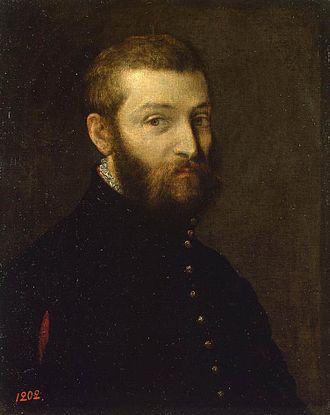
Why Paolo Veronese matters
Paolo Veronese ranks among the three defining painters of the Venetian Renaissance, alongside Titian and Tintoretto, and his large-scale feasts and allegories set a benchmark for color and pictorial ambition that later painters and critics returned to for centuries. For a collector or institution, Veronese represents an old-master name whose reputation is anchored almost entirely in museums rather than in the auction market, a case study in how scholarly consensus and institutional holding, not sale volume, sustain a historical reputation.
- Nationality
- Italian
- Media
- Painting, Fresco
- Movement
- Venetian Renaissance, Mannerism (influence)
- Education
- Apprenticed to Antonio Badile, Verona, by about 1541 to 1544; later recorded working with painter Giovanni Francesco (Giovanni Battista) Caroto, Verona, around 1544. No formal school or degree is documented; training followed the standard workshop apprenticeship model of the period.
- Signature motifs
- Grand banquet and feast scenes, Illusionistic architecture, Luminous color and light
By the numbers
- Venetian RenaissanceEraActive in Verona and Venice, about 1541 to 1588
- approx. USD 2.5MReported auction highAggregate market-database figure; specific work, house, and date not publicly documented
- 10+ major institutionsMuseum collectionsPrado, Louvre, Met, National Gallery London, Uffizi, Hermitage, and others
- None confirmedCatalogue raisonne
Selected works
Click any work to view it full screen.
Biography
Paolo Veronese was born Paolo Caliari in Verona in 1528, the son of Gabriele, a stonecutter, and is thought to have received his earliest artistic instruction in his father's workshop. By about 1541, at roughly age thirteen, he was apprenticed to the Veronese painter Antonio Badile; he had left Badile's household by 1544. Around that same year he is separately recorded working with the painter Giovanni Francesco (Giovanni Battista) Caroto, another leading Verona artist. No school or degree is documented for Veronese; his training followed the standard workshop apprenticeship model of the period.
He took his professional name from his native city and moved to Venice in the early 1550s, where he became one of the city's leading painters. His major commissions there included decorative and religious cycles for the Doge's Palace, San Marco, and the Villa Barbaro at Maser, alongside large narrative canvases such as The Wedding at Cana (1563) and The Feast in the House of Levi (1573). In 1573 he was summoned before the Venetian Inquisition to explain the secular and informal details in that canvas, then presented as a Last Supper; he defended the work as a matter of artistic license, and it subsequently became known by its current title. In 1557 he was awarded a gold chain as the prize for the best painter on the ceiling decoration of the Biblioteca Marciana in Venice. He ran a substantial family workshop, assisted by his brother Benedetto and his sons Gabriele and Carlo.
Veronese died in Venice in April 1588. Major reference sources disagree on the exact day: Encyclopaedia Britannica gives April 9, while the Italian Art Society, EBSCO, and several other standard references give April 19. The precise date should be treated as unresolved pending primary archival confirmation. The Metropolitan Museum of Art's artist essay attributes his death to a pulmonary infection contracted at a religious procession near his country house at Sant'Angelo, with burial at the Venice church of San Sebastiano, which he had largely decorated; this detail rests on a single cited source and is less certain than the death year itself.
Critical reception
From the seventeenth century onward, critics have singled out Veronese's color and pictorial invention. Writing in 1648, the biographer Carlo Ridolfi praised the richness of his figures, costumes, and settings, and in 1660 the Venetian writer Marco Boschini described his color and command of the medium in similarly superlative terms. Veronese is consistently grouped with Titian and Tintoretto as one of the three pillars of the late Venetian Renaissance, and his handling of light and color influenced later colorists for centuries.
Market
Veronese's market exists almost entirely outside the contemporary auction circuit. As a sixteenth-century old master whose major works are held in museums such as the Louvre, the Prado, and the National Gallery, London, very few paintings by his hand come to market at all. Market-data aggregators including MutualArt and Artsy report an auction high in the range of USD 2.5 million to roughly USD 2.7 million for a Veronese painting, but the specific work, auction house, sale location, and exact date behind that figure are not disclosed in the publicly accessible portions of those databases. That figure should be read as an approximate, unverified ceiling rather than a documented single sale.
Top auction results
| Work | Price | Sale |
|---|---|---|
| Not publicly identified (aggregate market-database figure, work unspecified) | USD 2,505,000 |
Selected exhibitions
| Years | Exhibition | Venues |
|---|---|---|
| 2025 | Paolo Veronese (1528 to 1588) | Museo Nacional del Prado, Madrid |
| 2012 to 2013 | Paolo Veronese: A Master and His Workshop in Renaissance Venice | John and Mable Ringling Museum of Art, Sarasota |
Museum collections
- Museo del Prado, Madrid
- Musee du Louvre, Paris
- Hermitage Museum, St. Petersburg
- Metropolitan Museum of Art, New York
- National Gallery, London
- Gallerie degli Uffizi, Florence
- Kunsthistorisches Museum, Vienna
- Gallerie dell'Accademia, Venice
- National Gallery of Art, Washington, D.C.
- Palazzo Ducale, Venice
Awards and honors
- Gold chain, prize for the best painter on the ceiling decoration of the Biblioteca Marciana (Marciana Library), Venice (1557)
Authentication and provenance
No catalogue raisonne.
No catalogue raisonne has been identified for Veronese in current research. Attribution relies on museum curatorial scholarship, early biographical sources such as Carlo Ridolfi (1648) and Marco Boschini (1660), and archival workshop records. As a historical artist who died in 1588, there is no certificate-of-authenticity program or living estate.
Primary reference: https://www.nationalgallery.org.uk/artists/paolo-veronese
What collectors should know
Veronese is a museum artist first. The great majority of his significant paintings are permanently held by institutions such as the Prado, the Louvre, the Hermitage, the Met, and the National Gallery, London, which sharply limits what could ever reach the market. No catalogue raisonne has been identified in current research, so attribution and authentication rest on museum curatorial scholarship, archival workshop records, and early biographical sources rather than a single authenticating body. Reported auction highs in the low millions of dollars should be treated cautiously, since the specific transaction behind the widely cited figure is not independently documented in accessible sources. Any acquisition should be verified directly against major auction house catalogs and current scholarship, including the Prado's 2025 monographic exhibition.
Further reading and resources
Data current as of 2026-07-10.

