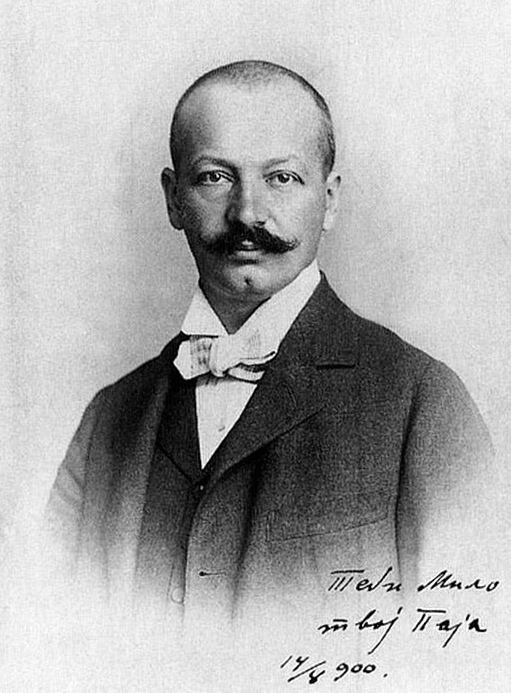
Why Paul Joanovitch matters
Paul Joanovitch is the market-facing name under which the Serbian realist and Orientalist painter Pavle "Paja" Jovanovic sold and signed much of his international work. He matters to collectors less as a headline blue-chip name than as a case study in careful attribution: the same painter appears across auction catalogs, museum records, and price databases under half a dozen spellings and, in some listings, under an outright incorrect death year. For a buyer, his significance lies in a well-documented career of institutional recognition in Vienna and Paris paired with a public sale record that is real but thin and inconsistently catalogued.
- Born
- 1859-06-16, Vrsac, Austrian Empire (present-day Serbia)
- Nationality
- Serbian
- Media
- Painting
- Movement
- Realism, Orientalism, Academic art
- Education
- Academy of Fine Arts, Vienna, circa 1876 to 1883 (exact enrollment and completion years not fully documented), studied under Leopold Karl Muller
- Signature motifs
- Orientalist genre scenes, Serbian national historical subjects
By the numbers
- 1859 to 1957LifespanVrsac to Vienna
- 4Documented gold medalsVienna 1898, Paris 1900, Vienna 1901, Paris Salon 1902
- GBP 6,875 (inc. premium)Best itemized auction resultBonhams; work: The Falconer; exact sale date and location not publicly disclosed
- No current gallery representation identifiedRepresented byTrades on the secondary/auction market only
Selected works
Click any work to view it full screen.
Biography
Paul Joanovitch was born on 16 June 1859 in Vrsac, then part of the Austrian Empire and now in Serbia, to Serbian parents. He trained at the Academy of Fine Arts in Vienna, roughly from 1876 into the early 1880s, under the Orientalist painter Leopold Karl Muller. In 1882 a painting known as The Wounded Montenegrin, shown in Budapest as Wounded, won him a prize at the Academy and a Hungarian State grant.
Over the following two decades he built a career on large-scale Serbian historical subjects and Orientalist genre scenes, work that brought him consistent institutional recognition: a gold medal at the National Exhibition in Vienna in 1898 for Cockfight, a gold medal at the 1900 Paris World's Fair for The Coronation of Emperor Dusan, a gold medal at the 1901 International Exhibition of the Vienna Art Society for The Wedding of Emperor Stefan Dusan, and a gold medal at the 1902 Paris Salon for the monumental Furor Teutonicus. He is also associated with The Migration of the Serbs, a work tied to the 1896 Millennium Exhibition in Budapest.
His paintings entered international collections under a range of signatures, including Joanowitch, Joanovits, and Joanowits, which is part of why the market today still refers to him as Paul Joanovitch even though Serbian scholarship uses Pavle Jovanovic. After the early death of his wife, he lived quietly in Vienna until his own death there in 1957, given by some sources as 30 November 1957, though that exact day is not independently corroborated beyond one structured-data source.
Critical reception
No exact, attributable critical quotations from named critics writing in major outlets have been located for this artist. What can be documented is a pattern of contemporary institutional recognition rather than retrospective critical writing: four gold medals across Vienna and Paris venues between 1898 and 1902, and a Hungarian State grant early in his career. General reference sources describe him, alongside Uros Predic and Djordje Krstic, as one of the most significant Serbian realist painters of his generation, prized for large history paintings on Serbian national themes and for Orientalist genre scenes from his years working in Vienna, Munich, and Berlin.
Market
Public information on Joanovitch's auction history is real but thin. The most fully attributable public result located is a Bonhams sale of the painting The Falconer, which realized GBP 6,875 including premium; the listing consulted does not disclose the exact sale date or sale location. A dealer archive, Boris Wilnitsky Fine Arts, states that the artist's works have reached prices as high as approximately USD 200,000 at auction, but without naming a specific lot, house, or date, so this figure should be treated as a general dealer characterization rather than a confirmed record. No public database consulted supports a definitive, itemized all-time auction record for this artist. Collectors should also be aware that some auction-market listings give his death year as 1913, a figure that conflicts with the consistent 1859 to 1957 dates given by Wikipedia, the Musee d'Orsay artist repertoire, and most major auction databases, and should be treated as a cataloguing error rather than a competing biography.
Top auction results
| Work | Price | Sale |
|---|---|---|
| The Falconer | GBP 6,875 (inc. premium) | Bonhams, Not specified in the public listing consulted |
Selected exhibitions
| Years | Exhibition | Venues |
|---|---|---|
| 1882 | Wounded (debut exhibition) | Budapest |
| 1896 | Millennium Exhibition | Budapest |
| 1898 | National Exhibition, Vienna (shown: Cockfight) | Vienna |
| 1900 | Exposition Universelle (Paris World's Fair) | Paris |
| 1901 | International Exhibition of the Vienna Art Society | Vienna |
| 1902 | Paris Salon (shown: Furor Teutonicus) | Paris |
| late 1800s to early 1900s | Orientalist-period exhibitions (years not fully documented) | Vienna, Munich, Berlin |
Museum collections
- National Gallery of Victoria, Melbourne (the work 'The Traitor')
Awards and honors
- Prize, Vienna Academy exhibition of historical painting, and Hungarian State grant, for The Wounded Montenegrin (exhibited in Budapest as Wounded) (1882)
- Gold Medal, National Exhibition, Vienna, for Cockfight (1898)
- Gold Medal, Exposition Universelle, Paris, for The Coronation of Emperor Dusan (1900)
- Gold Medal, International Exhibition of the Vienna Art Society, for The Wedding of Emperor Stefan Dusan (1901)
- Gold Medal, Paris Salon, for Furor Teutonicus (1902)
Authentication and provenance
No catalogue raisonne.
No published catalogue raisonne or certificate-of-authenticity program has been identified for this artist. Auction and museum records also disagree on his life dates, with some market listings giving 1859 to 1913 and encyclopedic and museum sources giving 1859 to 1957. Attribution should rely on named auction house cataloguing, exhibition history, and museum-linked records rather than aggregator summaries alone.
Primary reference: https://en.wikipedia.org/wiki/Paja_Jovanovi%C4%87
What collectors should know
Before buying, collectors should treat name variants as a first-order due-diligence issue rather than a footnote: works may be catalogued as Joanovitch, Joanowitch, or Joanovits, and all three refer to the same painter. There is no known catalogue raisonne, so provenance should be checked against named auction house records and museum-linked sources, such as the Musee d'Orsay's artist entry and the National Gallery of Victoria's documentation of The Traitor, rather than relying on aggregator summary statistics. Public sale data is sparse and often missing lot-level detail, and at least one market listing carries an incorrect death date, so any single online record should be corroborated with at least one other independent source before it informs a valuation.
Further reading and resources
Data current as of 2026-07-13.

