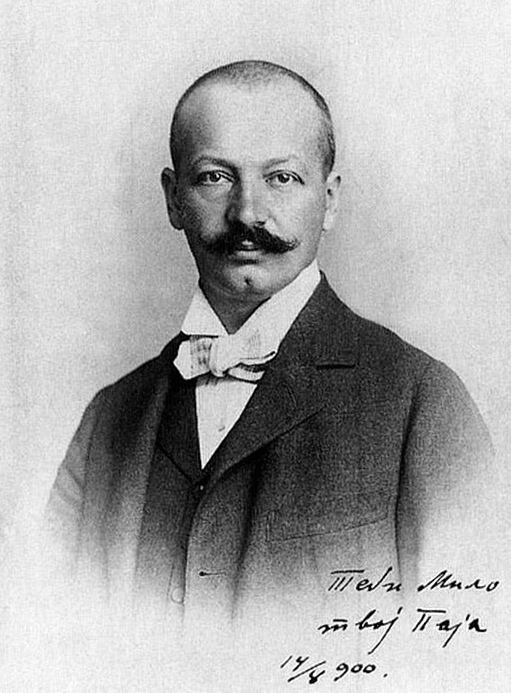
Why Paul Joanowits matters
Paul Joanowits is the Westernized name under which the Serbian realist painter Pavle "Paja" Jovanović (1859 to 1957) is catalogued in many international museums, dealer records, and auction houses. Trained at the Academy of Fine Arts in Vienna and decorated with gold medals at major exhibitions of his era, he stands with Uroš Predić and Đorđe Krstić among the founding figures of Serbian realist painting. For collectors, his case is both an opportunity and a caution: a substantial, museum-held body of academic and orientalist work whose auction record is scattered across a half dozen spellings of the same signature.
- Born
- 1859-06-16, Vršac, Austrian Empire (present-day Serbia)
- Nationality
- Serbian
- Media
- Painting
- Movement
- Realism, Orientalism, Academic art
- Education
- Academy of Fine Arts, Vienna, circa 1877 to 1880. Studied in the class of Christian Griepenkerl, with additional courses under Leopold Carl Müller.
- Signature motifs
- Orientalist genre scenes, Historical and battle compositions
By the numbers
- Not independently confirmedAuction highMutualArt reports paintings reaching up to USD 649,682; the specific work, sale house, and date could not be verified in current research.
- 1859 to 1957LifespanVršac to Vienna
- 158 recordedAuction appearancesArtprice entry under the Joanovits spelling; likely excludes sales recorded under other name variants
- 2 gold medalsMajor honorsVienna 1901, Paris 1902
Selected works
Click any work to view it full screen.
Biography
Paja Jovanović was born on 16 June 1859 in Vršac, then part of the Austrian Empire. As a boy he taught himself to draw by copying church pictures, and later received his first formal art instruction from a local teacher named Vodecki. In the mid-1870s his father brought him to Vienna, where he enrolled at the Academy of Fine Arts around 1877, studying in the class of Christian Griepenkerl and taking further courses under the orientalist painter Leopold Carl Müller, whose influence shaped his lifelong interest in Balkan and Near Eastern genre subjects. He completed his studies at the Academy in 1880.
Over a long career he produced more than 1,100 paintings, including large historical and orientalist compositions such as The Wounded Montenegrin (1882), Decorating of the Bride (1886), The Takovo Uprising (1894), Migration of the Serbs (1896), and The Coronation of Emperor Dušan (1900). His work won gold medals at the International Exhibition of the Vienna Art Society (1901) and the Paris Salon (1902), and, late in life, Yugoslavia's Order of Merits for the People, 1st Class, in 1949. He died on 30 November 1957.
Critical reception
No verbatim critic commentary from a named writer in a major outlet was located in current research, so none is reproduced here. In general biographical accounts, Jovanović is regarded as one of the founding figures of Serbian academic realism, distinguished for his orientalist genre scenes and large-scale historical and battle compositions. His international exhibitions during his career are described in secondary sources as having gathered some of the most significant acclaim of his lifetime, though the original period reviews behind that reputation were not accessible for direct quotation. Today he is treated primarily as an important documentary figure in Serbian art history rather than a frequent subject of contemporary English-language criticism.
Market
A confirmed all-time auction record for this artist could not be independently verified in current research. MutualArt reports auction prices for paintings under the Joanowitch signature reaching as high as USD 649,682, but the underlying work, sale house, and exact sale date behind that figure were not accessible for confirmation. Artprice's entry under the Joanovits spelling records roughly 158 public auction appearances for the artist, though this likely does not capture sales recorded under other name variants. Because his paintings are catalogued under multiple signature variants, including Joanowits, Joanovits, Joanowitch, and Joanovitsch, no single database captures a complete price history, and any headline price figure should be treated as provisional pending a work by work reconciliation across variants.
Selected exhibitions
| Years | Exhibition | Venues |
|---|---|---|
| 1901 | International Exhibition of the Vienna Art Society | Vienna |
| 1902 | Paris Salon | Paris |
Museum collections
- National Gallery of Victoria, Melbourne
- Utah Museum of Fine Arts
Awards and honors
- Gold Medal, International Exhibition of the Vienna Art Society, for The Wedding of Duke Ferri (also known as The Wedding of Emperor Stefan Dušan) (1901)
- Gold Medal, Paris Salon, for Furor Teutonicus (1902)
- Order of Merits for the People, 1st Class, Yugoslavia (1949)
Authentication and provenance
No catalogue raisonne.
No published catalogue raisonne has been confirmed for this artist. His paintings are catalogued across museums and auction houses under several signature variants, including Joanowits, Joanovits, Joanowitch, and Joanovitsch, so attribution should be checked against the artist's documented life dates and known oeuvre rather than a single signature form.
Primary reference: https://en.wikipedia.org/wiki/Paja_Jovanovi%C4%87
What collectors should know
The single most important fact for a collector is that "Paul Joanowits" and "Paul Joanovits," "Joanowitch," "Joanovitsch," and "Paul Ivanovitch" all refer to one artist, Paja Jovanović, so provenance research and comparable-sale searches need to be run across every variant spelling to be complete. No catalogue raisonne has been confirmed, and no current gallery or estate representation could be identified, so attribution and condition should be verified directly against known museum holdings and documented exhibition history. Given the fragmented, decades-old auction record, and the absence of a single confirmed all-time high, any price figure encountered under any spelling should be treated as a data point rather than a settled benchmark.
Further reading and resources
Data current as of 2026-07-11.

