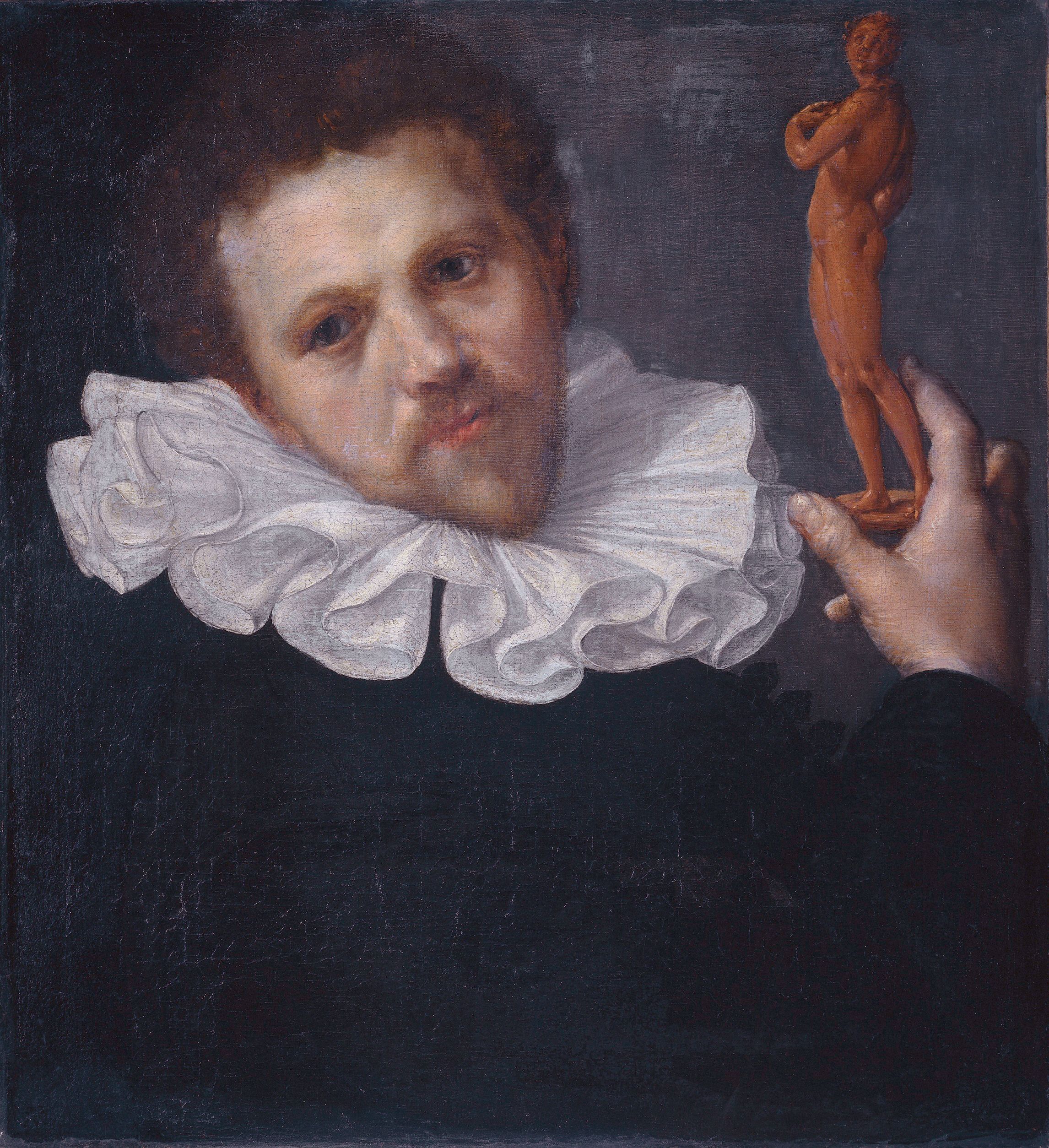
Why Paulus van Vianen matters
Paulus van Vianen was the leading Dutch silversmith of his generation and, together with his brother Adam, one of the principal originators of the auricular style, the fluid, ear-like ornament that reshaped European silver design in the early seventeenth century. He spent his final decade as court goldsmith to Emperor Rudolf II in Prague, and the works that survive from that period, above all the 1613 ewer and basin with scenes of Diana now in the Rijksmuseum, are treated by museums as high points of Northern Mannerist metalwork. For collectors, he represents an extreme case of museum-anchored scarcity: almost everything of importance he made is already in institutional hands, so the market is built on a small, irregular supply of drawings and smaller silver and plaquette works.
- Nationality
- Dutch
- Media
- Silverwork and goldsmithing, Drawing
- Movement
- Northern Mannerism, Auricular style
- Education
- Apprenticeship under Bruno Ellardsz. van Leydenberch and later Cornelis Ellardsz. van Leydenberch, Utrecht, c. 1580 to 1586. No formal degree; craft and guild-based training only.
- Signature motifs
- Auricular (kwab) ornament, Mythological scenes in relief silver
By the numbers
- GBP 130,000Auction highSilver plaquette, The Judgement of King Midas, Morton & Eden, London, 2021
- c. 1570 to 1613Active periodUtrecht to Prague
- Kammergoldschmied to Emperor Rudolf IICourt positionPrague, 1603 to 1613
- NoneCatalogue raisonneAttribution via museum scholarship and archival guild records
Selected works
Click any work to view it full screen.
Biography
Paulus van Vianen was born in Utrecht around 1570 into a family of silversmiths. Rather than being trained by his father, a document dated 1599 records that he apprenticed for about four years under the Utrecht silversmith Bruno Ellardsz. van Leydenberch, then spent roughly two further years under Bruno's brother Cornelis. No formal school or academic degree is documented; his training was entirely craft- and guild-based.
After his apprenticeship, van Vianen traveled through France, Germany, and Italy, work that scholars believe introduced him to the Mannerist style visible in his later designs. He entered the service of the Dukes of Bavaria in Munich, becoming a citizen and guild member there in 1598 and working at that court until 1601. He then worked briefly at the Salzburg court before entering the service of Emperor Rudolf II in Prague, where from 1603 until his death he held the position of court goldsmith.
Paulus van Vianen died in Prague in 1613. Museum and scholarly sources agree on the year and place of death; the Rijksmuseum's own account narrows this to May 1613, and a single secondary source gives 3 June 1613, but no day is corroborated across independent institutions, so the exact date remains unconfirmed. Dutch-language sources suggest he probably died during a plague epidemic, though this cause is not corroborated by a second independent source. Following his death, the Amsterdam Gold and Silversmiths' Guild commissioned a commemorative silver monument in his honor, an unusual mark of the esteem in which he was held by his own profession.
Critical reception
Museum scholarship, led by the Rijksmuseum and the Metropolitan Museum of Art, consistently places Paulus van Vianen at the center of the development of the auricular style in precious metal, working alongside his brother Adam. His late Prague work is described in institutional literature as the culmination of his career and among the most important silver objects of the period. No exact, attributable critical quotation from a named critic in a major outlet could be confirmed in the available research, so none is reproduced here.
Market
Paulus van Vianen's market is thin and dominated by museum absence rather than museum presence: his major silver, including the Diana ewer and basin, is not in private circulation. The best-documented public auction result is a silver plaquette, The Judgement of King Midas, signed and dated 1605, sold at Morton & Eden in London on 25 February 2021; trade press reported a price of GBP 130,000, though the auction house's own online lot record lists a hammer price of GBP 95,000, and the exact realized figure is not fully reconciled between sources. A drawing attributed to him, A Path Through Woods, sold at Sotheby's for a hammer price of USD 120,650 against a USD 25,000 to 35,000 estimate, a result reported in a 2024 market summary; it remains below the plaquette price under either figure and illustrates how far individual sale results can swing given the small number of works that ever reach the block. Given the rarity of firmly attributed material, each new sale tends to be treated as a market event in its own right rather than a data point on a trend line.
Top auction results
| Work | Price | Sale |
|---|---|---|
| The Judgement of King Midas (silver plaquette, signed and dated 1605) (2021) | GBP 130,000 | Morton & Eden, London, 2021-02-25 |
Selected exhibitions
| Years | Exhibition | Venues |
|---|---|---|
| 1613 | Ewer and basin with scenes of Diana | Rijksmuseum, Amsterdam (permanent collection) |
| c. 1600 to 1605 | Study of the Side of a Rocky Cliff; verso: Dam on a Mountain Stream | Metropolitan Museum of Art, New York (Drawings and Prints, not on view) |
Museum collections
- Rijksmuseum, Amsterdam
- Metropolitan Museum of Art, New York
- Ashmolean Museum, Oxford
Authentication and provenance
No catalogue raisonne.
No catalogue raisonne exists for Paulus van Vianen. Attribution rests on comparison with signed and dated works, chiefly the 1613 silver ewer and basin with scenes of Diana at the Rijksmuseum, together with guild and court archival records. Works are verified through museum and academic scholarship rather than a certification program.
Primary reference: https://www.rijksmuseum.nl/en/stories/dutch-masters/story/paulus-vianen-10
What collectors should know
There is no catalogue raisonne for Paulus van Vianen, and attribution depends on comparison with a small number of signed and dated benchmark pieces together with guild and court archival records rather than any certification program. The available market consists almost entirely of drawings, medals, and smaller silver objects such as plaquettes, since his major silver survives in institutional collections and rarely if ever comes to market. Because so few works are available for comparison, provenance history and firm scholarly attribution carry outsized weight, and buyers should expect long gaps between comparable sales rather than a continuous price record.
Further reading and resources
Data current as of 2026-07-18.

