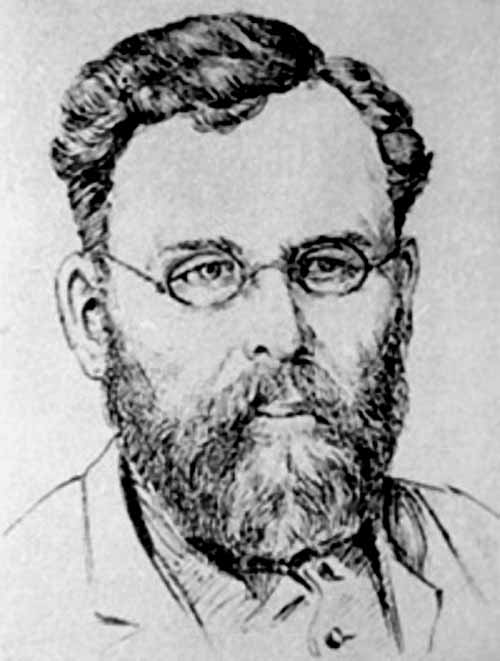
Why Petr Petrovich Vereshchagin matters
Petr Petrovich Vereshchagin was a 19th-century Russian landscape and cityscape painter, and an Academician of the Imperial Academy of Arts, whose topographical views of Russian cities, the Volga, the Caucasus, and the Urals helped shift Russian landscape painting away from the Italianate scenery favored by earlier academics and toward the Russian Empire's own architecture and terrain. His work sits today in the two leading Russian national collections, the State Tretyakov Gallery and the State Russian Museum, and it continues to appear at major international Russian art sales.
- Born
- 1834-01-14, Perm, Russian Empire
- Nationality
- Russian
- Media
- Painting
- Movement
- Russian Academic art, 19th-century Russian landscape painting
- Education
- Imperial Academy of Arts, St. Petersburg, 1858 to 1865; Academician of landscape painting, 1873
- Signature motifs
- Topographical Russian cityscapes, Volga, Caucasus, and Ural landscapes
By the numbers
- USD 746,500Auction highView of St Petersburg, Sotheby's New York, 2011
- Academician, 1873Academy rankLandscape painting, Imperial Academy of Arts
- 1886DeathSaint Petersburg or Perm; sources differ
- 2 confirmed museumsMajor holdingsState Tretyakov Gallery and State Russian Museum; further regional holdings are reported but unverified
Selected works
Click any work to view it full screen.
Biography
Petr Petrovich Vereshchagin (Пётр Петрович Верещагин) is also transliterated as Pyotr Petrovich Vereshchagin, Piotr Petrovich Vereshchagin, and, in German-language sources, as Pjotr Petrowitsch Wereschtschagin. Sources place his birth in Perm, in the Russian Empire, though they disagree on the year: Russian Wikipedia and Wikidata give 14 January 1834 (Julian calendar, 26 January New Style), while the Web Gallery of Art, Christie's, and Bonhams catalogue him as born in 1836. He is not to be confused with his brother Vasily Petrovich Vereshchagin, also a painter, nor with the far better known war artist Vasily Vasilievich Vereshchagin, who was unrelated.
He received his first artistic training at home from his father, the Perm painter Petr Prokofievich Vereshchagin, and, after his father's death, from his maternal grandfather, the icon painter Ivan Vasilyevich Babin. In 1858 he entered the Imperial Academy of Arts in St. Petersburg, where he studied landscape painting for seven years, principally under Professor Sokrat Maksimovich Vorobiev. He won a small silver medal in 1861 for the etude "On the Volga" and a large silver medal in 1862 for "In Baku." He graduated in 1865 with the title of class artist, 3rd degree, for "View in Nizhny Novgorod," and was subsequently promoted to class artist, 2nd degree, in 1867 and 1st degree in 1868. In 1873 the Academy named him Academician of landscape painting.
From the late 1860s onward, Vereshchagin traveled extensively to paint topographical views: Moscow, St. Petersburg, Finland, Crimea, the Caucasus, Kiev, Sevastopol, and the Urals, along with the city of Reval (now Tallinn) and Baku. He died in January 1886. Most art-historical sources, including German Wikipedia, the Web Gallery of Art, and the Adamovskiy Foundation, place his death on 16 January (Old Style) or 28 January (New Style) 1886 in Saint Petersburg. English Wikipedia and a Perm regional biographical site instead state that he died and was buried in Perm. The exact place has not been resolved with a definitive primary source.
Critical reception
Vereshchagin is credited in Russian and international reference sources as one of the earlier Russian landscape painters to turn his attention systematically to Russian architecture, cities, and terrain rather than the Italianate views that dominated academic landscape painting earlier in the 19th century, and his large cycles of city views, including views of Reval shown at the Academy in 1864, are cited as the basis for his official recognition and eventual Academician title. No exact, attributable critical quotation about him from a named 19th- or 20th-century critic in a major outlet has been located; most surviving commentary is biographical and descriptive rather than quoted criticism, and should be treated accordingly.
Market
Vereshchagin's auction record is "View of St Petersburg," which sold for USD 746,500 (above a presale high estimate of USD 500,000) at Sotheby's New York on 12 April 2011, from the collection of Mikhail Baryshnikov. A separate significant result was recorded at Koller Auktionen in Zurich, where an interior view of the Transfiguration Cathedral sold for CHF 537,500 including premium, against an estimate of CHF 450,000 to 600,000. A Sotheby's London sale of "A panoramic view of Saint Petersburg" on 1 July 2026 realized within an estimate of GBP 200,000 to 300,000; converted to USD this remains below the 2011 New York result, so the auction high is unchanged. His works also appear periodically at Christie's, Bonhams, Sotheby's, and MacDougall's Russian art sales, generally in the range of tens of thousands to several hundred thousand dollars depending on subject and condition. Public auction volume for this artist is thin compared to more heavily traded 19th-century names, so individual results should be read as data points rather than a smooth trend line.
Top auction results
| Work | Price | Sale |
|---|---|---|
| View of St Petersburg | USD 746,500 (USD 746,500) | Sotheby's, New York, 2011-04-12 |
Selected exhibitions
| Years | Exhibition | Venues |
|---|---|---|
| 1863 | Academic Exhibition | Imperial Academy of Arts, St. Petersburg |
| 1864 | Academic Exhibition (views of Reval) | Imperial Academy of Arts, St. Petersburg |
| 1868 to 1886 | Academicians' Exhibitions | Imperial Academy of Arts and associated venues, St. Petersburg |
Museum collections
- State Tretyakov Gallery, Moscow
- State Russian Museum, St. Petersburg
Awards and honors
- Small silver medal, Imperial Academy of Arts (for 'On the Volga') (1861)
- Large silver medal, Imperial Academy of Arts (for 'In Baku') (1862)
- Class artist, 3rd degree (graduation title, for 'View in Nizhny Novgorod') (1865)
- Class artist, 1st degree (1868)
- Academician of landscape painting, Imperial Academy of Arts (1873)
Authentication and provenance
No catalogue raisonne.
No catalogue raisonne or certificate-of-authenticity program has been identified for this artist. Works are verified through auction house scholarship, museum documentation, and provenance research, since no foundation or estate archive is known to exist.
Primary reference: https://en.wikipedia.org/wiki/Pyotr_Vereshchagin
What collectors should know
Basic biographical facts for Vereshchagin, including his birth year and the place of his death, are genuinely disputed across otherwise credible reference sources, a reminder that documentation for secondary 19th-century Russian academic painters can be thinner than for their more famous contemporaries. There is no catalogue raisonne and no gallery or estate representation; works circulate through the secondary market via major auction houses and specialist Russian art dealers, which places extra weight on provenance, condition, and cataloguing detail for any prospective purchase. Collectors should also take care not to confuse this artist with his brother Vasily Petrovich Vereshchagin or with the unrelated war painter Vasily Vasilievich Vereshchagin, since all three names circulate in overlapping transliterations.
Further reading and resources
Data current as of 2026-07-16.

