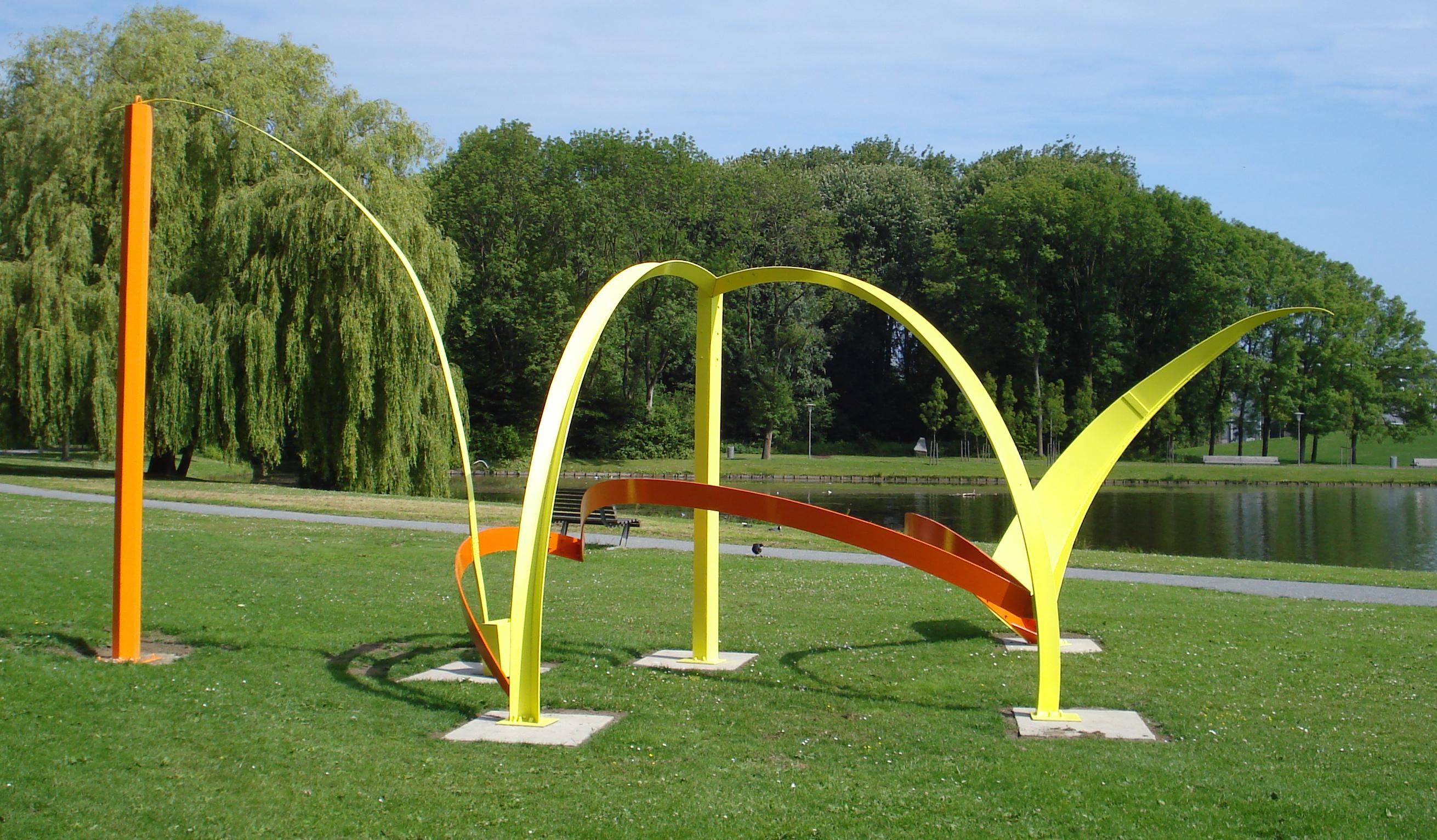
Why Phillip King matters
Phillip King was one of the central figures of postwar British sculpture, a leading voice of the "New Generation" that broke from bronze and stone toward bright, industrially made abstract form. Trained under Anthony Caro at Saint Martin's School of Art, he went on to represent Britain at the Venice Biennale, to lead the Royal Academy as its president, and to place work in the permanent collections of Tate, the Museum of Modern Art, and the Centre Pompidou, among many others. For a collector, he represents a case of deep institutional standing built over six decades, paired with a comparatively thin and largely UK-centered auction market.
- Born
- 1934-05-01, Tunis, Tunisia
- Nationality
- British
- Media
- Sculpture
- Movement
- New Generation sculpture, British sculpture
- Education
- Christ's College, University of Cambridge, modern languages, 1954 to 1957; Saint Martin's School of Art, London, sculpture, 1957 to 1958, studying under Anthony Caro
- Signature motifs
- Brightly colored abstract sculpture, Fiberglass and plastic construction
- Representation
- Thomas Dane Gallery, "Galerie Ceysson & Bénétière"
By the numbers
- GBP 127,875Auction highGenghis Khan, Christie's London, 2013, a world record for the artist at auction
- President, 1999 to 2004Royal Academy
- British Pavilion, 1968Venice Biennale
- Thomas Dane Gallery; Galerie Ceysson & BénétièreRepresented by
Biography
Phillip King was born on 1 May 1934 in Tunis, Tunisia, to a French mother and an English father, and moved to England in 1946. He studied modern languages at Christ's College, University of Cambridge, from 1954 to 1957, then turned to sculpture at Saint Martin's School of Art in London from 1957 to 1958, where he studied under Anthony Caro and briefly worked as an assistant to Henry Moore.
King rose to prominence with the group of sculptors later termed the "New Generation," shown at the Whitechapel Gallery, London, in 1964, and included two years later in "Primary Structures" at the Jewish Museum in New York, a landmark survey of minimal and geometric sculpture. In 1968 he represented Britain at the Venice Biennale alongside the painter Bridget Riley, the same year the Whitechapel Art Gallery mounted his first retrospective. A further retrospective followed at the Hayward Gallery in 1981, and Tate Britain presented a career survey in 2014.
King's institutional role grew alongside his exhibition record. He was elected an Associate of the Royal Academy in 1977 and a full Royal Academician in 1988, served as Professor of Sculpture at the Royal Academy Schools from 1989 to 1999, and then served as President of the Royal Academy of Arts from 1999 to 2004. He was made a Commander of the Order of the British Empire in 1974 and received an honorary doctorate from the University of Cambridge in 2012. He continued to exhibit into his final years, with shows at Galerie Ceysson et Benetiere and Thomas Dane Gallery. King died on 27 July 2021 in London at the age of 87; his death was announced by Thomas Dane Gallery, which represented him.
Critical reception
King's early work, made with fiberglass and plastic in flat planes of strong color, was read at the time as a decisive break from the material language of Moore and Caro's generation, and helped define the "New Generation" sensibility of 1960s British sculpture. His inclusion in "Primary Structures" in New York in 1966 placed him within the broader international conversation around minimal and geometric form. Later writing, including ArtReview's 2021 obituary describing him as an artist who "revolutionised British sculpture," has continued to treat him as a pivotal transitional figure between the modernist sculpture of Moore and Caro and the more materially experimental British sculpture that followed.
Market
King's auction record is Genghis Khan, which sold for GBP 127,875 at Christie's London on 11 July 2013, a result Christie's itself flagged as a world record price for the artist at auction. No later sale has been confirmed to exceed that figure through the present. His secondary market is small and concentrated in the United Kingdom, and public sale results remain infrequent relative to the scale of his museum presence, so any single result should be read in that context rather than as evidence of a deep or liquid trading market.
Top auction results
| Work | Price | Sale |
|---|---|---|
| Genghis Khan | GBP 127,875 | Christie's, London, 2013-07-11 |
Selected exhibitions
| Years | Exhibition | Venues |
|---|---|---|
| 1964 | New Generation | Whitechapel Gallery, London |
| 1966 | Primary Structures | Jewish Museum, New York |
| 1968 | British Pavilion (with Bridget Riley) | Venice Biennale |
| 1968 | Retrospective | Whitechapel Art Gallery, London |
| 1981 | Retrospective | Hayward Gallery, London |
| 2014 | Retrospective | Tate Britain, London |
| 2022 | Phillip King | Galerie Ceysson & Bénétière, Wandhaff, Luxembourg |
| 2024 | Moon / King: the work and friendship of Phillip King and Jeremy Moon, 1956 to 1973 | Thomas Dane Gallery, London, organized with Luhring Augustine |
Museum collections
- Tate, London
- Museum of Modern Art, New York
- Centre Pompidou, Paris
- Museum of Contemporary Art, Los Angeles
- Rijksmuseum, Amsterdam
- National Museum of Art, Osaka
Awards and honors
- Commander of the Order of the British Empire (CBE) (1974)
- Elected Associate of the Royal Academy (1977)
- President of the Royal Academy of Arts (to 2004) (1999)
- Lifetime Achievement Award, International Sculpture Center (2010)
- Honorary doctorate, University of Cambridge (2012)
Authentication and provenance
No catalogue raisonne.
No published catalogue raisonne has been confirmed for King. His estate's work is handled in the market by Thomas Dane Gallery and Galerie Ceysson et Benetiere, and his sculptures are extensively documented through decades of museum acquisition and exhibition records.
Primary reference: https://www.royalacademy.org.uk/art-artists/name/phillip-king-ppra-1
What collectors should know
There is no confirmed catalogue raisonne for Phillip King, and his estate's market is currently handled through Thomas Dane Gallery and Galerie Ceysson et Benetiere, which continue to mount solo and collaborative exhibitions of his work. Provenance and gallery or estate verification matter more than usual here because the number of public auction results is small, which means the recorded price history offers limited guidance on typical market value. His museum presence, spanning Tate, MoMA, the Centre Pompidou, and institutions across Europe, Japan, and Australia, is the clearest and most durable signal of his historical standing.
Further reading and resources
Data current as of 2026-07-13.

