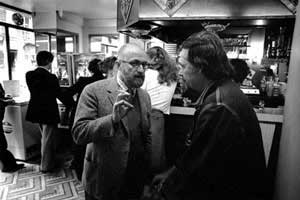
Why Pierre Alechinsky matters
Pierre Alechinsky is one of the few major living figures associated with the CoBrA generation, the loose, Northern European avant-garde that reshaped postwar abstraction around spontaneity, myth, and calligraphy. He built a decades-long, institutionally validated career, from a first CoBrA affiliation in 1949 to a 2018 Praemium Imperiale, while remaining active into his late nineties. For collectors, he represents a rare combination: broad museum acceptance and a long market history, paired with an auction record that is thinner and more volatile than his institutional standing might suggest.
- Born
- 1927-10-19, Brussels, Belgium
- Nationality
- Belgian
- Media
- Painting, Printmaking
- Movement
- CoBrA, Post-war European abstraction
- Education
- Ecole nationale superieure d'Architecture et des Arts decoratifs (La Cambre), Brussels, 1944 to 1948 (illustration, printing, photography); Atelier 17, Paris, from 1951, engraving under Stanley William Hayter. No formal degree is documented in the record.
- Signature motifs
- Multi-panel compositions with marginal ink "remarques", Calligraphic ink gesture
- Representation
- Galerie Lelong & Co.
By the numbers
- Not reliably confirmedAuction highSources point to a headline result near EUR 1.4M at Christie's in 2018, but the exact work, price, and sale date are unconfirmed
- 2018 Laureate, PaintingPraemium ImperialeJapan Art Association
- Joined 1949CoBrA founding generation
- Galerie Lelong & Co.Represented by
Biography
Pierre Alechinsky was born on 19 October 1927 in Brussels, Belgium (sources differ on the exact commune, citing either Schaerbeek or Saint-Gilles). He studied illustration, printing, and photography at La Cambre in Brussels from 1944 to 1948, and in 1949 joined CoBrA, the short-lived but influential group associated with Christian Dotremont, Asger Jorn, and Corneille, which drew on myth, folk art, and children's drawing against the rationalism of postwar abstraction elsewhere in Europe.
In 1951 he moved to Paris, where he has lived and worked since, and studied engraving at Atelier 17 under Stanley William Hayter, an experience that shaped the layered, printmaking-influenced structure of his later paintings. A trip to Japan in the mid-1950s to study calligraphy resulted in a short film, sometimes cited as Calligraphie japonaise, which won a special prize at the Bergamo art film festival. From the 1960s onward he developed the multi-panel format most associated with his name: a large central image framed by smaller marginal panels, or "remarques," that comment on or extend the main composition.
He taught painting at the Ecole nationale superieure des beaux-arts in Paris beginning in 1983, continuing for several years (some sources place this teaching post in Brussels instead, and the two accounts have not been reconciled). Galerie Lelong & Co., which grew out of the former Galerie Maeght, has exhibited and represented his work for decades and continues to show him as of 2026, though no single source confirms an exclusive current representation arrangement. As of the most recent institutional and gallery profiles, he continues to live and work in Paris.
Critical reception
Institutional recognition of Alechinsky has been sustained and international rather than tied to a single breakthrough moment. His inclusion in CoBrA from 1949 placed him at the center of one of postwar Europe's defining avant-gardes. The Andrew W. Mellon Prize in 1976 came with a major retrospective at the Carnegie Institute in Pittsburgh the following year. Further retrospectives followed at the Guggenheim Museum in New York in 1986 and at the Galerie nationale du Jeu de Paume in Paris in 1998, with a dedicated presentation of his graphic work at the Centre Pompidou in 2004. Honors accumulated alongside these exhibitions: the Triennale de la Gravure prize in Belgium in 1966, an honorary doctorate from the Universite libre de Bruxelles in 1994, and the Praemium Imperiale for painting in 2018. No verbatim, attributable critical quotation from a named critic in a major outlet could be confirmed for this profile; the case for his significance rests on this consistent institutional record rather than on a single defining review.
Market
Alechinsky's market has real depth of volume, with many auction appearances over decades spanning paintings, prints, and drawings, but the exact all-time auction record could not be independently confirmed for this profile. Available sources point to a headline result near EUR 1.4 million at Christie's in 2018, though the specific work title and sale date are not confirmed, while Lempertz's own artist index shows top verified results for other works in the range of roughly EUR 42,500 to 82,705, again without confirmed sale dates. Collectors should treat any single publicly cited "record" figure with caution until it can be traced to a dated, itemized sale.
Selected exhibitions
| Years | Exhibition | Venues |
|---|---|---|
| 2025 | Pierre Alechinsky and his artist friends | Die Galerie, Frankfurt am Main |
| 2004 | Pierre Alechinsky | Cabinet d'art graphique, Centre Georges Pompidou, Paris |
| 2000 | Pierre Alechinsky retrospective | IVAM, Institut Valencia d'Art Modern, Valencia |
| 1998 | Pierre Alechinsky retrospective | Galerie nationale du Jeu de Paume, Paris |
| 1986 | Pierre Alechinsky retrospective | Solomon R. Guggenheim Museum, New York |
| 1977 | Andrew W. Mellon Prize retrospective | Museum of Art, Carnegie Institute, Pittsburgh |
| 1963 | Pierre Alechinsky | Stedelijk Museum, Amsterdam; Museum Boijmans Van Beuningen, Rotterdam |
| 1955 | Pierre Alechinsky | Palais des Beaux-Arts, Brussels |
Museum collections
- Museum of Modern Art, New York
- Tate, London
- Museum Ludwig, Cologne
- Royal Museums of Fine Arts of Belgium, Brussels
- Centre Pompidou, Paris
Awards and honors
- Praemium Imperiale, Painting (Japan Art Association) (2018)
- Honorary Doctorate, Universite libre de Bruxelles (1994)
- Andrew W. Mellon Prize, Carnegie Institute, Pittsburgh (1976)
- Marzotto Prize, Italy (1968)
- Triennale de la Gravure Prize, Belgium (1966)
- Hallmark Prize, New York (1960)
Authentication and provenance
No catalogue raisonne.
No published catalogue raisonne is confirmed for the artist. Works are generally traced through exhibition and gallery history, including through Galerie Lelong & Co., which continues to exhibit his work, and through institutional collection records.
Primary reference: https://www.galerie-lelong.com/en/artiste/1/pierre-alechinsky/
What collectors should know
No catalogue raisonne is confirmed as published for Alechinsky, so verification of works relies on exhibition history, gallery documentation, and institutional collection records rather than a single authenticating source. His market combines high overall transaction volume with a small number of paintings that account for most seven-figure results, and even the headline auction figure circulating for his work cannot be tied to a confirmed title and date, so a single strong or weak sale, or a misreported record, can move headline statistics without reflecting the broader market. Collectors should weigh the medium, period, and scale of any specific work carefully rather than relying on any single cited auction high as a general benchmark.
Further reading and resources
Data current as of 2026-07-10.

