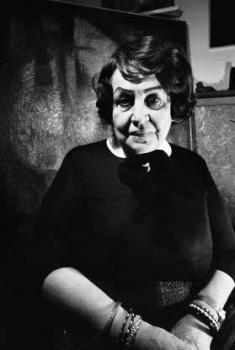
Why Princess Fahrelnissa Zeid matters
Princess Fahrelnissa Zeid was a pioneering Turkish modernist whose large, kaleidoscopic abstractions fused Islamic and Byzantine visual traditions with the language of European painting. She trained in Istanbul and Paris at a moment when few women had access to formal art academies, exhibited across London and Paris in the postwar decades, and later helped build an art institute in Amman. For a collector, she represents a historically significant, cross-cultural modernist whose museum profile has grown substantially since a major Tate Modern retrospective, even as her auction market remains thin and still being reassessed.
- Born
- 1901-12-06, Büyükada, Istanbul, Ottoman Empire
- Nationality
- Turkish
- Media
- Painting, Drawing, Sculpture
- Movement
- Turkish modernism, Abstraction, Nouvelle École de Paris circle
- Education
- İnas Sanayi-i Nefise Mektebi (Academy of Fine Arts for Women), Istanbul, enrolled 1919. Académie Ranson, Paris, 1928, under Roger Bissière. Istanbul Academy of Fine Arts, 1929. No degree documented from any institution.
- Signature motifs
- Kaleidoscopic abstraction, Islamic and Byzantine-influenced pattern
By the numbers
- USD 2.74MAuction highBreak of the Atom and Vegetal Life (1962), Christie's, 2013
- Tate Modern, 2017Major retrospectiveFirst UK retrospective of the artist's work
- 1976, AmmanInstitute foundedRoyal National Jordanian Institute of Fine Arts
Biography
Born Fahrünissa Şakir (later Kabaağaçlı) on 6 December 1901 on the island of Büyükada near Istanbul, she was educated in French religious schools before enrolling in 1919 at the İnas Sanayi-i Nefise Mektebi, the Academy of Fine Arts for Women in Istanbul, one of its first cohorts of women students. In 1928 she traveled to Paris and enrolled at the Académie Ranson, studying under the cubist painter Roger Bissière, and on her return to Istanbul in 1929 continued her training at the Istanbul Academy of Fine Arts.
She married Prince Zeid bin Hussein, a member of the Hashemite royal family, becoming a princess of Iraq and later of Jordan. She held her first solo exhibition in 1945 in the parlour of her own Istanbul apartment, followed by further shows in Izmir. In 1948 her work was shown at St George's Gallery in London, an exhibition reviewed by the critic Maurice Collis. Around 1949 she was associated with the circle known as the Nouvelle École de Paris. In the mid-1950s she exhibited at the Institute of Contemporary Arts in London, among the first women to show there.
Following her husband's death, she moved to Amman, Jordan, where in 1976 she founded and taught at what became the Royal National Jordanian Institute of Fine Arts. She continued to exhibit in Amman and in Europe through the late 1970s and 1980s. In 1990, Museum Ludwig in Cologne organized what is described as her first retrospective in the West. She died on 5 September 1991 in Amman, Jordan, as recorded by her estate, Tate, and other institutional and biographical sources.
Critical reception
Zeid's reputation rests on a rare synthesis: an artist trained inside both late Ottoman and Parisian modernist institutions, who translated Islamic ornament, Byzantine mosaic, and cubist structure into large-format abstraction. Her 1948 London exhibition drew early critical notice from Maurice Collis, and her association with the Nouvelle École de Paris circle placed her within the postwar Parisian abstraction scene. The clearest institutional statement of her standing came with the 2017 Tate Modern retrospective, the first dedicated to her in the UK, which was widely covered as the rediscovery of a major twentieth-century modernist. Critical attention since has focused on recovering her from decades of relative obscurity following her move to Amman, and on situating her work within both Turkish and pan-Arab modernist histories.
Market
Fahrelnissa Zeid's auction market is small relative to her institutional standing. Her all-time auction high is Break of the Atom and Vegetal Life (1962), which sold for approximately USD 2,741,000 at Christie's in 2013; the exact sale date and location are not confirmed in publicly available auction records. A separate major work, Towards a Sky (1953), sold for just under GBP 1 million in 2017, a figure consistent with, but below, the 2013 record. No published catalogue raisonne exists, and there is no single gallery or agent publicly documented as the exclusive representative of her estate; recent exhibitions organized by galleries such as Dirimart, in Istanbul and London, and DG Art Project, in Istanbul, have drawn on works from family and private collections. Institutional interest has grown since 2017, though specific recent acquisitions are not independently confirmed in available sources.
Top auction results
| Work | Price | Sale |
|---|---|---|
| Break of the Atom and Vegetal Life (1962) | USD 2,741,000 | Christie's |
Selected exhibitions
| Years | Exhibition | Venues |
|---|---|---|
| 1945 | First solo exhibition | Artist's apartment, Istanbul |
| 1948 | St George's Gallery exhibition | St George's Gallery, London |
| 1954 | Institute of Contemporary Arts exhibition | Institute of Contemporary Arts, London |
| 1990 | First Western retrospective | Museum Ludwig, Cologne |
| 2017 | Fahrelnissa Zeid | Tate Modern, London |
| 2017 | Fahrelnissa Zeid | Istanbul Modern, Istanbul |
| 2017 | Fahrelnissa Zeid retrospective, touring venue | Deutsche Bank KunstHalle, Berlin |
| 2025 | Immersion | Dirimart, London |
Museum collections
- Tate, London
- Istanbul Museum of Modern Art (Istanbul Modern)
Awards and honors
- Kingdom of Jordan Star medal, from King Hussein
Authentication and provenance
No catalogue raisonne.
No published catalogue raisonne has been confirmed for the artist. Provenance and attribution are generally established through family and estate records, since no centralized authentication body or exclusive estate gallery has been publicly identified as of 2026.
Primary reference: https://www.fahrelnissazeid.org/bio
What collectors should know
There is no catalogue raisonne for Fahrelnissa Zeid, and no single gallery or estate representative has been publicly confirmed, so provenance and attribution generally rely on family records and documented exhibition history. Her auction record is built on a small number of high-value results rather than a deep, continuous sales history, so individual sale prices can vary widely depending on the work and the moment. Growing museum acquisitions since her 2017 Tate retrospective are a meaningful signal of rising institutional regard, but collectors should treat any single auction result with caution given the thin trading record.
Further reading and resources
Data current as of 2026-07-10.

