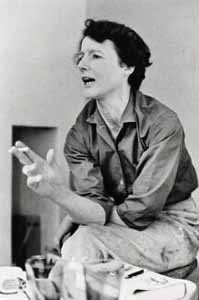
Why Prunella Clough matters
Prunella Clough is one of the more quietly influential painters of British post-war art, an artist who spent four decades turning cranes, factory yards, road surfaces, and other unglamorous working landscapes into a personal language of abstraction. Her museum standing, Tate, the V&A, MoMA, and a 2007 Tate Britain retrospective among them, is far stronger than her auction footprint, which makes her a case study in how institutional recognition and market visibility can diverge for a serious painter who was never widely collected at auction during her lifetime.
- Born
- 1919-11-14, Chelsea, London, UK
- Nationality
- British
- Media
- Painting, Printmaking, Assemblage
- Movement
- Post-war British art, Abstraction
- Education
- Chelsea School of Art, part-time, design, life drawing and sculpture, c. 1937 to 1939 (tutors included Henry Moore); Camberwell School of Art, part-time under Victor Pasmore, 1946 to 1949. No formal degree or diploma is documented.
- Signature motifs
- Industrial and urban subject matter, Late-career abstraction built from textures of machinery and city surfaces
- Representation
- Annely Juda Fine Art, Flowers Gallery
By the numbers
- GBP 126,000Auction highPrinter Checking Proofs, Christie's, London, 23 Mar 2022
- 1999Jerwood Painting PrizeAwarded the year of her death, for lifetime achievement
- 2007Tate Britain retrospective
- Annely Juda Fine Art; Flowers GalleryRepresented by
Biography
Prunella Clough was born in 1919 in London, the daughter of the poet Eric Taylor, and was privately educated at home before enrolling part time at Chelsea School of Art around 1937, where she studied design, life drawing, and sculpture under tutors that included Henry Moore. During the Second World War she worked as a cartographer for the Office of War Information, drawing charts and maps, an experience often linked by later critics to the aerial, mapped-out quality of her paintings. After the war she studied part time at Camberwell School of Art from 1946 to 1949 under Victor Pasmore.
Her first solo exhibition, at the Leger Galleries in London in 1947, showed still lifes and landscapes. Through the 1950s her subject matter turned to industrial and urban Britain, dockyards, lorry drivers, factory interiors, rendered in a muted, figurative style associated with the wider Neo-Romantic and post-war British scene. A touring retrospective at the Whitechapel Art Gallery in 1960 raised her profile and coincided with a decisive shift toward abstraction, as she increasingly used found textures, synthetic materials, and industrial surfaces as source material rather than direct subject. She taught part time at Chelsea School of Art from 1956 to 1969 and at Wimbledon School of Art from 1966 to 1997, maintaining a long, low-key institutional presence alongside her own practice.
Clough was offered an OBE in 1968 and a CBE in 1979 and declined both. Recognition came late but decisively: a solo show at the Serpentine Gallery in 1976, a critically important exhibition of recent paintings at Annely Juda Fine Art in 1989, and further shows at Camden Arts Centre in 1996 and Kettle's Yard in Cambridge in 1999. In 1999 she was awarded the Jerwood Painting Prize, worth 30,000 pounds, in recognition of a lifetime's work. She died on 26 December 1999 in London, at Chelsea and Westminster Hospital, following a long illness with cancer, at the age of 80. A major retrospective followed at Tate Britain in 2007, and a centenary retrospective was held at Pallant House Gallery, Chichester, in 2019.
Critical reception
Clough's reputation rests on the way she found formal, even lyrical, possibilities in unglamorous industrial subjects and, later, in the raw textures of urban surfaces themselves, taking the discarded material of ordinary working life seriously as art. Her critical standing rose steadily from the 1960 Whitechapel retrospective through the 1999 Jerwood Painting Prize and the 2007 Tate Britain retrospective, with recent institutional attention, including the 2019 Pallant House centenary show and a 2026 exhibition at Thomas Dane Gallery, treating her as a significant, still under-examined figure in post-war British painting.
Market
Clough's auction market is thin relative to her institutional standing. The highest price on record is 126,000 pounds (roughly USD 166,000), paid at Christie's in London on 23 March 2022 for a painting titled Printer Checking Proofs. Subsequent recorded sales have been far lower, including a print that sold for 1,050 pounds at Chiswick Auctions in February 2024 and an etching that sold for 340 pounds at Reeman Dansie, underscoring a low-volume, infrequent secondary market rather than a smoothly rising price curve. Annely Juda Fine Art has long been her principal gallery representative and continues to exhibit her paintings; Flowers Gallery also currently fields enquiries about her work.
Top auction results
| Work | Price | Sale |
|---|---|---|
| Printer Checking Proofs | USD 166,000 (GBP 126,000) | Christie's, London, 2022-03-23 |
Selected exhibitions
| Years | Exhibition | Venues |
|---|---|---|
| 2026 | Out and About: Prunella Clough paintings from the 1980s and 1990s | Thomas Dane Gallery, London |
| 2019 | Prunella Clough: A Centenary | Pallant House Gallery, Chichester |
| 2007 | Prunella Clough retrospective | Tate Britain, London |
| 1999 | Exhibition of recent work | Kettle's Yard Art Gallery, Cambridge |
| 1989 | Prunella Clough: Recent Paintings, 1980 to 1989 | Annely Juda Fine Art, London |
| 1976 | Arts Council solo exhibition | Serpentine Gallery, London |
| 1960 | Touring retrospective | Whitechapel Art Gallery, London |
| 1947 | First solo exhibition | Leger Galleries, London |
Museum collections
- Tate, London
- Victoria and Albert Museum, London
- British Museum, London
- Museum of Modern Art, New York
- Government Art Collection, United Kingdom
- Pallant House Gallery, Chichester
Awards and honors
- Jerwood Painting Prize (1999)
- City of London Midsummer Prize (1977)
Authentication and provenance
No catalogue raisonne.
No published catalogue raisonne has been confirmed. Annely Juda Fine Art and Flowers Gallery, her two principal current galleries, are the primary reference points for verification.
Primary reference: https://www.tate.org.uk/art/artists/prunella-clough-921
What collectors should know
There is no confirmed catalogue raisonne for Prunella Clough, so provenance research and verification through Annely Juda Fine Art and Flowers Gallery matter more than they would for an artist with an established scholarly catalogue. Her auction record is modest by contemporary art market standards and thin in volume, meaning any single sale result should be read with caution rather than treated as a stable benchmark. For collectors, the appeal is institutional: strong museum holdings, a defined art-historical narrative from industrial figuration to abstraction, and growing gallery and museum attention that has not yet been fully reflected in auction prices.
Further reading and resources
Data current as of 2026-07-13.

