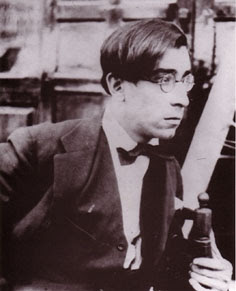
Why Rafael Barradas matters
Rafael Barradas is a founding figure of Latin American and Spanish modernism, the originator of Vibrationism, a style that fused Futurist dynamism with Cubist structure to capture the speed and noise of the modern city. He forms a direct bridge between the River Plate avant-garde and Spain's Generation of '27 circle, and his short career, followed by his family's gift of nearly his entire surviving oeuvre to the Uruguayan state, makes him a rare case of an artist whose reputation rests on institutional stewardship rather than on a deep auction record.
- Born
- 1890-01-04, Montevideo, Uruguay
- Nationality
- Uruguayan
- Media
- Painting, Drawing, Stage design
- Movement
- Modernism, Vibrationism
- Education
- No documented formal art school training; self-taught. Introduced to painting informally by his father, the painter Antonio Perez Barradas, and exposed to Futurism and Cubism during a trip to Europe.
- Signature motifs
- Vibrationist urban dynamism, Theatrical set and costume design
By the numbers
- USD 104,500Highest documented saleHombre en la taberna, from the Los Magnificos series; Christie's Latin American Sale, New York; exact sale date not confirmed in sources reviewed
- Paris, Exposition Internationale des Arts Decoratifs et IndustrielsGrand PrixTheatre category, c. 1924 to 1925
- Museo Nacional de Artes Visuales, MontevideoPrimary collectionHolds the bulk of the artist's surviving oeuvre, donated by his family
- None publishedCatalogue raisonneVerification runs through MNAV's holdings and archive
Selected works
Click any work to view it full screen.
Biography
Rafael Perez Gimenez Barradas, known professionally as Rafael Barradas, was born on 4 January 1890 in Montevideo, Uruguay, to Spanish immigrant parents: his father, Antonio Perez Barradas, was a painter and wall decorator, and it was in this family setting that Barradas absorbed his earliest sense of art. He had no documented formal art school training and is described by every major biographical source as self-taught. He began as a draughtsman and illustrator for newspapers and magazines in Montevideo and Buenos Aires.
In 1913 he traveled to Europe, initially to accompany a friend, and the trip exposed him to Futurist and Cubist currents then unsettling European painting; he settled in Spain, working between Barcelona and Madrid. By 1917 he was showing work in Madrid, and around 1918 he held his first solo exhibition, introducing his own aesthetic, vibracionismo, an attempt to render the vibration and simultaneity of modern urban life in paint. In 1922 he became artistic director of the avant-garde journal Alfar in La Coruna, and he later worked as a stage and costume designer, notably for productions connected to the Spanish actress Margarita Xirgu. Around 1924 to 1925 his set designs for Gregorio Martinez Sierra's Un Teatro de Arte were shown at the Exposition Internationale des Arts Decoratifs et Industriels in Paris, where he received the Grand Prix in the theatre category. In 1925 he took part in the landmark first exhibition of the Sociedad de Artistas Ibericos in Madrid, where he was widely recognized as an emblem of Spain's "arte nuevo."
In his last years Barradas moved toward a more figurative, return-to-order style. He fell ill in 1928 and returned to Montevideo, bringing back almost the entirety of his life's work, and was honored publicly at the Teatro Solis shortly before his death. He died on 12 February 1929 in Montevideo, at the age of 39. His family retained the collection until it was donated to Uruguay's Ministry of Education and Culture, forming the core of the holdings now at the Museo Nacional de Artes Visuales.
Critical reception
Barradas's critical standing was established quickly and has held since. His participation in the 1925 Sociedad de Artistas Ibericos exhibition in Madrid, the first of its kind, led contemporaries to treat him as a central figure of Spain's artistic renewal, and his Vibrationist canvases were read by supporters, including the writer Ramon Gomez de la Serna, as an original response to modern city life rather than a derivative echo of Italian Futurism or French Cubism. Museum texts in Uruguay and Argentina consistently frame his materials and compositions as an attempt to record the pace, noise, and structure of urban modernity. His posthumous reputation was reinforced through a series of retrospectives and group presentations at the Museo Nacional de Artes Visuales in Montevideo in 1965, 1972, 1982, and 1987.
Market
Barradas's auction footprint is thin and unevenly documented. Available records point to a sale of USD 104,500 for Hombre en la taberna, from the Los Magnificos series, at Christie's Latin American Sale in New York, though the exact sale date could not be confirmed in the sources reviewed. A smaller work, an untitled 1922 watercolor and pencil drawing, was offered at Subastas Segre, though its sale price and date could not be confirmed in the sources reviewed. Neither work could be confirmed as the artist's all-time record, and no comprehensive auction database was available to establish one with confidence. No current gallery or estate representation could be confirmed in the sources reviewed. Because the bulk of his surviving oeuvre sits in Uruguay's national collection rather than in private hands, the pool of works available to the market is inherently small.
Top auction results
| Work | Price | Sale |
|---|---|---|
| Hombre en la taberna (from the series Los Magnificos) | USD 104,500 (USD 104,500) | Christie's, New York |
| Sin titulo (watercolor and pencil on paper, 1922) | Subastas Segre |
Selected exhibitions
| Years | Exhibition | Venues |
|---|---|---|
| 1918 | First solo exhibition, presenting vibracionismo | Spain (specific venue not documented in sources reviewed) |
| 1925 | Exposicion de la Sociedad de Artistas Ibericos | Madrid, Spain |
| 1924 to 1925 | Exposition Internationale des Arts Decoratifs et Industriels | Paris, France (theatre section; stage designs for Martinez Sierra's Un Teatro de Arte; Barradas received the Grand Prix) |
| 1965 | Barradas | Museo Nacional de Artes Visuales, Montevideo |
| 1972 | Rafael Barradas | Museo Nacional de Artes Visuales, Montevideo |
| 1982 | Barradas | Museo Nacional de Artes Visuales, Montevideo |
| 1987 | Seis Maestros de la Pintura Uruguaya | Museo Nacional de Artes Visuales, Montevideo |
Museum collections
- Museo Nacional de Artes Visuales, Montevideo
- Fundacion MAPFRE, Madrid
- Museo de Arte Latinoamericano de Buenos Aires (MALBA)
Awards and honors
- Grand Prix, theatre category, Exposition Internationale des Arts Decoratifs et Industriels, Paris (some sources date the award to 1924) (1925)
Authentication and provenance
No catalogue raisonne.
No published catalogue raisonne has been identified for Barradas. The largest body of his surviving work, donated by his family to the Uruguayan state, is held and referenced at the Museo Nacional de Artes Visuales in Montevideo, which functions as the primary scholarly resource for verification.
Primary reference: https://mnav.gub.uy/cms.php?a=2
What collectors should know
There is no published catalogue raisonne for Barradas, and the single most important reference point for authentication is the Museo Nacional de Artes Visuales in Montevideo, which holds the collection donated by his family. Because he died at 39 after a relatively brief and geographically split career, between Uruguay, Argentina, and Spain, his output is small and much of it sits permanently in public institutions rather than circulating privately. Auction data is sparse and inconsistently reported, so collectors should treat any single price as a data point rather than a market trend, verify provenance carefully given the number of naming variants attached to the artist (Rafael Barradas, Rafael Perez Barradas, Rafael Perez Gimenez Barradas), and confirm current gallery or dealer relationships directly rather than assuming formal estate representation.
Further reading and resources
Data current as of 2026-07-18.

