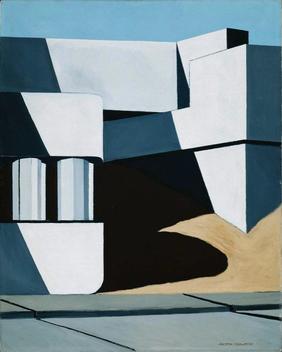
Why Ralston Crawford matters
Ralston Crawford is one of the clearest American voices of Precisionism, a Canadian-born painter, lithographer, and photographer who translated grain elevators, bridges, aircraft, and New Orleans street signage into spare, geometric compositions. His work sits in the permanent collections of the Whitney, the National Gallery of Art, and the Smithsonian, yet his auction market remains thin, small, and dominated by prints, making him a case study in the gap between institutional stature and market liquidity.
- Born
- 1906-09-05, St. Catharines, Ontario, Canada
- Nationality
- American (Canadian-born)
- Media
- Painting, Lithography, Photography
- Movement
- Precisionism, American Modernism
- Education
- Studied at Otis Art Institute, Los Angeles, circa 1927; Pennsylvania Academy of the Fine Arts and the Barnes Foundation, Philadelphia and Merion, PA, 1927 to 1930; Academie Colarossi and Academie Scandinave, Paris, 1932 to 1933; Columbia University, New York, 1933. No degree is documented at any institution.
- Signature motifs
- Industrial Precisionism, Bridges and grain elevators, Torn signage, New Orleans jazz photography
- Representation
- "Menconi + Schoelkopf, New York (estate exhibitions)"
By the numbers
- USD 42,500Auction high (documented)Heritage Auctions house record, Nov 8, 2018; global all-time high unconfirmed
- 344Recorded auction lotsArtprice, 1983 to 2026; majority prints and multiples
- Whitney, NGA, Smithsonian, and othersMuseum collectionsamong major public collections
- Menconi + Schoelkopf, New YorkEstate exhibitionsrecent gallery programming
Biography
Ralston Crawford was born on September 5, 1906 (some sources give September 25, 1906), in St. Catharines, Ontario, Canada, and spent his childhood in Buffalo, New York, before later settling in the United States. He moved to Los Angeles around 1927, where he studied at the Otis Art Institute. He continued his training from 1927 to 1930 at the Pennsylvania Academy of the Fine Arts in Philadelphia and the Barnes Foundation in Merion, Pennsylvania. In 1932 and 1933 he traveled and studied in Europe, enrolling at the Academie Colarossi and the Academie Scandinave in Paris, and returned to New York in 1933 to study briefly at Columbia University. No source documents a completed degree from any of these institutions.
Crawford developed a Precisionist style built from industrial and urban subjects rendered in flattened, geometric planes, and he later extended this vocabulary into photography, most notably a long engagement with New Orleans and its jazz culture that produced hundreds of photographs alongside paintings and prints. He taught at several institutions over his career and continued to exhibit steadily through the 1950s and 1960s, including retrospectives at the Milwaukee Art Center in 1958 and of his lithographs at the University of Kentucky in 1961 and 1962.
Crawford died of cancer on April 27, 1978, in Houston, Texas, at the age of 71, as reported in his New York Times obituary. He was given a traditional jazz funeral and was buried in New Orleans, the city whose culture had shaped so much of his late work.
Critical reception
Crawford is treated by museums and specialist galleries as a central, if still under-recognized, figure of American Precisionism, prized for stripping industrial subjects, bridges, factories, grain elevators, aircraft, down to essential geometric forms. Recent institutional attention, including the Vilcek Foundation's exhibition and video on his torn-sign paintings, the New Orleans Museum of Art's 2012 survey of his jazz-era photography, and Menconi + Schoelkopf's 2026 gallery exhibition, reflects a sustained effort to reposition Crawford as a major rather than a marginal Precisionist.
Watch
Market
Crawford's auction market is difficult to rank with precision from public sources. Artprice records 344 auction results for the artist between 1983 and 2026, the large majority in lithographs and other prints rather than paintings, but full price data sits behind a paywall. The only auction figure that can be independently confirmed from available sources is a USD 42,500 record at Heritage Auctions, set November 8, 2018, which Heritage itself describes as a record for that house rather than a claim to the artist's global high. A verified all-time auction record, work, price, and date, could not be confirmed for this profile and should not be treated as established. The scarcity of major paintings at auction, many of which are already held by museums, means that any single high-value sale could read as an outlier against a market otherwise built on lower-value print material.
Top auction results
| Work | Price | Sale |
|---|---|---|
| Title not specified in source (Heritage Auctions artist-record page) | USD 42,500 | Heritage Auctions, Dallas, 2018-11-08 |
Selected exhibitions
| Years | Exhibition | Venues |
|---|---|---|
| 1934 | Paintings by Ralston Crawford | Print Room, The Maryland Institute, Baltimore |
| 1958 | Retrospective exhibition | Milwaukee Art Center, Milwaukee |
| 2012 | Ralston Crawford and Jazz | New Orleans Museum of Art |
| 2014 | Ralston Crawford: Early Work | University of Wyoming Art Museum, Laramie |
| 2018 to 2019 | Ralston Crawford: Torn Signs | Vilcek Foundation, New York |
| 2026 | Reconstructing Ralston Crawford | Menconi + Schoelkopf (Schoelkopf Gallery), New York |
Museum collections
- Whitney Museum of American Art, New York
- National Gallery of Art, Washington, D.C.
- Smithsonian American Art Museum, Washington, D.C.
- Metropolitan Museum of Art, New York
- Museum of Modern Art, New York
Awards and honors
- Award, National Academy of Design, New York (1972)
Authentication and provenance
No catalogue raisonne.
No published catalogue raisonne has been identified for Ralston Crawford. Attribution generally rests on provenance, exhibition history, and the records of institutions and galleries, including Menconi + Schoelkopf, that have organized recent exhibitions of his work.
Primary reference: https://whitney.org/artists/301
What collectors should know
There is no published catalogue raisonne for Ralston Crawford, so provenance and exhibition history carry extra weight when evaluating a work, and current gallery activity around the estate is concentrated at Menconi + Schoelkopf in New York. The market itself is thin and difficult to benchmark from public data: strong museum holdings have kept many of his best paintings out of circulation, auction volume is dominated by prints at modest prices, and no single confirmed sale price should be treated as an established ceiling for his paintings without direct access to full auction house records.
Further reading and resources
Data current as of 2026-07-11.

