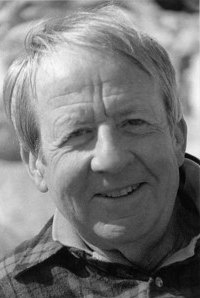
Why Ray Metzker matters
Ray Metzker, trained at the Institute of Design in Chicago in the tradition descending from the New Bauhaus, is one of the more formally ambitious photographers of the postwar American generation. He is best known for his "Composites," large assemblages built from multiple frames of film that turn the street photograph into something closer to a constructed field of pattern and light. For collectors, he represents a figure whose reputation rests almost entirely on museum and curatorial validation rather than on a deep or highly liquid auction market, a profile common among important but historically under-traded photographers.
- Born
- 1931-09-10, Milwaukee, Wisconsin, USA
- Nationality
- American
- Media
- Photography
- Movement
- Postwar American photography, Institute of Design (New Bauhaus) tradition
- Education
- Beloit College, BA Fine Arts, 1953; Institute of Design (Illinois Institute of Technology), Chicago, MS, 1959
- Signature motifs
- Black-and-white urban cityscapes, "Composites" (multi-frame photographic assemblages)
- Representation
- Howard Greenberg Gallery (estate), Les Douches la Galerie
By the numbers
- Institute of Design, ChicagoFormal trainingMS, 1959; the postwar New Bauhaus program
- 1966Guggenheim Fellowship
- J. Paul Getty Museum, 2013Major retrospectivetraveled to the Nelson-Atkins Museum of Art and Henry Art Gallery
- Howard Greenberg Gallery (estate); Les Douches la GalerieRepresented by
Biography
Ray K. Metzker was born on September 10, 1931, in Milwaukee, Wisconsin. He earned a bachelor's degree in fine arts from Beloit College in Wisconsin in 1953. He later entered the graduate program at the Institute of Design in Chicago, part of the Illinois Institute of Technology and heir to the New Bauhaus curriculum, studying there from 1956 to 1959 and earning a master's degree in 1959.
Metzker settled in Philadelphia in the early 1960s and made the city, alongside Chicago, the primary subject of his photography for the rest of his career. His work is defined by stark, formally rigorous black-and-white images and by his best-known innovation, the Composite: a single large-scale work built from many individual film frames arranged into a unified visual field. He had his first solo museum exhibition at the Art Institute of Chicago in 1959 and his first one-man show at the Museum of Modern Art in New York in 1967, and he went on to numerous solo museum exhibitions over his career.
Metzker died in Philadelphia on October 9, 2014, at the age of 83, following a long illness, as reported in his Philadelphia Inquirer obituary and corroborated by museum and gallery sources.
Critical reception
Curators have consistently framed Metzker as a formalist of unusual discipline whose work goes beyond technical experimentation. Anne Wilkes Tucker, the longtime curator of photography at the Museum of Fine Arts, Houston, wrote in a tribute published after his death that his street photographs convey the vitality of the city rather than its decay or dysfunction. Museum retrospectives, from the Art Institute of Chicago in 1959 through the Getty's 2013 traveling survey, have placed him among the central figures of the Institute of Design lineage in postwar American photography, with critics returning repeatedly to his Composites as evidence of a formal ambition rare among his contemporaries.
Market
Metzker's secondary market is thin and remains closer to an academic and specialist photography market than to a blue-chip contemporary market. Reported results are difficult to reconcile: one source describes a Heritage Auctions sale of $9,560 on May 25, 2007 as Metzker's auction record, while Phillips separately lists individual results of $20,000 for Leapin' zzz and $18,750 for Gumball, both higher than the figure labeled a record and without confirmed sale dates. Sotheby's estimated the vintage print Philadelphia at $4,000 to $6,000 in a 2024 New York sale. Given these inconsistencies, no single all-time record price for Metzker's work can be confirmed, and any such figure should be treated as unresolved pending a dedicated auction-database check.
Selected exhibitions
| Years | Exhibition | Venues |
|---|---|---|
| 2025 to 2026 | Ray K. Metzker: Light Sculptor | Les Douches la Galerie, Paris |
| 2013 | Retrospective | J. Paul Getty Museum, Los Angeles, traveled to Nelson-Atkins Museum of Art and Henry Art Gallery, Seattle |
| 2004 | Solo exhibition | Cleveland Museum of Art |
| 2000 | My Philadelphia (retrospective) | Philadelphia Museum of Art |
| 1991 | Solo exhibition | Art Institute of Chicago |
| 1984 | Retrospective | Museum of Fine Arts, Houston, traveled to SFMOMA, Art Institute of Chicago, Philadelphia Museum of Art, High Museum of Art, and others |
| 1978 | Retrospective | International Center of Photography, New York |
| 1967 | First one-man museum show | Museum of Modern Art, New York |
Museum collections
- Museum of Modern Art, New York
- Metropolitan Museum of Art, New York
- Whitney Museum of American Art, New York
- National Gallery of Art, Washington, D.C.
- Art Institute of Chicago
- J. Paul Getty Museum, Los Angeles
- Philadelphia Museum of Art
Awards and honors
- Guggenheim Fellowship, John Simon Guggenheim Memorial Foundation (1966)
- National Endowment for the Arts Fellowship, Photography (1975)
- National Endowment for the Arts Fellowship, Photography (second award) (1988)
- Bernheim Fellowship, Bernheim Arboretum and Research Forest (1989)
- Centenary Medal and Honorary Fellowship, Royal Photographic Society (2000)
Authentication and provenance
No catalogue raisonne.
No published catalogue raisonne has been identified for this artist. Howard Greenberg Gallery holds primary representation of the Ray K. Metzker estate, and Les Douches la Galerie also actively represents his work. Authentication for the secondary market runs through these representatives rather than through a certificate program.
Primary reference: https://www.howardgreenberg.com/artists/82-ray-k.-metzker/
What collectors should know
Metzker's market is defined less by price momentum than by institutional depth: his work sits in the permanent collections of the Museum of Modern Art, the Metropolitan Museum of Art, the Whitney Museum, the National Gallery of Art, the Art Institute of Chicago, the Getty, and the Philadelphia Museum of Art, among others, and the Howard Greenberg Gallery now holds primary representation of his estate. There is no published catalogue raisonne, so provenance and authentication run through the estate's representatives. Because public auction results are limited in number and inconsistent in what they claim, any single sale price should be read in the context of a small, specialist market rather than as evidence of a broader trend.
Further reading and resources
Data current as of 2026-07-18.

