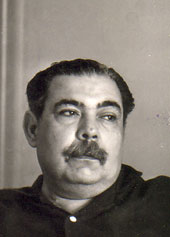
Why Rene Portocarrero matters
Rene Portocarrero is one of the central figures of twentieth century Cuban painting, a self-taught artist whose densely patterned, brightly colored images of Havana, its women, and its carnival and religious life came to define what critics have called the second generation of the Cuban vanguardia. His work sits in the collections of the Museum of Modern Art, the National Gallery of Canada, and Cuba's own national museum of fine arts, and his career included the two exhibitions that most reliably signal international standing for a mid-century Latin American painter: inclusion in a major Museum of Modern Art survey and an invited showing at the Venice Biennale. For collectors, he represents a well documented, museum validated Cuban modernist whose market runs through auction houses and dealers rather than a single representing gallery.
- Born
- 1912-02-24, El Cerro, Havana, Cuba
- Nationality
- Cuban
- Media
- Painting, Ceramics, Murals
- Movement
- Cuban Modernism, Cuban Vanguardia, second generation
- Education
- Attended classes at the Villate Art Academy and the San Alejandro Academy of Fine Arts, Havana, circa 1924 to 1926. Left before completing formal training and is consistently described as self-taught thereafter.
- Signature motifs
- "Havana cityscapes (Paisajes de La Habana)", "Ornamented women and floral imagery"
- Representation
- No single exclusive gallery or estate representative is documented as of 2026. Works are handled through multiple secondary market dealers and major auction houses.
By the numbers
- USD 295,500Auction highChristie's, 22 November 2016, per LotSearch; work title not specified in the source
- 1951National Painting PrizeCuba, for Homenaje a Trinidad
- 1963 to 1964Sambra International AwardVII Sao Paulo Bienal, for best series presented
- 1966Venice BiennaleRetratos de Flora series, invited artist, 33rd Biennale
Biography
Rene Portocarrero was born in the El Cerro district of Havana, Cuba, on 24 February 1912, though a minority of sources give 1914 as his birth year. He attended classes at the Villate Art Academy and the San Alejandro Academy of Fine Arts in Havana from roughly 1924 to 1926 but did not complete formal training, and he is consistently described in institutional sources as largely self-taught from that point forward.
He held his first solo exhibition at the Lyceum of Havana in 1934 and, by his participation in the landmark Primera Exposicion de Arte Moderno in 1937, was recognized as part of the Havana School of Cuban modernism. His international profile rose sharply in 1944, when Alfred H. Barr Jr. included him in Modern Cuban Painters at the Museum of Modern Art in New York, followed by a solo exhibition at New York's Julien Levy Gallery in 1945 and a show at the Pan American Union in Washington, D.C. in 1946.
In 1951 he won Cuba's National Painting Prize for the oil Homenaje a Trinidad, a work that led into his long running Paisajes de La Habana, or Havana Landscapes, series. His Color de Cuba paintings of the early 1960s, juxtaposing Afro-Cuban religious imagery, carnival figures, and cityscapes, were shown at the Galeria de La Habana in 1963 and helped bring him the Sambra International Award at the VII Sao Paulo Bienal that same period, for the best series presented. Two years later his Retratos de Flora series was shown at the 33rd Venice Biennale, in 1966, as an invited artist. Cuba awarded him the Order Felix Varela in 1981.
Portocarrero died in Havana, Cuba, on 7 April 1985. A major retrospective of his work had opened at the Museo Espanol de Arte Contemporaneo in Madrid in December 1984, drawing on the collection of Cuba's Museo Nacional de Bellas Artes, and remained on view into early 1985.
Critical reception
Portocarrero was recognized during his lifetime as a defining figure of Cuban modernism, with the Organization of American States' Art Museum of the Americas placing him among the artists who helped initiate Cuba's modern art movement. That standing was reinforced institutionally: his inclusion in Alfred H. Barr Jr.'s Modern Cuban Painters at the Museum of Modern Art in 1944 introduced him to an American museum audience, his 1963 Sambra International Award at the Sao Paulo Bienal and his invited appearance at the 1966 Venice Biennale placed him among the internationally recognized Latin American painters of his time, and the 1984 to 1985 Madrid retrospective, drawn from Cuba's national collection, affirmed his standing at the end of his career.
Market
Portocarrero's secondary market runs through international auction houses, including Christie's, Phillips, and Heritage Auctions, rather than a single gallery. The best documented auction result identified in current research is 295,500 USD, achieved at Christie's on 22 November 2016; the work's title was not specified in the source consulted (LotSearch), so the figure should be treated as the highest confirmed public result rather than an exhaustively itemized record. A separate Christie's sale of the still life Flores reportedly brought 200,000 USD, which Christie's described as a record for a still life by the artist, though the exact sale date could not be confirmed. No single gallery or estate currently represents Portocarrero exclusively; his work circulates through multiple dealers and auction houses.
Top auction results
| Work | Price | Sale |
|---|---|---|
| Not specified in source | USD 295,500 | Christie's, 2016-11-22 |
Selected exhibitions
| Years | Exhibition | Venues |
|---|---|---|
| 1934 | First solo exhibition | Lyceum of Havana |
| 1937 | Primera Exposicion de Arte Moderno | Havana |
| 1944 | Modern Cuban Painters | Museum of Modern Art, New York, organized by Alfred H. Barr Jr. |
| 1945 | Solo exhibition | Julien Levy Gallery, New York |
| 1946 | Solo exhibition | Pan American Union, Washington, D.C. |
| 1963 to 1964 | VII Sao Paulo Bienal | Sao Paulo, Brazil |
| 1966 | 33rd Venice Biennale | Venice, Italy, invited artist |
| 1984 to 1985 | Retrospective | Museo Espanol de Arte Contemporaneo, Madrid |
Museum collections
- Museum of Modern Art, New York
- Museo Nacional de Bellas Artes de Cuba, Havana
- Museum of Fine Arts, Houston
- National Gallery of Canada, Ottawa
- Museo de Bellas Artes de Caracas, Venezuela
- Washington County Museum of Fine Arts, Hagerstown, Maryland
Awards and honors
- National Painting Prize (Premio Nacional de Pintura), Cuba (1951)
- Sambra International Award, VII Sao Paulo Bienal (1963)
- Invited artist, 33rd Venice Biennale (1966)
- Order Felix Varela, Cuba (1981)
Authentication and provenance
No catalogue raisonne.
No published catalogue raisonne has been identified for this artist, and no formal estate authentication board is confirmed in current sources. Provenance is generally established through auction house cataloguing and gallery or museum records.
Primary reference: https://en.wikipedia.org/wiki/Ren%C3%A9_Portocarrero
What collectors should know
Portocarrero has no published catalogue raisonne and no confirmed centralized authentication body, so provenance and attribution rest on auction house cataloguing, museum records, and gallery documentation rather than a single scholarly reference. His birth year carries a documented minor discrepancy between 1912 and 1914 across otherwise reliable sources, and at least one reference source lists his death year as 1986 rather than 1985; the 7 April 1985 date given by Wikipedia, Artnet, and Cuban cultural press is the better corroborated one and is used here. The best documented auction result, 295,500 USD at Christie's on 22 November 2016, lacks a confirmed work title in the source consulted, so it should be treated as the current market ceiling rather than a fully itemized benchmark. With no exclusive representing gallery, buyers should expect to transact across multiple auction houses and dealers and should weight provenance documentation accordingly.
Further reading and resources
Data current as of 2026-07-13.

