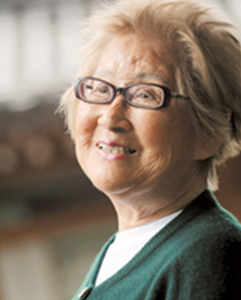
Why Rhee Seundja matters
Rhee Seundja was one of the first Korean painters of her generation to build a career in postwar Paris, arriving in 1951 and turning to abstraction by the mid 1950s at the height of the city's Art Informel moment. For collectors, she represents a rare case of a Korean modernist whose work was absorbed into French institutional life during her lifetime, backed today by major holdings at Korea's national museum and France's national art collection, and by an auction market that set back-to-back records in 2024.
- Born
- 1918-06-03, Jinju, South Korea
- Nationality
- South Korean
- Media
- Painting, Printmaking, Ceramics
- Movement
- Abstraction, Art Informel
- Education
- Jinju Girls' High School, Korea; Jissen Women's University, Tokyo, attended circa 1935 to 1938, no degree documented; Academie de la Grande Chaumiere, Paris, from 1953, studied under Henri Goetz and Yves Brayer; Atelier 17, Paris, etching training under Stanley William Hayter, 1953.
- Signature motifs
- Nature-derived abstraction, Synthesis of East Asian and Western modernist idiom
- Representation
- "Seundja Rhee Foundation (estate steward); no exclusive commercial gallery documented"
By the numbers
- USD 1.29MAuction highJamais vu de memoire d'arbre, Christie's Hong Kong, 26 September 2024
- Chevalier, Ordre des Arts et des LettresHonorFrance, 1991
- 2018Centennial retrospectiveNational Museum of Modern and Contemporary Art, Seoul
- Seundja Rhee FoundationEstateExclusive gallery representation not documented
Biography
Rhee Seundja was born on 3 June 1918 in Jinju, in what is now South Korea. She attended Jinju Girls' High School before continuing her studies in Japan at Jissen Women's University in Tokyo, though sources disagree on whether that stay ran from 1935 to 1938 or began only in 1938, and no degree from the institution is documented. She returned to Korea and married soon after.
In 1951, during the Korean War, Rhee left for France. She began formal art training only in Paris, enrolling at the Academie de la Grande Chaumiere in 1953 to study painting under Henri Goetz and Yves Brayer, and training in etching the same year at Stanley William Hayter's Atelier 17. Her work moved decisively toward abstraction around 1956, and that year a piece shown in a Paris group exhibition drew the attention of the French critic Georges Boudaille. Over roughly six decades she mounted an estimated 84 solo exhibitions and close to 300 group exhibitions across France, Korea, and beyond, including appearances at international print biennials in Ljubljana and Buenos Aires. France named her a Chevalier de l'Ordre des Arts et des Lettres in 1991.
Rhee died on 8 March 2009 in Tourrettes-sur-Loup, France. She left behind more than 1,300 paintings, roughly 12,000 engravings, and about 500 ceramic works, the bulk of which are now held in South Korean and French public collections. A centennial retrospective, "Rhee Seundja: Road to the Antipodes," opened at the National Museum of Modern and Contemporary Art in Seoul in 2018.
Critical reception
Rhee's reputation rests on her early integration into the Parisian avant-garde and on a critical narrative that consistently frames her work as a bridge between East Asian and Western modernist idioms. Georges Boudaille, a leading French critic, took note of her painting in a Paris group exhibition in 1956, an early sign of acceptance within the Paris scene. That framing has carried through to recent institutional attention, including her pairing with the Lebanese-American poet and painter Etel Adnan at White Cube Seoul in 2026 and the 2018 centennial retrospective at Korea's national museum, both of which situate her within a broader, global account of postwar abstraction rather than as a regional footnote.
Market
Rhee's auction market strengthened sharply in 2024. On 26 September 2024, Christie's Hong Kong sold "Jamais vu de memoire d'arbre (Never seen the memories of a tree)" (1963) for approximately USD 1.29 million (HKD 10,050,000), a new all-time high for the artist and roughly 23 percent above the record she had set only months earlier. That prior record, HKD 8,190,000 (about USD 1.05 million) for "La Montagne Sans Ombre (The Mountain without Shadow)" (1962), had been set at Christie's Hong Kong on 28 May 2024 and had itself surpassed a 2022 result of roughly USD 722,000. No single gallery is documented as her exclusive representative; her estate is stewarded by the Seundja Rhee Foundation, and White Cube mounted a two-person exhibition pairing her with Etel Adnan in Seoul in early 2026.
Top auction results
| Work | Price | Sale |
|---|---|---|
| Jamais vu de memoire d'arbre (Never seen the memories of a tree) (1963) | USD 1,290,000 (HKD 10,050,000) | Christie's, Hong Kong, 2024-09-26 |
| La Montagne Sans Ombre (The Mountain without Shadow) (1962) | USD 1,050,000 (HKD 8,190,000) | Christie's, Hong Kong, 2024-05-28 |
Selected exhibitions
| Years | Exhibition | Venues |
|---|---|---|
| 2026 | Etel Adnan and Seundja Rhee: To meet the sun | White Cube, Seoul |
| 2018 | Rhee Seundja: Road to the Antipodes | National Museum of Modern and Contemporary Art, Seoul |
| 2016 | Apesanteur enchantee, oeuvres de Seund Ja Rhee | Musee des Arts Asiatiques, Nice |
| 1997 | Solo exhibition | International Monetary Fund, Washington, D.C. |
| 1988 | Solo exhibition | Musee des Beaux-Arts de Nice |
| 1984 | Solo exhibition | UNESCO, Paris |
| 1970 | Solo exhibition | National Museum of Modern and Contemporary Art, Seoul |
| 1956 | Group exhibition | Paris (work noted by critic Georges Boudaille) |
Museum collections
- National Museum of Modern and Contemporary Art, Korea (MMCA)
- Centre national des arts plastiques (CNAP), France
Awards and honors
- Chevalier de l'Ordre des Arts et des Lettres, France (1991)
Authentication and provenance
No catalogue raisonne.
No published catalogue raisonne has been located for Rhee Seundja. The Seundja Rhee Foundation is documented as a steward of her legacy, and the largest institutional holdings sit with the National Museum of Modern and Contemporary Art, Korea and the Centre national des arts plastiques, France, but no independent authentication protocol is documented in public sources.
Primary reference: https://awarewomenartists.com/en/artiste/seund-ja-rhee/
What collectors should know
There is no published catalogue raisonne for Rhee Seundja, so provenance research depends on the Seundja Rhee Foundation and on cross-referencing the major institutional holdings at Korea's National Museum of Modern and Contemporary Art and France's Centre national des arts plastiques. Her auction market is comparatively young and thin relative to the size of her documented body of work, roughly 1,300 paintings plus thousands of prints and ceramics, so the sequential records set in May and September 2024 should be read as a market still finding its level rather than a fully mature price curve. Her name also appears across sources in several forms, including Rhee Seundja, Seund Ja Rhee, Rhee Seund-ja, and Rhee SeundJa, all referring to the same artist, which is worth keeping in mind when searching auction databases or verifying comparables.
Further reading and resources
Data current as of 2026-07-10.

