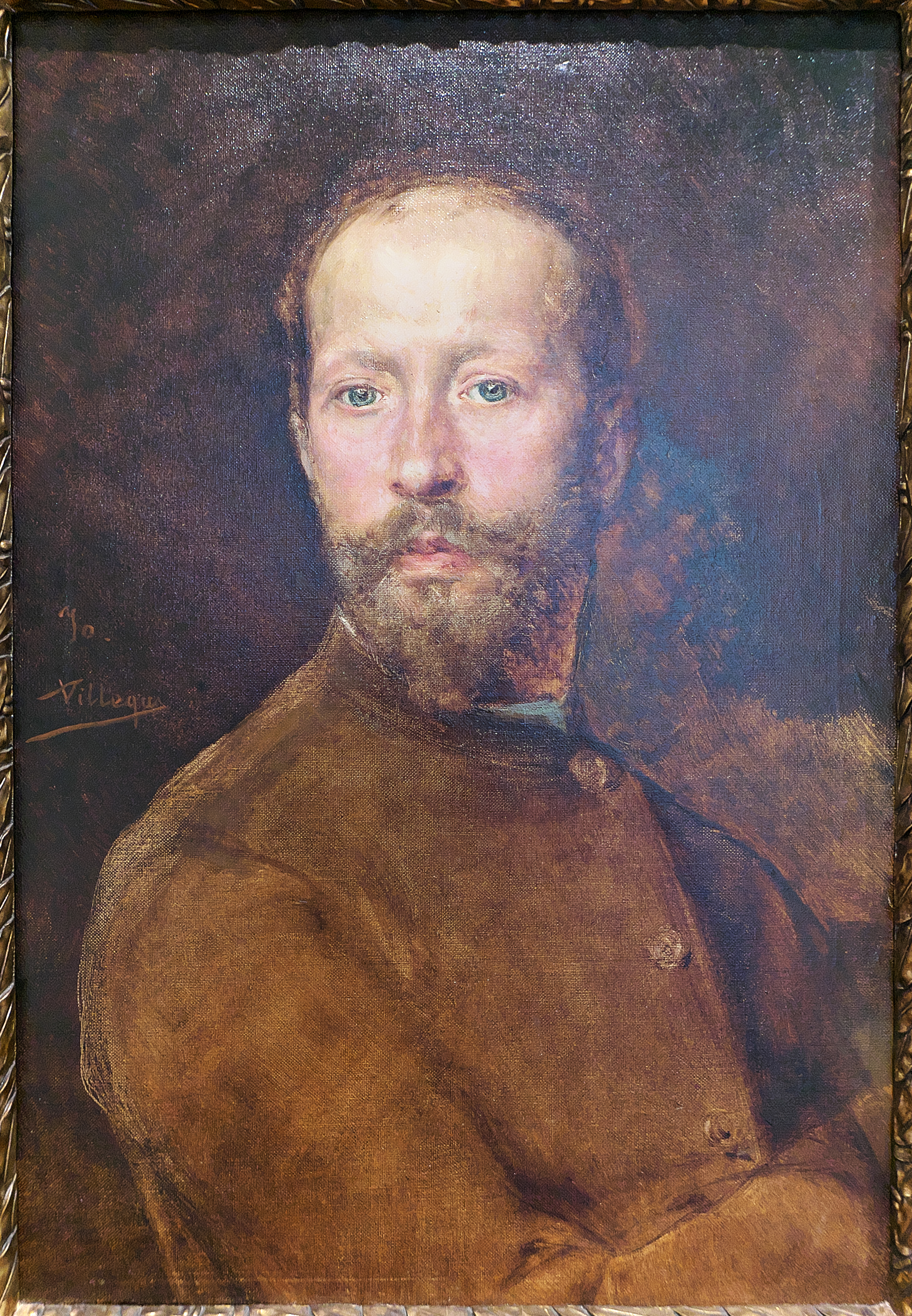
Why Ricardo Villegas Cordero matters
Ricardo Villegas Cordero was a nineteenth century Spanish painter active in Seville and Madrid, best known today for a Munich exhibition medal and for exhibited history and genre paintings. His work sits at the edge of the documented market: the surviving record is thin, and his name is frequently confused with that of his more celebrated brother, Jose Villegas Cordero. For a collector, his interest lies less in a strong auction history, which the record does not currently support, than in his place within a well documented Seville painting family and in the historical, costumbrista, and Orientalist subject matter typical of his generation.
- Nationality
- Spanish
- Media
- Painting
- Movement
- 19th-century Spanish painting, Orientalism
- Education
- No formal art school degree is documented. One source states he began studying architecture in Madrid before turning to painting; he was reportedly influenced by his brother, the painter Jose Villegas Cordero, and by Mariano Fortuny. Specific years are not documented.
- Signature motifs
- Genre and costumbrista scenes, Historical subjects, Orientalist and North African themes
By the numbers
- 1849 to 1896LifespanBorn and active in Seville, Spain; died by drowning in the Guadalquivir River
- 1888Munich International ExhibitionSecond-class gold medal for Vendedora de pescado and Herrero
- Exposicion Nacional de Bellas Artes, MadridExhibited1887 and 1890
- Jose Villegas CorderoBrotherBetter-known Spanish painter; the two are frequently conflated in market and museum records
Selected works
Click any work to view it full screen.
Biography
Ricardo Villegas Cordero was born in Seville, Spain, in 1849. No formal art school degree for him is documented in the sources available. One source states he began studying architecture in Madrid before turning to painting, and he was reportedly influenced by his brother and by the painter Mariano Fortuny. He was the younger brother of Jose Villegas Cordero, a painter who went on to build a considerably larger reputation and market.
Villegas exhibited Vendedora de pescado and Herrero at the Exposicion Nacional de Bellas Artes in Madrid in 1887. Both paintings were subsequently shown at the Exposicion Internacional de Munich in 1888, where they won a second class gold medal, the clearest documented honor of his career. In 1890 he returned to the Madrid national exhibition with La muerte de Viriato, a history painting depicting the assassination of the Lusitanian leader Viriato. His surviving body of work also includes historical, costumbrista, and Orientalist subjects; a Christie's lot record describes a painting of an Arab rifle merchant attributed to him as his Orientalist masterpiece.
Villegas died in 1896. Spanish language sources and secondary art market sites agree that he drowned in the Guadalquivir River after falling from the boat he was traveling on; no source available gives an exact date or a more specific place beyond the river itself.
Critical reception
Substantial critical literature on Ricardo Villegas Cordero specifically has not surfaced in the sources consulted. The clearest documented mark of contemporary esteem is the second class gold medal his Vendedora de pescado and Herrero received at the 1888 Munich International Exhibition, after their debut at the 1887 Madrid national exhibition. A Christie's catalogue note on an Orientalist work attributed to him describes it as his Orientalist masterpiece, though this is auction house cataloguing language rather than an independent critical assessment, and no named critic's verbatim assessment of his work in a major outlet has been located.
Market
No verified all time auction record for Ricardo Villegas Cordero could be confirmed in the sources consulted for this profile. A Christie's lot description attributes an Orientalist painting of an Arab rifle merchant to the artist, but the available record does not include a hammer price or a sale date. Collectors should take particular care with this name: his brother, Jose Villegas Cordero, has a separate and more extensive auction history, and any price result attached to that name should not be attributed to Ricardo.
Selected exhibitions
| Years | Exhibition | Venues |
|---|---|---|
| 1887 | Vendedora de pescado; Herrero | Exposicion Nacional de Bellas Artes, Madrid |
| 1888 | Vendedora de pescado; Herrero (second-class gold medal) | Exposicion Internacional de Munich |
| 1890 | La muerte de Viriato | Exposicion Nacional de Bellas Artes, Madrid |
Awards and honors
- Second-class gold medal, Exposicion Internacional de Munich, for Vendedora de pescado and Herrero (1888)
Authentication and provenance
No catalogue raisonne.
No catalogue raisonne or certification program has been identified for this artist. His work is also frequently confused in the market with that of his brother, the painter Jose Villegas Cordero. Attribution should rely on period exhibition records and documented provenance rather than any published raisonne.
Primary reference: https://es.wikipedia.org/wiki/Ricardo_Villegas_Cordero
What collectors should know
Ricardo Villegas Cordero is a minor figure relative to his brother Jose Villegas Cordero, and the two are easily conflated in listings, provenance notes, and even museum attributions. No catalogue raisonne or certification program has been identified for either artist's work, so attribution should rest on period exhibition records, signed inventory, and dealer provenance rather than any market shortcut. Because no confirmed public auction record exists for Ricardo specifically, any price claimed for a work under this name should be checked directly against the lot's cataloguing and against his birth and death years, 1849 to 1896, before it is treated as comparable to results for his brother.
Further reading and resources
Data current as of 2026-07-16.

