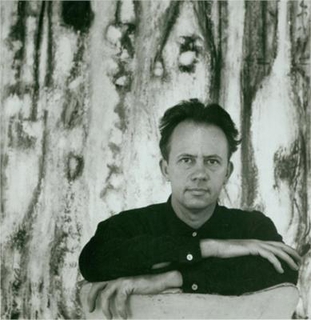
Why Richard Pousette-Dart matters
Richard Pousette-Dart was a founding member of the New York School and one of the first generation of Abstract Expressionists, working alongside Jackson Pollock, Mark Rothko, and Willem de Kooning from the early 1940s. He is best known for densely built surfaces built up in impasto and organized around a recurring motif, a luminous, radiating orb or disc, that carries through six decades of painting, sculpture, drawing, and photography. For collectors, he represents a deeply museum-validated but comparatively thin auction market: a canonical historical name whose supply at sale is limited relative to peers of his generation.
- Born
- 1916-06-08, Saint Paul, Minnesota, USA
- Nationality
- American
- Media
- Painting, Sculpture, Photography
- Movement
- Abstract Expressionism, New York School
- Education
- Scarborough School, Scarborough-on-Hudson, NY, graduated 1935 or 1936 (sources vary); briefly attended Bard College, left within his first semester, no degree. Largely self-taught as a painter.
- Signature motifs
- Luminous orbs, Densely encrusted impasto surfaces
- Representation
- Pace Gallery
By the numbers
- USD 2.6MAuction highChristie's, 2015; exact work and sale date not publicly documented
- 1963, 1974, 1998Whitney retrospectivesWhitney Museum of American Art
- Main pavilion, 1982Venice Biennale
- Pace Gallery (estate)Represented by
Biography
Richard Warren Pousette-Dart was born on 8 June 1916 in Saint Paul, Minnesota, to Nathaniel Pousette, a painter and art writer, and Flora Dart, a musician and poet, who combined their names into a single hyphenated surname. He grew up in Valhalla, New York, graduated from the Scarborough School in Scarborough-on-Hudson around 1935 to 1936, and briefly enrolled at Bard College before leaving within his first semester to pursue art independently in New York City. He had no further formal art training and is generally described as self-taught.
By the early 1940s Pousette-Dart was showing with the artists who would become known as the Abstract Expressionists, holding his first solo exhibition at The Artists' Gallery in New York in 1941 and later exhibiting at Peggy Guggenheim's Art of This Century in 1947 and at Betty Parsons Gallery from 1948. His work entered the Museum of Modern Art's collection in 1940 and appeared in the Whitney and Art Institute of Chicago annuals by 1949. He built a body of work that moved between thickly encrusted, symbol-laden paintings and later, sparer "white paintings" and "presences" built around glowing circular forms.
Pousette-Dart taught for many years at Bard College, where he was named the Milton Avery Distinguished Professor of Arts in 1981, and received the inaugural Distinguished Lifetime in Art Award from the Louis Comfort Tiffany Foundation the same year. He represented the United States in the main pavilion of the 40th Venice Biennale in 1982. He died on 25 October 1992 in New York City, at age 76, following a prolonged illness with cancer, survived by his wife, the painter Evelyn Gracey, and his children Joanna and Jonathan, both also artists.
Critical reception
With their bold colors, encrusted surfaces and luminous orbs, his paintings don't so much hang on the wall as float in front of it.
Pousette-Dart's standing rests on his place as a founding figure of the New York School whose work diverged from his peers through its recurring circular, radiant forms and heavily worked surfaces. Writing in The New York Times in 2007, critic Roberta Smith described his paintings as surfaces where "bold colors, encrusted surfaces and luminous orbs" make the canvas seem to "float in front of" the wall rather than hang on it. Earlier, critic Hilton Kramer, also writing in The New York Times, singled out a 1981 exhibition of Pousette-Dart's black-and-white "Presences" paintings at Marisa del Re Gallery as among the best exhibitions of that year, a judgment widely cited by his foundation and dealers though the original wording is not independently reproducible here. The consistent critical thread across six decades is that his abstraction, unlike the more gestural work of some contemporaries, is built through accretion and symbol, treating the painted surface as a site of near-mystical light and mass.
Market
Pousette-Dart's auction record stands at USD 2,629,000 for a painting sold at Christie's in 2015; leading market databases (MutualArt, Artsy, Artprice) confirm this as his all-time high, though the exact work title, sale date, and location are not documented in accessible public sources. His market is defined less by trading volume than by institutional standing: retrospectives at the Whitney Museum of American Art in 1963, 1974, and 1998, a traveling survey organized by the Indianapolis Museum of Art from 1990 to 1992, and a European retrospective at the Peggy Guggenheim Collection in Venice in 2007 have kept his reputation before museum audiences even as public sales of his major paintings remain infrequent. Pace Gallery represents his estate and continues to mount exhibitions of his work, most recently Geometry of Summer in New York in 2026.
Top auction results
| Work | Price | Sale |
|---|---|---|
| Not publicly documented | USD 2,629,000 | Christie's |
Selected exhibitions
| Years | Exhibition | Venues |
|---|---|---|
| 1941 | First solo exhibition | The Artists' Gallery, New York |
| 1963 | First museum retrospective | Whitney Museum of American Art, New York |
| 1969 to 1970 | Richard Pousette-Dart: Presences | Museum of Modern Art, New York, traveled to ten US venues |
| 1982 | 40th Venice Biennale | Main pavilion, Venice |
| 1990 to 1992 | Richard Pousette-Dart (retrospective) | Indianapolis Museum of Art, traveled to Detroit Institute of Arts, Columbus Museum, and The Phillips Collection |
| 2007 | Richard Pousette-Dart (European retrospective) | Peggy Guggenheim Collection, Venice |
| 2016 to 2017 | Abstract Expressionism | Royal Academy of Arts, London, traveled to Guggenheim Museum Bilbao |
| 2026 | Geometry of Summer | Pace Gallery, New York (540 West 25th Street) |
Museum collections
- Museum of Modern Art, New York
- Metropolitan Museum of Art, New York
- Whitney Museum of American Art, New York
- Solomon R. Guggenheim Museum, New York
- The Phillips Collection, Washington, D.C.
- Philadelphia Museum of Art
- Smithsonian American Art Museum, Washington, D.C.
- Tate, London
Awards and honors
- M.V. Kohnstamm Prize, Art Institute of Chicago (1961)
- Second Prize, Biennial of Contemporary American Painting, Corcoran Gallery of Art (1965)
- Honorary Doctor of Humane Letters, Bard College (1965)
- National Endowment for the Arts Award for Individual Artists (1967)
- Distinguished Lifetime in Art Award, Louis Comfort Tiffany Foundation (1981)
- Milton Avery Distinguished Professor of Arts, Bard College (1981)
Authentication and provenance
No catalogue raisonne.
No published catalogue raisonne has been confirmed. The Richard Pousette-Dart Foundation maintains the artist's archive and exhibition history, and Pace Gallery represents the estate; these are the primary points of reference for provenance questions.
Primary reference: https://www.pacegallery.com/artists/richard-pousette-dart/
What collectors should know
Pousette-Dart's market is thin relative to his historical importance: strong museum representation and a rising benchmark auction result sit alongside comparatively few public sales of his major paintings in any given year, so individual results can vary widely depending on period, scale, and medium. There is no published catalogue raisonne, which places extra weight on estate and foundation records, and on Pace Gallery, when assessing provenance. Collectors should also expect meaningful price variation between his major mid-century paintings, later works on paper, and his sculpture and photography, which trade in distinct and much smaller markets.
Further reading and resources
Data current as of 2026-07-09.

