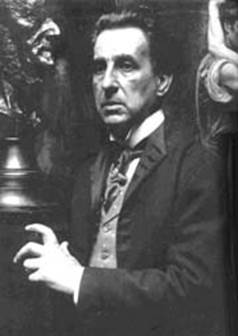
Why Rogelio de Egusquiza matters
Rogelio de Egusquiza is a Spanish painter, sculptor, and etcher remembered chiefly for a body of Wagnerian subject work grounded in a personal friendship with Richard Wagner; secondary literature also credits him with exhibiting alongside the Symbolist movement at the Salons de la Rose-Croix in Paris in the 1890s, though this is not independently confirmed here. He is not an active auction-market name today. For a collector, his significance rests on institutional standing rather than a deep sale record: his work sits in the Prado, the Bilbao Fine Arts Museum, and the Santander regional museum, and he received a silver medal at the 1900 Paris Exposition Universelle and the Legion d'honneur, but the public auction record for his work is thin and only partially documented.
- Born
- 1845-07-20, Santander, Spain
- Nationality
- Spanish
- Media
- Painting, Etching, Sculpture
- Movement
- Symbolism
- Education
- Studied drawing under Francisco de Mendoza from 1858, then at the Escuela de Bellas Artes in Madrid. Entered the Ecole des Beaux-Arts in Paris under Leon Bonnat from 1860. Associated with Rome in the mid-1870s, reportedly taking over Maria Fortuny's studio there; details of any formal coursework in Rome are not confirmed in available sources. No formal degree is documented in any source.
- Signature motifs
- Wagnerian subjects, Symbolist portraiture
By the numbers
- Low four figuresAuction results (documented)Tristan and Isolde sold for GBP 3,360, Sotheby's London, 2005; a second work sold for USD 3,438, Doyle New York, 2018. No comprehensive auction database confirms an all-time high.
- Silver medal1900 Paris Exposition UniverselleAwarded for a series of five Parsifal etchings
- Legion d'honneur, FranceHonorAwarded circa 1900, following the Paris Exposition
- No current gallery or estate representation identifiedRepresented byWorks are held principally in museum collections
Selected works
Click any work to view it full screen.
Biography
Rogelio de Egusquiza y Barrena was born in Santander, Spain, on 20 July 1845. His artistic training began in the summer of 1858, when he received drawing lessons from the painter Francisco de Mendoza, a professor at the Escuela de Bellas Artes de Madrid, and he went on to study at that school in Madrid. In 1860 he traveled to Paris and entered the Ecole des Beaux-Arts, studying under Leon Bonnat. He continued to travel through England, Belgium, the Netherlands, and Germany from 1862, before resettling in Paris later in the decade. After the death of the painter Maria Fortuny in 1874, Egusquiza is reported to have moved to Rome and taken over Fortuny's studio there through about 1875, though the specifics, including any invitation by the Madrazo brothers or formal coursework at an academy, are not confirmed in available sources.
He became closely associated with Richard Wagner and built a lasting body of work on Wagnerian subjects, including Parsifal, Tristan and Isolde, and figures from the Ring cycle, in etchings, paintings, and at least one sculpture, a portrait bust of Wagner (sometimes dated to 1892, though the exact date is not confirmed in available sources). He exhibited at the Exposicion Nacional de Bellas Artes in Madrid in 1867, where he received a second class honorable mention, and again in 1906. Secondary literature also places him at the official French Salons and the Galerie Petit in Paris through the 1870s and 1880s, and at the Symbolist Salons de la Rose-Croix in 1892, 1893, 1896, and 1897, though these appearances are not independently confirmed by the primary museum sources consulted for this profile. At the 1900 Exposition Universelle in Paris he showed a series of five Parsifal etchings, for which he received a silver medal and, shortly after, the Legion d'honneur from the French government. Secondary literature further places him at the Salon National des Beaux-Arts in Paris in 1907 and the Salon de la Societe Nationale des Beaux-Arts in 1909, though these too rest on secondary sources rather than confirmed primary documentation. He returned to Madrid at the outbreak of the First World War and died there on 10 February 1915.
Critical reception
His Wagnerian etchings and canvases were recognized at the Exposition Universelle of 1900, where they earned a silver medal and the Legion d'honneur. Secondary literature also describes attention to his genre paintings at the official Paris Salons and the Galerie Petit in the 1870s and 1880s, and to his Wagnerian work at the Paris Salons of 1907 and 1909, including a reported reference by the Symbolist writer and critic Josephin Peladan to the Parsifal series and Tristan and Isolde around 1909, though none of this could be independently confirmed or quoted verbatim from the sources available for this profile. Modern institutional attention has centered on a 2015 centenary retrospective at the Museo de Arte Moderno y Contemporaneo de Santander y Cantabria, which remains the most recent dedicated museum exhibition of his work identified in current research.
Market
Egusquiza has essentially no active auction market today. Two public sales in the low four figures have been identified: Tristan and Isolde sold at Sotheby's London in 2005 for GBP 3,360, against an estimate of GBP 1,000 to 1,500, and an unspecified work sold at Doyle in New York for USD 3,438 in a 2018 Belle Epoque sale. A further sale at Christie's New York in 1999 is documented in gallery literature but its price could not be confirmed. No comprehensive auction database was available to determine an all-time high, and exact sale dates beyond the year are not confirmed for any of these results. Occasional secondary-market and dealer listings exist, including a painting offered privately through a gallery listing service, but these are asking prices rather than recorded auction results and are not treated here as market benchmarks. He does not have current commercial gallery or estate representation; his work circulates almost entirely through museum collections, occasional loans, and infrequent private sales.
Top auction results
| Work | Price | Sale |
|---|---|---|
| Tristan and Isolde (2005) | GBP 3,360 | Sotheby's, London |
| Unspecified work (lot 20, Belle Epoque sale) (2018) | USD 3,438 (USD 3,438) | Doyle, New York |
Selected exhibitions
| Years | Exhibition | Venues |
|---|---|---|
| 1867 | Exposicion Nacional de Bellas Artes | Madrid (second-class honorable mention, painting section) |
| 1892 to 1897 | Salons de la Rose-Croix | Paris (editions of 1892, 1893, 1896, and 1897; reported in secondary literature) |
| 1900 | Exposition Universelle | Paris (Parsifal etching series; silver medal) |
| 1906 | Exposicion Nacional de Bellas Artes | Madrid (honorable mention, painting section) |
| 1907 | Salon National des Beaux-Arts | Paris (reported in secondary literature) |
| 1909 | Salon de la Societe Nationale des Beaux-Arts | Paris (reported in secondary literature) |
| 2015 | Rogelio de Egusquiza (1845 to 1915): Luces y sombras | Museo de Arte Moderno y Contemporaneo de Santander y Cantabria, Santander (centenary retrospective) |
Museum collections
- Museo Nacional del Prado, Madrid
- Museo de Arte Moderno y Contemporaneo de Santander y Cantabria (MAS), Santander
- Museo de Bellas Artes de Bilbao (Bilbao Fine Arts Museum)
- Biblioteca Nacional de Espana, Madrid
Awards and honors
- Honorable mention, second class, Exposicion Nacional de Bellas Artes, Madrid (1867)
- Silver medal, Exposition Universelle, Paris (1900)
- Legion d'honneur, France (1900)
- Honorable mention, Exposicion Nacional de Bellas Artes, Madrid (1906)
Authentication and provenance
No catalogue raisonne.
No catalogue raisonne has been published. Institutional sources document a 2015 centenary retrospective at the Museo de Arte Moderno y Contemporaneo de Santander y Cantabria, but no comprehensive scholarly catalogue predating it could be confirmed. Attribution relies on museum provenance records, principally at the Prado and at MAS Santander.
Primary reference: https://www.museodelprado.es/coleccion/artista/egusquiza-y-barrena-rogelio-de/ca21fb43-ec42-47a5-9e4e-744e621da298
What collectors should know
There is no catalogue raisonne for Egusquiza, and no comprehensive scholarly catalogue predating the 2015 MAS Santander centenary exhibition could be confirmed, so attribution and verification depend on museum provenance, principally through the Prado and MAS Santander. The documented public auction record is limited to a small number of modest sales, so any single data point should be treated with caution rather than as evidence of a broader market trend. There is no current gallery or estate representing the artist, and collectors should expect that most of his significant work will be found in, or have passed through, museum and institutional hands rather than the commercial market.
Further reading and resources
Data current as of 2026-07-18.

