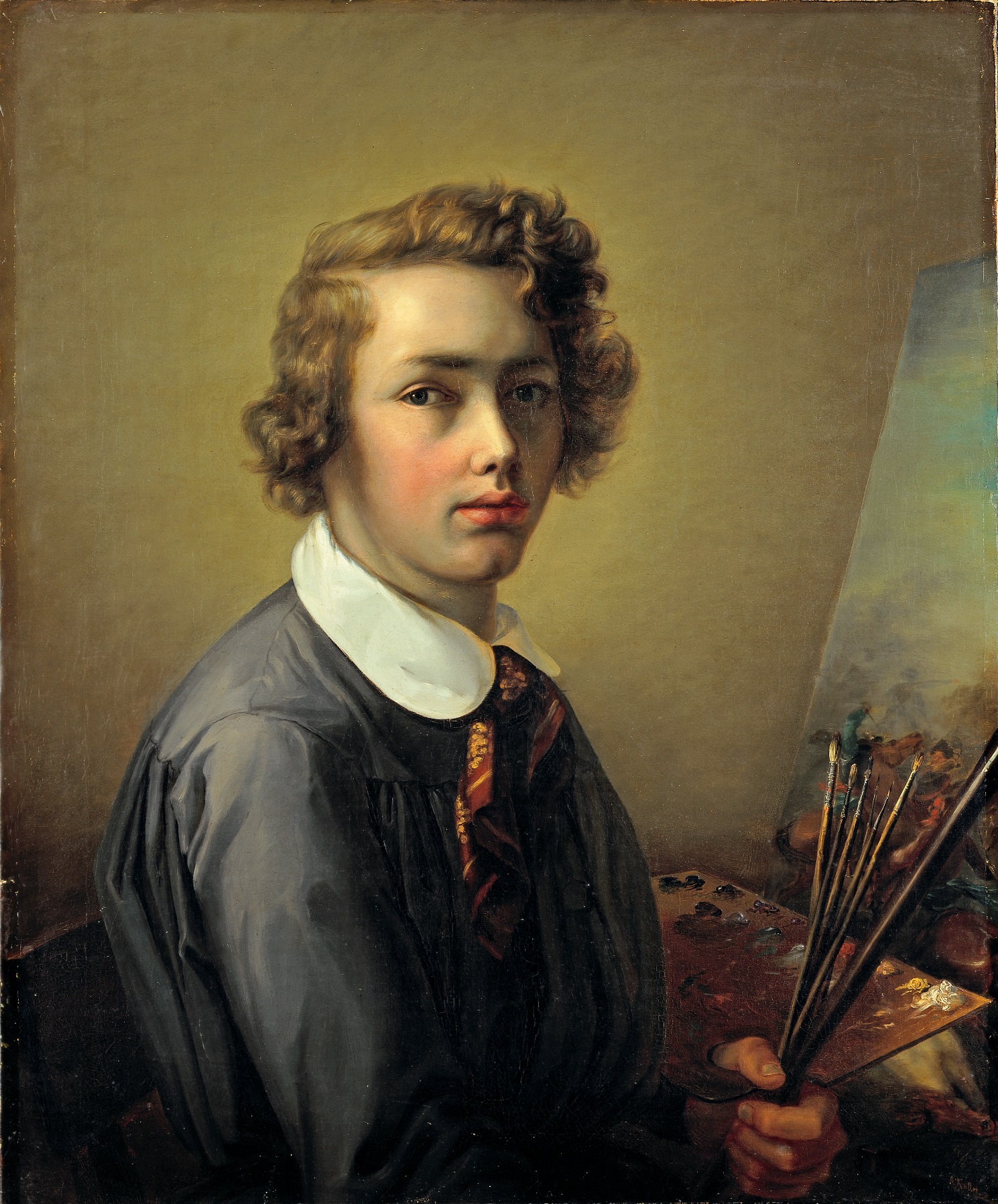
Why Rudolf Koller matters
Rudolf Koller is regarded as Switzerland's foremost nineteenth-century animal and landscape painter, the artist most closely associated with the Alpine cattle, horses, and rural scenes that came to stand for a national visual identity. His 1873 painting "Die Gotthardpost" is one of the best-known images in Swiss art, and his work anchors the collections of Switzerland's leading museums. For a collector, he represents a historically significant but very thin market: a canonical figure whose major paintings are almost entirely in public hands, with only occasional, modestly documented works reaching auction.
- Born
- 1828-05-21, Zurich, Switzerland
- Nationality
- Swiss
- Media
- Painting
- Movement
- Realism
- Education
- Kantonale Industrieschule Zurich, 1840 to 1843 (left early); private apprenticeship under Jacques Schweizer, Johann Rudolf Obrist, and Johann Jakob Ulrich, Zurich, from 1843; Kunstakademie Dusseldorf, figure class under Karl Ferdinand Sohn, 1846 to 1847; honorary doctorate, University of Zurich, 1898
- Signature motifs
- Alpine cattle and herding scenes, Horses and equestrian subjects, Swiss landscape realism
By the numbers
- CHF 550,000Auction highRecord price for the artist, Galerie Kornfeld, Bern, June 2018 auctions; exact title and sale date not publicly confirmed
- No current galleryRepresented byWorks concentrated in Swiss museum collections, led by Kunsthaus Zurich
- Honorary doctorate, University of Zurich, 1898Honor
- 1905DiedZurich, Switzerland
Selected works
Click any work to view it full screen.
Biography
Rudolf Koller was born on 21 May 1828 in Zurich. He attended a private school known as Zum schwarzen Garten and then the Fraumunster elementary school, before enrolling at the Kantonale Industrieschule Zurich, a vocational institution, from 1840 to 1843. He left that school early, in the spring of 1843, to pursue painting, having already received early tuition from an uncle who was a landscape painter. From 1843 he trained privately in Zurich under three teachers: Jacques Schweizer for drawing, Johann Rudolf Obrist for portraiture, and Johann Jakob Ulrich for landscape.
In 1845 he traveled near Stuttgart to study the Arabian horses of the royal Wurttemberg stud, an early encounter with the equestrian subjects that would define much of his later career. In 1846 and 1847 he studied figure drawing under Karl Ferdinand Sohn at the Kunstakademie Dusseldorf, and in 1847 he traveled with the Swiss painter Arnold Bocklin to Brussels and Antwerp before studying the old masters in the Louvre in Paris.
Koller settled in Zurich, working from a studio at Zurichhorn, and built his reputation on paintings of Alpine cattle, horses, and rural genre scenes rendered in a realist style. His best-known work, "Die Gotthardpost" (1873), depicts a horse-drawn postal coach crossing the Gotthard Pass and became one of the most reproduced images in Swiss art; it now hangs at Kunsthaus Zurich. In 1898, on his 70th birthday, the University of Zurich awarded him an honorary doctorate, and a major retrospective of his work in Zurich reportedly drew about 20,000 visitors. Rudolf Koller died on 5 January 1905 at his home in Zurich, in the Zurichhorn area, and is buried at Sihlfeld Cemetery in Zurich.
Critical reception
Reference and institutional sources consistently describe Koller as Switzerland's finest animal painter, with some encyclopedic accounts ranking him alongside George Stubbs, Rosa Bonheur, and Theodore Gericault, and calling him the painter of the Swiss national animal for his many depictions of Alpine cattle. Together with Frank Buchser and Gustave Eugene Castan, he is counted among the most important Swiss painters of the nineteenth century. No verbatim, attributable quotation from a named critic in a major outlet could be confirmed for this profile; the assessments above come from encyclopedic and institutional sources rather than a signed review.
Market
Koller's market is exceptionally thin and dominated by institutional holdings rather than sustained secondary trading, typical of a canonical national painter whose major works were absorbed into museums soon after his death. The best-documented auction result is a painting the auction house described only as an "icon of Swiss art history," which sold for CHF 550,000 by absentee bid at Galerie Kornfeld's June 2018 auctions in Bern, a price the house called a record for the artist; the exact title and calendar sale date have not been confirmed in public sources. Below that level, results are modest: a Koller work sold for CHF 10,625 including premium at Koller Auktionen, Zurich, against an estimate of CHF 8,000 to 12,000, and another sold for EUR 2,000 at Dorotheum's 19th Century Paintings and Watercolours sale. Collectors should treat the CHF 550,000 figure as the best available benchmark rather than a fully documented catalogue result.
Top auction results
| Work | Price | Sale |
|---|---|---|
| Untitled painting, described by the auction house only as an 'icon of Swiss art history'; exact title not publicly confirmed (2018) | CHF 550,000 | Galerie Kornfeld, Bern, Switzerland |
Selected exhibitions
| Years | Exhibition | Venues |
|---|---|---|
| 1898 | 70th-birthday retrospective | Zurich (specific venue not identified in available sources); reported to have drawn about 20,000 visitors |
Museum collections
- Kunsthaus Zurich
- Kunstmuseum Basel
- Kunstmuseum Luzern
- Kunst Museum Winterthur Reinhart am Stadtgarten
- Aargauer Kunsthaus, Aarau
Awards and honors
- Honorary doctorate (Dr. h.c.), University of Zurich, awarded for his 70th birthday (1898)
Authentication and provenance
No catalogue raisonne.
No catalogue raisonne has been published. Koller's estate, including seven paintings, most of his known sketchbooks, and his studio furnishings, passed to Kunsthaus Zurich after his death, and the Zentralbibliothek Zurich holds his letters and papers; these institutional holdings function as the primary basis for provenance and attribution today.
Primary reference: https://en.wikipedia.org/wiki/Rudolf_Koller
What collectors should know
No catalogue raisonne exists for Koller. Authentication rests on estate and archival material held by Kunsthaus Zurich, which holds seven paintings and most of his known sketchbooks along with studio furnishings, and by the Zentralbibliothek Zurich, which holds his letters and papers. No commercial gallery or dealer currently represents his estate. His major paintings are concentrated in Swiss public collections, led by Kunsthaus Zurich along with Kunstmuseum Basel, Kunstmuseum Luzern, Kunst Museum Winterthur Reinhart am Stadtgarten, and the Aargauer Kunsthaus in Aarau, which limits both the volume and the price discovery available at auction. The highest documented auction price, CHF 550,000, comes from a single 2018 sale whose exact title and date are not publicly confirmed, so it should be read as directional rather than a precise, fully sourced benchmark.
Further reading and resources
Data current as of 2026-07-18.

