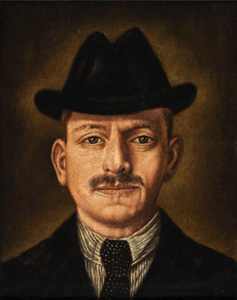
Why Sal Meijer matters
Sal Meijer is a modest but persistent presence in the Dutch art market and in Amsterdam's museums: a self-taught painter who left a career in the diamond trade to paint cats and Amsterdam cityscapes, was largely overlooked for decades, then was reappraised by Dutch critics in the late 1950s as a significant naive painter. For a collector, he represents a niche, regionally rooted market rather than a blue-chip one, with value resting on subject matter, condition, and provenance more than on a deep price history.
- Born
- 1877-12-06, Amsterdam, Netherlands
- Nationality
- Dutch
- Media
- Painting, Etching
- Movement
- Naive art
- Education
- No documented formal art academy training. Described in the literature as a self-taught painter.
- Signature motifs
- Cats, Amsterdam cityscapes and canals
By the numbers
- 1877 to 1965Life datesAmsterdam to Blaricum, Netherlands
- USD 19,125Best-documented auction priceBonhams Skinner, Spring Americana online sale, 2024; top lot of that sale; exact title and closing date not confirmed
- Raphael of the Cats1957 critical reappraisalPhrase used by critic Kasper Niehuis
- Stedelijk Museum, 1958Museum exhibitionAmsterdam
Biography
Salomon "Sal" Meijer was born on December 6, 1877, at Zwanenburgwal 10 in Amsterdam, the son of a Jewish diamond-cutting family. He worked in the diamond trade as a young man before turning to painting, and by 1914 he had dedicated himself to art full time. He had no formal art academy training; the literature consistently describes him as self-taught.
His first solo exhibition took place in 1926, though the venue is not documented in available sources. In 1930 he moved from Amsterdam to Blaricum, where he lived for the rest of his life. In 1939 his work was included in Onze Kunst van Heden (Our Art of Today), an exhibition and sale of contemporary Dutch art at the Rijksmuseum in Amsterdam.
For much of his career Meijer worked outside critical attention. That changed in 1957, when the Dutch critic Kasper Niehuis published an article recasting him as a major figure, an event widely credited with launching a broader reappraisal of his work. The following year, in 1958, the Stedelijk Museum in Amsterdam devoted an exhibition to his paintings.
Meijer died on February 1, 1965, in Blaricum, Netherlands, at the age of 87. Following his death, a collection of his works was exhibited at Gallery Mokum in Amsterdam, where roughly half the works on view reportedly sold on the opening evening. A touring retrospective followed in 1971 and 1972, traveling to the Singer Museum in Laren, the Romi Goldmuntz Center in Antwerp, the Van Reekum Gallery in Apeldoorn, and De Beyaard in Breda.
Critical reception
Sal Meijer spent much of his working life outside serious critical notice, aside from inclusion in the Rijksmuseum's 1939 Onze Kunst van Heden. The turning point came in 1957, when critic Kasper Niehuis published an article that described him as, in the phrase that has stuck to his reputation ever since, the "Raphael of the Cats." The outlet in which Niehuis's article originally appeared is not confirmed in available sources, but the phrase and the broader reappraisal it represents are repeated consistently across museum and auction-house accounts. The Stedelijk Museum's 1958 exhibition followed directly from that reappraisal. No formal prizes, medals, or state honors for Meijer are documented; his standing rests instead on this critical rehabilitation and on continuing museum interest, including his cat paintings held at Amsterdam's Kattenkabinet.
Market
Sal Meijer's market is a secondary one. Available research finds no gallery or estate that currently and formally represents him; his paintings and etchings instead circulate through auction houses such as Bonhams Skinner and Veilinghuis AAG, and through Dutch dealers including Simonis & Buunk and listings on platforms such as Artnet, Invaluable, and Gallerease. The best-documented auction price identified is USD 19,125 for a painting of a black and white cat, the top lot of Bonhams Skinner's Spring Americana online sale in 2024; the work's formal title and the exact closing date within that online sale window are not confirmed in the sources reviewed, so this should be read as the strongest verified data point rather than a confirmed all-time record. Given the thin and fragmentary public sale data, any single result for this artist should be treated with caution.
Top auction results
| Work | Price | Sale |
|---|---|---|
| Portrait of a black and white cat (informal description; no confirmed formal title) (2024) | USD 19,125 (USD 19,125) | Bonhams Skinner, Online, Spring Americana sale |
Selected exhibitions
| Years | Exhibition | Venues |
|---|---|---|
| 1971 to 1972 | Retrospective tour | Singer Museum, Laren; Romi Goldmuntz Center, Antwerp; Van Reekum Gallery, Apeldoorn; De Beyaard, Breda |
| 1965 | Posthumous collected-works exhibition | Gallery Mokum, Amsterdam |
| 1958 | Exhibition devoted to Sal Meijer's work | Stedelijk Museum, Amsterdam |
| 1939 | Onze Kunst van Heden (Our Art of Today) | Rijksmuseum, Amsterdam |
| 1926 | First solo exhibition | Venue not documented |
Museum collections
- Kattenkabinet (Cat Cabinet Museum), Amsterdam
- Stedelijk Museum, Amsterdam (historical loan and 1958 exhibition)
Authentication and provenance
No catalogue raisonne.
No catalogue raisonne has been identified for Sal Meijer. Works are generally authenticated through provenance history, dealer and auction-house expertise in Dutch naive painting, and comparison with his known subjects and signature.
Primary reference: https://en.wikipedia.org/wiki/Sal_Meijer
What collectors should know
There is no catalogue raisonne for Sal Meijer, and no gallery or estate currently manages his market in a formal way, so provenance and dealer expertise carry unusual weight in authenticating any given work. Public auction data for his paintings is sparse and fragmentary, and the single strongest verified price identified in research, USD 19,125 for a cat painting at Bonhams Skinner's 2024 Spring Americana sale, comes without a confirmed formal title or exact closing date, so it should not be treated as a settled benchmark. Collectors should also note the naming variation in the market: he appears as "Sal Meijer," "Salomon Meijer," and in catalogue-style surname-first form as "Meijer, Salomon," all referring to the same Dutch painter (1877 to 1965). His cat paintings and Amsterdam street and canal views are the subjects most consistently sought after and most closely tied to his critical reputation.
Further reading and resources
Data current as of 2026-07-09.

