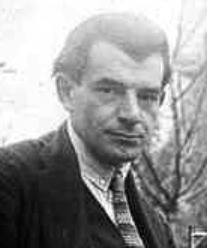
Why Sandor Bortnyik matters
Sandor Bortnyik is one of the central figures of the Hungarian avant-garde, an artist whose career moved from the activist circle around Lajos Kassak's journal MA through Constructivist poster design and into the leadership of Hungary's official art establishment. For a collector, he represents an important, historically documented Central European modernist whose market is regional, thinly traded, and built on museum standing rather than headline auction results.
- Born
- 1893-07-03, Marosvasarhely, Austria-Hungary (now Targu Mures, Romania)
- Nationality
- Hungarian
- Media
- Painting, Graphic design, Poster art
- Movement
- Hungarian avant-garde, Constructivism
- Education
- Free art school of Karoly Kernstok, Jozsef Rippl-Ronai and Janos Vaszary, Budapest, c. 1913 to 1915, no formal degree. Informal association with the Bauhaus circle in Weimar, c. 1922 to 1924, never formally enrolled.
- Signature motifs
- Constructivist geometric abstraction, Advertising and poster design
- Representation
- "Kieselbach Auction House, Budapest (secondary market)", "November Gallery, Budapest (secondary market)"
By the numbers
- 1973Kossuth PrizeHungary's highest state honor for art and culture
- 1949 to 1956Academy directorshipDirector, Hungarian University of Fine Arts, Budapest
- MoMA, Thyssen-Bornemisza, LACMA, Museum AbteibergMuseum collections
- Secondary market onlyMarketNo estate gallery; handled by Hungarian auction houses
Biography
Sandor Bortnyik was born on July 3, 1893, in Marosvasarhely, then part of Austria-Hungary and now Targu Mures, Romania, and moved to Budapest, where he trained briefly, from roughly 1913 to 1915, at a free art school run by Karoly Kernstok, Jozsef Rippl-Ronai and Janos Vaszary, an informal setting rather than a degree-granting academy, and sources describe him as largely self-taught beyond that period.
In Budapest he joined the activist wing of the Hungarian avant-garde around Lajos Kassak and the journal MA, and his early work absorbed Cubism and Expressionism before settling into a Constructivist idiom built on geometric abstraction and mechanized figures. Between about 1922 and 1924 he spent time in Weimar, close to the Bauhaus circle, though he was never formally enrolled as a student there. Back in Hungary, he became a leading figure in advertising and poster design, founding the Muhely school for commercial and applied art, active from roughly 1928 to 1938 and later described as a "little Bauhaus."
After the Second World War, Bortnyik moved into art administration, teaching at Hungary's Academy of Fine Arts in Budapest from the mid-1930s and serving as its director from 1949 to 1956. He received a series of Hungarian state honors over the following two decades, including the Munkacsy Prize in 1955 and the Kossuth Prize, Hungary's highest cultural award, in 1973. Sandor Bortnyik died on December 31, 1976, in Budapest, and is buried in Kerepesi Cemetery, also known as the Fiume Road Cemetery. A small number of Hungarian sources give a slightly different December 1976 death date, but the great majority of international reference sources converge on December 31.
Critical reception
Hungarian and international reference sources consistently describe Bortnyik as one of the most significant figures of the Hungarian avant-garde and among the most important masters of Hungarian poster art, crediting him with carrying Cubist and Expressionist influence into a distinctly Hungarian Constructivism. His later institutional role, as director of the country's leading fine arts academy through the 1950s, is treated as a separate and complementary strand of his legacy, alongside his design work through the Muhely school. No verbatim, attributable critical assessment from a named critic in a major outlet could be confirmed for this profile.
Market
Bortnyik's market operates mainly within Hungary. His work is handled on the secondary market by Budapest venues including Kieselbach and November Gallery, and pieces have also appeared occasionally in Central European sales at Christie's and Sotheby's. The highest publicly documented result located for this profile is Ohne Titel, which sold for EUR 49,980 including premium at Lempertz, Cologne, with a second work, Komposition, realizing EUR 44,640 at the same house; exact sale dates for both could not be confirmed from available sources, so no fully dated, cross-sourced all-time auction record could be established.
Selected exhibitions
| Years | Exhibition | Venues |
|---|---|---|
| 1933 | Milan International Triennial of Decorative Arts | Milan, Italy |
Museum collections
- Hungarian National Gallery, Budapest
- Museum of Modern Art, New York
- Museo Nacional Thyssen-Bornemisza, Madrid
- Museum Abteiberg, Monchengladbach
- Los Angeles County Museum of Art
- Janus Pannonius Museum, Pecs
Awards and honors
- Kossuth Prize (1973)
- Order of Labour, gold grade (also awarded 1964) (1968)
- Munkacsy Prize (1955)
- Medal of Merit of the Hungarian People's Republic, gold grade (1950)
- Silver Medal, Milan International Triennial of Decorative Arts (1933)
Authentication and provenance
No catalogue raisonne.
No published catalogue raisonne has been identified for Bortnyik. Works are authenticated primarily through Hungarian auction houses and galleries, including Kieselbach and November Gallery in Budapest, together with museum provenance records.
Primary reference: https://www.sothebys.com/en/artists/sandor-bortnyik
What collectors should know
There is no published catalogue raisonne for Bortnyik, and no gallery or foundation currently functions as an official representative of his estate, so authentication rests on the expertise of Hungarian auction houses and on museum provenance rather than a single centralized record. His work sits in significant public collections, including the Museum of Modern Art, the Museo Nacional Thyssen-Bornemisza, Museum Abteiberg, and the Los Angeles County Museum of Art, which supports his historical standing, but the auction market outside Hungary is thin and a confirmed global price record could not be established. Collectors should treat any single sale result with caution and expect limited price transparency compared with better-documented avant-garde peers.
Further reading and resources
Data current as of 2026-07-13.

