Why Sharaku matters
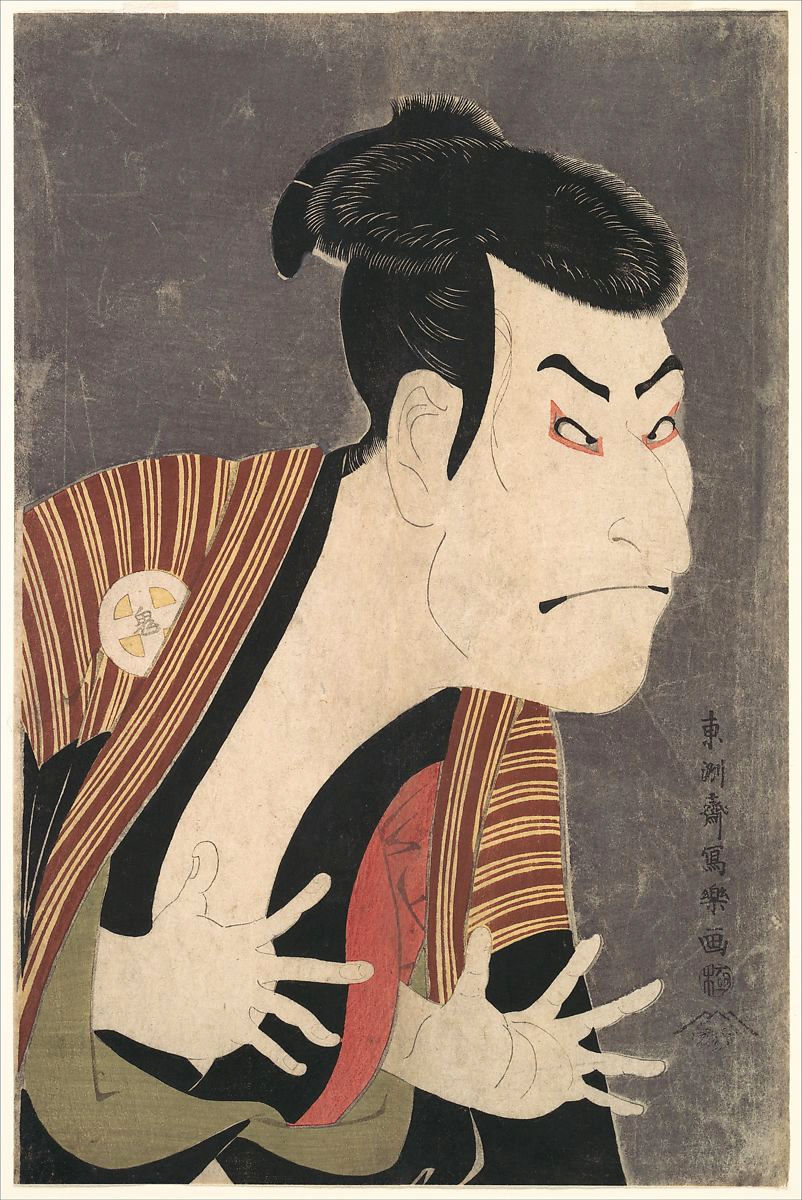
Sharaku is the great enigma of ukiyo-e. In roughly ten months between 1794 and 1795 he produced around 140 kabuki actor portraits of startling psychological directness, then disappeared from the record entirely, leaving no confirmed name, birth date, or death date behind. For collectors, he matters on two levels at once: as one of the most historically significant designers in the Japanese print canon, whose reputation was transformed by Julius Kurth's 1910 monograph after two centuries of relative obscurity, and as a case study in how rarity, condition, and provenance, rather than any living market apparatus, drive value for a centuries-old, publicly dispersed body of work.
- Nationality
- Japanese
- Media
- Woodblock prints (ukiyo-e)
- Movement
- Ukiyo-e, Edo period
- Education
- No documented formal education, school, or apprenticeship exists under any name. A leading theory identifies him as a Noh actor, though sources differ on whether he was based in the Awa Tokushima domain or in Osaka, and this remains unconfirmed by primary records.
- Signature motifs
- "Kabuki actor portraits (yakusha-e)", "Large-head portraits (okubi-e) with exaggerated, psychologically direct expression"
By the numbers
- 1794 to 1795Active periodAbout ten months of documented print production, then he vanished from the record
- About 140 printsKnown worksMostly kabuki actor portraits
- EUR 389,000Notable auction priceArashi Ryuzo I as Ishibe Kinkichi, Piasa, Paris, 2009
- Art Institute of ChicagoMajor collectionOne of the largest Sharaku holdings among museum collections
Biography
Sharaku's entire documented career runs from the fifth month of 1794 to the first month of 1795, when the Edo publisher Tsutaya Juzaburo issued a rapid sequence of woodblock prints under the name Toshusai Sharaku. Most are okubi-e, large-head portraits of kabuki actors in specific roles, rendered with an unflattering, almost caricatural realism that set them apart from the more idealized actor prints of the period. A smaller group depicts sumo wrestlers and warriors. The Tokyo National Museum notes that his portraits were seen by contemporaries as too realistic, even bizarre, a view some historians cite as a likely reason his output ended so abruptly.
After early 1795, Sharaku vanishes from the historical record. Neither his birth date nor his death date is documented in any primary source, and his true identity remains unconfirmed. The most discussed hypothesis identifies him with Saito Jurobei, a Noh actor; nineteenth-century scholarship, including the historian Saito Gesshin writing in 1844, first advanced versions of this theory, though sources differ on whether he was based in the Awa Tokushima domain or in Osaka. No school, apprenticeship, or formal training is documented for him under any name. Because his output is firmly dated to the 1790s, he is understood with certainty to be long deceased, even though no source records an exact date or place of death.
Critical reception
Sharaku's modern reputation was largely built by Western scholarship long after his own era offered him no formal recognition. Contemporary Edo audiences reportedly found his uncompromisingly realistic portraits off-putting, and his production ceased within about ten months. Julius Kurth's 1910 monograph, Sharaku, is widely credited with introducing him to international audiences and transforming his critical standing. The Art Institute of Chicago's exhibition Masterworks of Japanese Prints: Toshusai Sharaku, drawing on the museum's own deep holdings, has renewed public attention to the work.
Market
Sharaku's prints are in the public domain and are not represented by any gallery or estate; they circulate through museums, specialist Japanese-print dealers, and the major auction houses. The clearest documented price point is a single design, Arashi Ryuzo I as Ishibe Kinkichi, which sold for EUR 389,000 at Piasa in Paris in 2009; an auction-house lot description cites this as a record price for a Sharaku print, though no earlier sale history for this design is confirmed in current sourcing. Aggregated auction databases also cite a higher figure, up to USD 721,034, for works catalogued there as paintings rather than prints, but no title, auction house, location, or date is publicly attached to that sale, so it is not treated here as the confirmed record. As with other 18th-century ukiyo-e masters, condition and the generation of the impression, early versus later printings, fading, trimming, matter enormously to price, often more than the design itself.
Top auction results
| Work | Price | Sale |
|---|---|---|
| Arashi Ryuzo I as Ishibe Kinkichi (2009) | EUR 389,000 | Piasa, Paris, 2009 |
Selected exhibitions
| Years | Exhibition | Venues |
|---|---|---|
| n.d. | Masterworks of Japanese Prints: Toshusai Sharaku | Art Institute of Chicago |
| n.d. | Sharaku | Tokyo National Museum, Japanese Gallery (Honkan) |
Museum collections
- Art Institute of Chicago
- Tokyo National Museum
Authentication and provenance
No catalogue raisonne.
No catalogue raisonne exists. The roughly 140 known prints have been catalogued by museums and scholars over time, and attribution rests on connoisseurship, publisher seals, and documented provenance rather than any certificate program. The artist's own identity remains unresolved.
Primary reference: https://en.wikipedia.org/wiki/Sharaku
What collectors should know
There is no catalogue raisonne for Sharaku, and there never can be one in the modern sense, since even his identity is unresolved. What exists instead is a settled scholarly count of roughly 140 known prints, and attribution in practice rests on publisher seals, censor marks, connoisseurship, and documented provenance rather than any certificate program. Because no gallery or estate manages the market, prices are set entirely at auction and depend heavily on impression quality and collecting history. Collectors should treat any headline price figure that lacks a named work, house, and date, such as the higher "paintings" figure that appears in some aggregated databases, with caution until the underlying lot can be verified.
Further reading and resources
Data current as of 2026-07-11.

