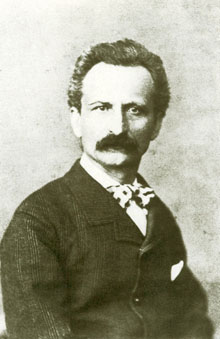
Why Silvestro Lega matters
Silvestro Lega was one of the core painters of the Macchiaioli, the group of Florence-based Italian realists who, working roughly a generation ahead of French Impressionism, built their pictures from macchie, patches of tone and color, rather than academic line and finish. Within the group he is often singled out as its most intimate voice, the one who turned the Macchiaioli's plein-air technique toward quiet domestic interiors and family scenes as well as toward patriotic and historical subjects. For collectors, he is also a useful reminder that not every historically important painter has a well-documented modern auction footprint. Current research located no verifiable public auction sale record for his work, even though his paintings are held in Italian public collections, a gap in the auction record rather than a statement about the work's importance.
- Born
- 1826-12-08, Modigliana, Italy
- Nationality
- Italian
- Media
- Painting
- Movement
- Macchiaioli
- Education
- Piarist College, Modigliana (from 1838); Accademia di Belle Arti di Firenze, c. 1843 to 1847, under Benedetto Servolini, Tommaso Gazzarrini, and Giuseppe Bezzuoli; private study with Luigi Mussini from 1847; later trained under Antonio Ciseri.
- Signature motifs
- Macchia technique (patches of tone and color), Domestic and patriotic Italian genre scenes
By the numbers
- MacchiaioliMovementFlorence-based Italian Realist group, active mid to late 1800s
- 1870Silver medalNational Exposition, Parma
- 1889Exposition UniverselleParis, group exhibition
- Not publicly documentedAuction recordNo verified sale located in research as of 2026-07-11
Biography
Silvestro Lega was born on 8 December 1826 in Modigliana, in what is now the province of Forli-Cesena, Italy. He trained at the Piarist College in Modigliana from 1838, then enrolled at the Accademia di Belle Arti in Florence around 1843 to 1847, studying under Benedetto Servolini, Tommaso Gazzarrini, and briefly Giuseppe Bezzuoli. In 1847 he left the Accademia for private lessons with the purist painter Luigi Mussini, and later trained under Antonio Ciseri. He became active in Florence's art circles in the decades that followed and was associated with the circle of painters known as the Macchiaioli, who rejected academic convention in favor of tonal patches of light and color, often painted from direct observation. Lega's own work moved between two poles: intimate, quietly observed domestic and family scenes, and more overtly patriotic and historical subjects, including his 1873 painting of the dying nationalist leader Giuseppe Mazzini.
His work was recognized publicly during his lifetime: he won the Accademia's Concorso Trienniale in 1852 with David Placating Saul, received a silver medal at the National Exposition in Parma in 1870, and showed at the 1889 Exposition Universelle in Paris.
Lega's later years were marked by hardship. According to Italian art-historical sources, he died in poverty in Florence on 21 September 1895, reportedly of stomach cancer. One auction-market biography lists a later November death date, but the September date is supported by the majority of art-historical sources consulted, including a detailed monographic account and Wikidata-sourced records.
Critical reception
The Italian art-history publication Finestre sull'Arte titles its account of him "the most intimate of the Macchiaioli painters," a framing that captures the recurring critical view of his domestic and family subjects as the emotional center of the group's realism, in contrast to the more purely landscape- or battle-focused work of some Macchiaioli peers. Beyond this, the dossier assembled for this profile did not surface additional named-critic commentary that could be reproduced verbatim with attribution.
Market
No verified auction result for a work by Silvestro Lega could be confirmed in the research completed for this profile as of 2026-07-11. His work is held in Italian public collections, including the Galleria d'Arte Moderna at the Palazzo Pitti in Florence and the Pinacoteca di Brera in Milan, but no confirmed current gallery or estate representation and no verified auction record could be established. Collectors and researchers should treat any auction price circulating for this artist as unverified until it can be traced to a named auction house, sale date, and lot.
Selected exhibitions
| Years | Exhibition | Venues |
|---|---|---|
| 1870 | National Exposition, Parma | Reale Esposizione, Parma (silver medal awarded) |
| 1889 | Exposition Universelle | Paris |
| n.d. | Societa Promotrice delle Belle Arti | Florence |
Museum collections
- Galleria d'Arte Moderna, Palazzo Pitti, Florence
- Pinacoteca di Brera, Milan
Awards and honors
- Concorso Trienniale dell'Accademia, Accademia di Belle Arti, Florence (for David Placating Saul) (1852)
- Silver medal, National Exposition, Parma (1870)
Authentication and provenance
No catalogue raisonne.
No published catalogue raisonne was confirmed in available sources. Authentication questions for Macchiaioli-era works are generally addressed through period documentation, exhibition history, and specialist scholarship rather than a single certifying catalogue.
Primary reference: https://en.wikipedia.org/wiki/Silvestro_Lega
What collectors should know
Documentation for Silvestro Lega is thinner than for many artists of comparable historical standing: there is no catalogue raisonne and no confirmed current auction record, although his paintings are held in named Italian public collections including the Palazzo Pitti and the Pinacoteca di Brera. Any specific price, provenance, or attribution claim for a work sold as "Silvestro Lega" should be verified against a named auction house record or a documented museum accession before being relied upon.
Further reading and resources
Data current as of 2026-07-11.

