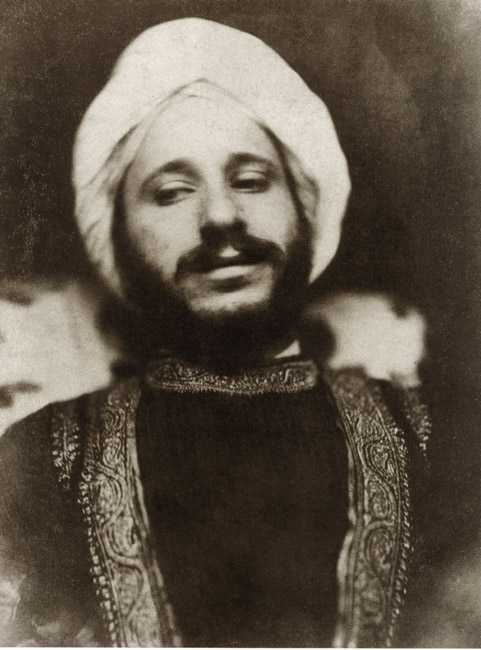
Why Simeon Solomon matters
Simeon Solomon was one of the most distinctive painters to emerge from the Pre-Raphaelite circle, known for biblical, mythological, and Jewish devotional imagery charged with an emotional and homoerotic intensity that few Victorian contemporaries attempted. His mainstream career was cut short by a criminal prosecution in 1873, after which he spent three decades in poverty on the margins of the art world he had once helped define. For today's collectors, he matters both as a documented influence on Burne-Jones and the wider Aesthetic movement and as an artist now being actively rediscovered by major museums, a rediscovery that is reshaping demand for a market that has historically been thin and hard to read from a small number of public sales.
- Born
- 1840-10-09, Sandys Street, Bishopsgate, London, England
- Nationality
- British
- Media
- Painting, Drawing, Watercolour
- Movement
- Pre-Raphaelite circle, Aesthetic movement
- Education
- Royal Academy Schools, London, admitted 1856. No degree or diploma is documented; earlier informal training with his brother from about 1850 and at Carey's Art Academy in 1852.
- Signature motifs
- Biblical and mythological subjects, Jewish ritual and devotional scenes, Androgynous figures
By the numbers
- Not independently confirmedAuction highMutualArt aggregate data cites realized prices up to USD 492,500 for paintings and USD 314,407 for works on paper; exact lot-level record unverified in sources reviewed.
- 1858 to 1872Royal Academy yearsYears as a regular Royal Academy exhibitor
- No current gallery or estate representationRepresented bySecondary market runs through Christie's and Sotheby's
- 2027Next major museum surveyDelaware Art Museum, first major U.S. museum exhibition devoted to the artist
Selected works
Click any work to view it full screen.
Biography
Simeon Solomon was born on 9 October 1840 at Sandys Street, Bishopsgate, London, the youngest of eight children in a middle-class Orthodox Jewish family. His father, Michael (Meyer) Solomon, was an importer and manufacturer of Leghorn hats, and his mother, Kate (Catherine) Levy, was an amateur miniature painter. Two older siblings, Abraham Solomon and Rebecca Solomon, were also practicing artists who exhibited at the Royal Academy, and Simeon received early informal instruction from Abraham from around 1850 before attending Carey's Art Academy in 1852. He was admitted to the Royal Academy Schools on 24 April 1856; no degree or diploma is recorded.
Solomon made his Royal Academy exhibition debut in 1858 and continued to show there regularly until 1872. In 1860 his painting The Mother of Moses, exhibited at the Royal Academy, was bought by the collector Thomas E. Plint and won a silver medal from the Society for the Encouragement of the Fine Arts, one of the few formal distinctions documented in his career. He moved in the circle of Dante Gabriel Rossetti and became a close friend of Edward Burne-Jones, who is quoted in modern museum accounts of the artist as having called him "the greatest of us all." Through the 1860s and into the early 1870s Solomon also exhibited regularly at the progressive Dudley Gallery in London.
On 11 February 1873, Solomon was arrested in London on a charge of attempted sodomy and convicted; a second arrest followed in Paris in 1874 and resulted in a three-month prison sentence. The prosecution effectively ended his standing within the Royal Academy establishment. Accounts of his remaining three decades describe a steep decline into poverty and alcoholism, with periods spent in and out of workhouses while he continued to produce drawings and watercolors. He died on 14 August 1905 in St Giles Workhouse, Holborn, London. Sources differ on the immediate cause, with some attributing death to a heart attack and others to complications of alcoholism; both are documented in institutional accounts and neither is definitively resolved. He was buried in the Jewish Cemetery at Willesden, London. Two memorial exhibitions of his work were held in 1906.
Critical reception
The greatest of us all.
Burne-Jones's oft-quoted assessment that Solomon was "the greatest of us all" captures the esteem in which contemporaries held him before 1873. That standing collapsed after his arrest that year, and for over a century his reputation was shaped as much by scandal as by his paintings. Scholarly and curatorial reassessment began in earnest with Love Revealed: Simeon Solomon and the Pre-Raphaelites, staged by Birmingham Museum and Art Gallery in 2005 and 2006 and billed as the first full-scale survey of his work, which then traveled to the Ben Uri Gallery in London and to Museum Villa Stuck in Munich. That reappraisal continues with the Delaware Art Museum's planned 2027 exhibition, Simeon Solomon: Queer and Jewish in Victorian London, described by the museum as the first major U.S. museum exhibition devoted to him, framing his work explicitly through his Jewish identity and his sexuality rather than treating the 1873 case as a footnote to be minimized.
Market
Solomon's precise all-time auction record could not be independently confirmed. Aggregated market data from MutualArt cites realized prices up to USD 492,500 for paintings and USD 314,407 for works on paper, though the underlying lot-level details, including exact titles, auction houses, and sale dates, could not be verified in the sources reviewed. According to Artprice, works by Solomon have come to public auction more than 400 times, though most results fall well short of these upper figures. There is no current gallery or estate representation; his work circulates through periodic Victorian and Pre-Raphaelite sales at Christie's and Sotheby's in London and through specialist secondary-market dealers rather than a standing commercial program.
Selected exhibitions
| Years | Exhibition | Venues |
|---|---|---|
| 2027 | Simeon Solomon: Queer and Jewish in Victorian London | Delaware Art Museum, Wilmington |
| 2005 to 2006 | Love Revealed: Simeon Solomon and the Pre-Raphaelites | Birmingham Museum and Art Gallery; toured to Ben Uri Gallery, London, and Museum Villa Stuck, Munich |
| 1906 | Memorial exhibitions | London (specific venues not documented in sources reviewed) |
| 1858 to 1872 | Annual exhibitions | Royal Academy of Arts, London |
| 1860s to 1872 | Regular exhibitor | Dudley Gallery, London |
Museum collections
- Tate, London
- Victoria and Albert Museum, London
- Ben Uri Gallery and Museum, London
- Birmingham Museum and Art Gallery
- Delaware Art Museum, Wilmington
- Wightwick Manor, Wolverhampton
- Leighton House, London
Awards and honors
- Silver medal, Society for the Encouragement of the Fine Arts, for The Mother of Moses (exhibited Royal Academy, 1860) (1860)
Authentication and provenance
No catalogue raisonne.
No published catalogue raisonne has been identified. The Simeon Solomon Research Archive is the principal scholarly resource on the artist, and works are verified in practice through museum records, exhibition history, and auction-house provenance research.
Primary reference: https://www.tate.org.uk/art/artists/simeon-solomon-513
What collectors should know
Solomon's market is small, historically documented, and now the subject of renewed institutional attention, which is likely to be the main driver of any future price movement. There is no catalogue raisonne, so provenance, exhibition history, and cross-checking against institutional holdings such as those at Tate, the Victoria and Albert Museum, Wightwick Manor, and the Delaware Art Museum are the practical route to verification, alongside the scholarship maintained by the Simeon Solomon Research Archive. Because public sales are infrequent and the precise top results are not reliably documented, any single auction result should be read in the context of the specific work and moment of sale rather than as a smooth market trend.
Further reading and resources
Data current as of 2026-07-11.

