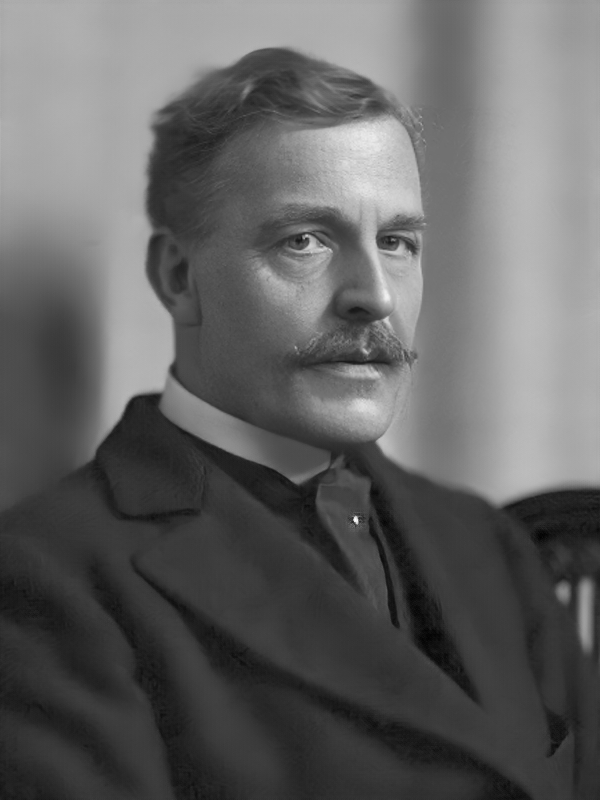
Why Sir James Guthrie matters
Sir James Guthrie was one of the leading figures of the Glasgow Boys, the group of painters who brought a plein-air, French-influenced realism into Scottish art in the 1880s, and he went on to become one of the leading Scottish portrait painters of the early twentieth century as President of the Royal Scottish Academy. For a collector, he represents a historically important but thinly traded market: a painter whose reputation is anchored in national museum collections rather than in a large or liquid auction record.
- Born
- 1859-06-10, Greenock, Scotland
- Nationality
- Scottish
- Media
- Painting
- Movement
- Glasgow Boys, Scottish Realism
- Education
- Glasgow High School; matriculated at Glasgow University to study law, left in 1877 without a degree to pursue painting; largely self-taught as an artist, with brief informal guidance from James Drummond and John Pettie. Honorary LL.D., University of Glasgow, 1906, and later honorary LL.D. degrees from the University of Edinburgh and the University of St Andrews, exact years undocumented.
- Signature motifs
- Rural realist genre scenes, Society portraiture
By the numbers
- 1902 to 1919President, Royal Scottish Academy
- 1903Knighted
- Glasgow BoysMovement
Selected works
Click any work to view it full screen.
Biography
James Guthrie was born on 10 June 1859 in Greenock, Scotland. He was educated at Glasgow High School and matriculated at Glasgow University to study law, but left in 1877, without a degree, to pursue painting. He had no formal art school training; his early development came instead from brief, informal guidance from the painter James Drummond in Glasgow and from John Pettie in London, and he is generally described as largely self-taught.
In the 1880s Guthrie became a central figure among the Glasgow Boys, a loose group of painters who rejected academic convention in favor of rural realism drawn from French plein-air painting. His rural genre scenes from this period, including A Hind's Daughter and To Pastures New, remain among his best known works and are held in Scottish public collections. From the later 1880s he shifted increasingly toward portraiture, building a career as a sought-after society portrait painter. He was elected an Associate of the Royal Scottish Academy in 1888 and a full member in 1892, then elected President of the Royal Scottish Academy in November 1902, a position he held until 1919. He was knighted in 1903. A high point of his later career was the commission of Statesmen of World War I for the National Portrait Gallery, London; seventeen preparatory oil studies for the work were donated to the Scottish National Portrait Gallery. In 1920 he was made a Commander of the Order of the Crown by the King of Belgium. He received honorary Doctor of Laws degrees from the University of Glasgow (1906) and, at unspecified later dates, from the University of Edinburgh and the University of St Andrews.
Guthrie died on 6 September 1930, at the age of 71, at his retirement home at Rowmore, Rhu, in Dunbartonshire, Scotland.
Critical reception
Guthrie was recognized in his own time as a leader of Scottish art, first for the rural realism of the Glasgow Boys and later for a portrait practice admired for its psychological insight. J. L. Caw, writing the standard 1932 monograph on the artist, praised Guthrie's ability to convey a sitter's character and personality through portraiture. Institutional assessments since have consistently framed him as a pivotal transitional figure, moving Scottish painting from rural realism toward a more Whistlerian, psychologically attentive portraiture, a trajectory that underpinned his presidency of the Royal Scottish Academy and his selection for major state commissions.
Market
Guthrie's market is small and infrequent relative to painters of comparable historical standing, reflecting both a modest surviving output at auction and the concentration of his major works in museum collections. Independent verification could not confirm a single, well documented all-time auction record with a specific work, price, and sale date; auction databases including MutualArt, Artprice, and Invaluable track his sales, and his work continues to appear periodically at British auction houses such as Bonhams, Christie's, Dreweatts, and Lyon and Turnbull. Any claim of a specific record price for Guthrie should be treated as unverified pending confirmation from a primary auction house source.
Selected exhibitions
| Years | Exhibition | Venues |
|---|---|---|
| c. 1880 to 1890s | Glasgow Boys group exhibitions | Glasgow Institute of the Fine Arts and related Scottish venues |
| 1880 to 1919 | Royal Scottish Academy annual exhibitions | Royal Scottish Academy, Edinburgh |
| ongoing during his career | Glasgow Art Club annual exhibitions | Glasgow Art Club, Glasgow |
| 1921 | Society of Graphic Art exhibition | London |
| 1930 to 1931 | Sir James Guthrie Memorial Exhibition | Kelvingrove Art Gallery and Museum, Glasgow |
| 2022 | The Glasgow Boys | The Fine Art Society, London |
| 2023 | Master Drawings New York | Robert Simon Fine Art, New York |
Museum collections
- National Galleries of Scotland, Edinburgh (Scottish National Gallery and Scottish National Portrait Gallery)
- National Portrait Gallery, London
- Aberdeen Art Gallery
- Kelvingrove Art Gallery and Museum, Glasgow
- McLean Museum and Art Gallery, Greenock
Awards and honors
- Associate, Royal Scottish Academy (ARSA) (1888)
- Full Member, Royal Scottish Academy (RSA) (1892)
- Elected President, Royal Scottish Academy (served 1902 to 1919) (1902)
- Knighted (1903)
- Honorary Doctor of Laws (LL.D.), University of Glasgow (1906)
- Commander, Order of the Crown (Belgium) (1920)
Authentication and provenance
No catalogue raisonne.
No catalogue raisonne has been published for Guthrie. The standard scholarly reference is J. L. Caw's 1932 monograph, Sir James Guthrie (Macmillan, London). Works entering the market are typically vetted through auction house specialists, provenance research, and comparison against documented exhibition history.
Primary reference: https://www.nationalgalleries.org/art-and-artists/artists/sir-james-guthrie
What collectors should know
There is no catalogue raisonne for Guthrie, and no gallery or estate currently holds exclusive representation of his work; paintings reach the market chiefly through UK auction houses and occasional secondary-market gallery exhibitions rather than through a primary dealer. That absence of a centralized authentication body places extra weight on provenance, exhibition history, and specialist auction-house vetting when evaluating a work. Because his auction appearances are relatively infrequent and no single verified record price could be confirmed, collectors should read his broader, museum-anchored reputation as the more reliable signal, rather than treating any individual sale figure as a firm benchmark.
Further reading and resources
Data current as of 2026-07-10.

