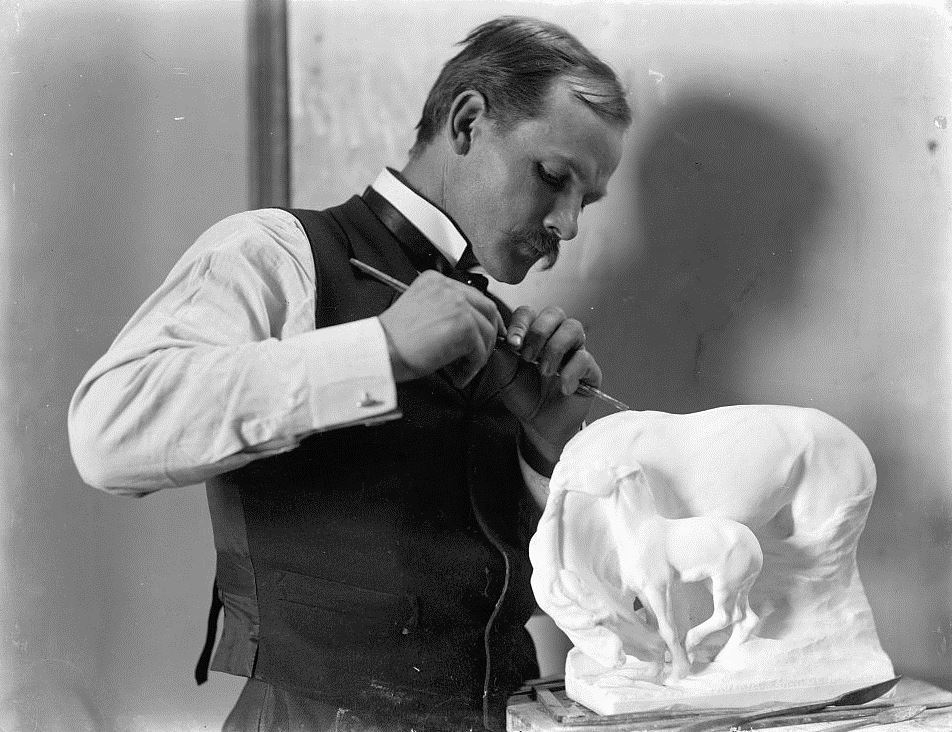
Why Solon Borglum matters
Solon Borglum was one of the leading American sculptors of the frontier generation, a contemporary of Frederic Remington and the younger brother of sculptor Gutzon Borglum. He earned the nickname "sculptor of the prairie" from fellow students in Paris. His bronzes of cowboys, horses, and Native American subjects helped define how Western American life was represented in fine art at the turn of the twentieth century, and his work now sits in major museum and public collections rather than in active gallery trade. For a collector, he is a study in a historical market defined by institutional stewardship rather than by a living estate or dealer network.
- Born
- 1868-12-22, Ogden, Utah, USA
- Nationality
- American
- Media
- Sculpture, Painting
- Movement
- Western American sculpture, Beaux-Arts sculpture tradition
- Education
- J. Laurie Wallace, Omaha, 1893; Cincinnati Art Academy, mid-1890s; Académie Julian, Paris, late 1890s (some sources cite study with Emmanuel Fremiet).
- Signature motifs
- Horses and cowboys, Native American figures, Frontier and ranch-life bronzes
By the numbers
- USD 57,475Highest documented auction pricePushing Ahead, Washington, 1753; Coeur d'Alene Art Auction; exact sale date not published
- Salon award, 1898Paris SalonFor Lassoing Wild Horse
- 1913Armory ShowExhibited seven sculptures, New York
- School of American Sculpture, 1920School foundedNew York City; taught there until his death
- None documentedCurrent gallery representationWork held mainly in museums and public monuments
Selected works
Click any work to view it full screen.
Biography
Solon Hannibal Borglum was born on December 22, 1868, in Ogden, Utah, the younger brother of sculptor Gutzon Borglum, who later carved Mount Rushmore. The family settled in Nebraska, where Solon worked on a ranch and took occasional painting lessons in Omaha. In 1893 he studied briefly with J. Laurie Wallace in Omaha.
He entered the Cincinnati Art Academy in the mid-1890s and shifted his focus from painting to sculpture. He went on to study at the Académie Julian in Paris in the late 1890s; some sources say he received guidance there from the French sculptor Emmanuel Fremiet. In 1898 his sculpture Lassoing Wild Horse received an award at the Paris Salon, and French students at the Académie gave him the title "sculptor of the prairie."
Borglum returned to the United States and set up a studio in New York City, where he held his first major solo show, thirty-two small bronzes, at the Keppel Gallery in 1903. He went on to win a silver medal at the 1901 Pan-American Exposition in Buffalo and a gold medal at the 1904 Louisiana Purchase Exposition in St. Louis. Major public commissions followed, including the equestrian statue of General John B. Gordon in Atlanta (completed 1907) and the Rough Rider memorial to Bucky O'Neil in Prescott, Arizona, a work Borglum considered among his best. He exhibited seven sculptures at the landmark 1913 Armory Show in New York and showed The Pioneer at the 1915 Panama-Pacific International Exposition in San Francisco.
During the First World War, Borglum served with the Foyers du Soldat soldiers' relief service and was awarded France's Croix de Guerre. In 1920 he founded the School of American Sculpture in New York City, one of the first schools devoted solely to American sculpture, and taught there until his death. He died on January 31, 1922, at Stamford Hospital in Stamford, Connecticut, following complications from an appendectomy, as reported at the time by The New York Times. (A small number of later museum sources give January 30 as the date; the contemporary Times obituary and most institutional biographies support January 31.)
Critical reception
Borglum's contemporaries placed him among the most original American sculptors of his generation, with the critic Charles H. Caffin ranking him near the top of the field for originality among sculptors then working in the United States. His reputation rested on bringing an unsentimental, closely observed vision of Western ranch life, horses, and Native American subjects into a sculptural language shaped by his Cincinnati and Paris training. The Paris Salon's early recognition of Lassoing Wild Horse in 1898, followed by medals at the 1900 Exposition Universelle, the 1901 Pan-American Exposition, and the 1904 Louisiana Purchase Exposition, established him quickly as a peer to the leading Beaux-Arts-trained sculptors of the period. His inclusion among just a handful of sculptors at the 1913 Armory Show placed his work at a pivotal moment in American art history, even as his own style remained rooted in representational, frontier subject matter rather than in the modernism the show is best remembered for introducing.
Market
Borglum's market is thin and almost entirely historical. The highest verifiable auction price identified in accessible sources is USD 57,475 for the bronze Pushing Ahead, Washington, 1753, sold through Coeur d'Alene Art Auction; the exact sale date is not published in the auction house's public results and could not be confirmed. Bucking Broncho, also sold at Coeur d'Alene Art Auction, achieved USD 36,300 under the same limitation. A dated result exists for a bronze sculpture sold at Heritage Auctions on May 12, 2023, for USD 18,750, with the lot title not published. No comprehensive, cross-house auction database was available for verification, so none of these figures should be treated as a confirmed all-time record; they are simply the highest results identified in the sources reviewed. There is no evidence of any gallery or estate currently representing him in the contemporary market. His sculpture circulates primarily through museum collections, public monuments, and estate or institutional archives rather than through active dealer inventory, which is typical for a sculptor of his period and standing.
Top auction results
| Work | Price | Sale |
|---|---|---|
| Pushing Ahead, Washington, 1753 | USD 57,475 (USD 57,475) | Coeur d'Alene Art Auction, Not published |
Selected exhibitions
| Years | Exhibition | Venues |
|---|---|---|
| 1893 | World's Columbian Exposition | Chicago |
| 1898 | Paris Salon | Paris (Salon award for Lassoing Wild Horse) |
| 1900 | Exposition Universelle | Paris (silver medal) |
| 1901 | Pan-American Exposition | Buffalo, New York (silver medal) |
| 1903 | Solo exhibition of small sculptures | Keppel Gallery, New York |
| 1904 | Louisiana Purchase Exposition | St. Louis (gold medal) |
| 1913 | Armory Show | New York (seven sculptures exhibited) |
| 1915 | Panama-Pacific International Exposition | San Francisco (The Pioneer) |
Museum collections
- New Britain Museum of American Art
- Detroit Institute of Arts
Awards and honors
- Salon award, Paris, for Lassoing Wild Horse (1898)
- Silver Medal, Exposition Universelle, Paris (1900)
- Silver Medal, Pan-American Exposition, Buffalo (1901)
- Gold Medal, Louisiana Purchase Exposition, St. Louis (1904)
- Croix de Guerre, France, for WWI-era service with Foyers du Soldat (exact year not confirmed)
Authentication and provenance
No catalogue raisonne.
No published catalogue raisonne has been located. The New Britain Museum of American Art holds the largest repository of the artist's work, following a 1973 gift from his descendants of bronzes, marbles, plasters, and drawings. The Smithsonian's Archives of American Art and the Library of Congress hold Borglum and Borglum-family papers used for provenance research.
Primary reference: https://americanart.si.edu/artist/solon-h-borglum-509
What collectors should know
Because Borglum's market runs almost entirely through museum stewardship and public commissions rather than an active gallery or estate program, provenance research depends heavily on institutional records, particularly the New Britain Museum of American Art, which holds the largest concentration of his work following a 1973 family gift, and the Smithsonian's Archives of American Art, which holds Borglum family papers. There is no catalogue raisonne, so attribution and dating should be checked against these archival holdings and against signed and dated bronzes in known museum collections. Collectors should also be aware that his work is sometimes catalogued or discussed alongside that of his more famous brother, Gutzon Borglum, and should confirm which Borglum is being referenced, since the market and body of work for each are distinct. Given the small number of publicly documented auction results, and the lack of confirmed sale dates for the two highest known prices, any single sale price should be treated as an indicative data point rather than a stable benchmark.
Further reading and resources
- Solon H. Borglum, artist pageSmithsonian American Art Museum
- Solon BorglumWikipedia
- Solon H. Borglum and Borglum family papersArchives of American Art, Smithsonian Institution
- Solon Hannibal Borglum, National AcademicianNational Academy of Design
- Solon H. Borglum, Sculptor of the PrairieNew Britain Museum of American Art
Data current as of 2026-07-16.

