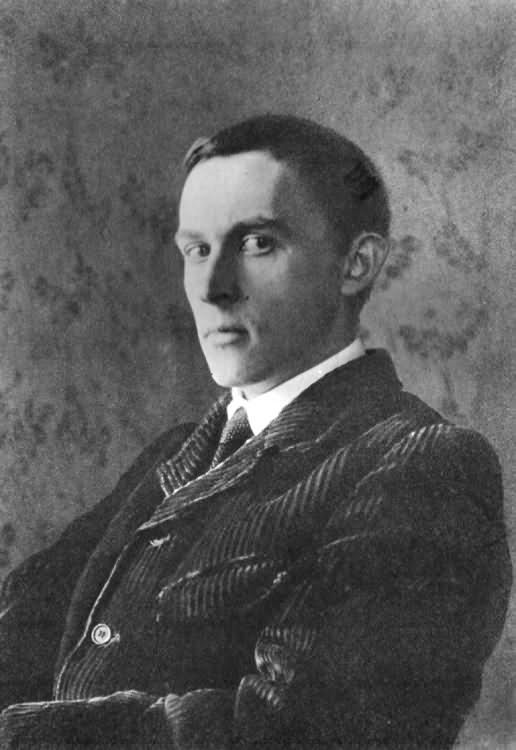
Why Stanisław Ignacy Witkiewicz (Witkacy) matters
Stanislaw Ignacy Witkiewicz, known as Witkacy, was one of the key figures of the Modernist avant-garde in Poland, working simultaneously as a painter, photographer, novelist, playwright, and philosopher. For a collector, he represents a rare combination: documented museum presence, including a self-portrait photograph in the National Gallery of Art, alongside an auction record concentrated in the Polish market and only partially disclosed by subscription price databases. His name is also shared with his father, the 19th-century painter and architect Stanislaw Witkiewicz (1851 to 1915), which makes careful attribution essential when researching either artist's market.
- Born
- 1885-02-24, Warsaw, Congress Poland (Russian Empire)
- Nationality
- Polish
- Media
- Painting, Photography, Drawing
- Movement
- Expressionism, Polish avant-garde
- Education
- Privately educated at home in Zakopane; matriculation exam c. 1901 to 1903 (sources vary, one gives Lviv, 1903); studied painting at the Krakow Academy of Fine Arts under Jozef Mehoffer and Jan Stanislawski, without completing a degree.
- Signature motifs
- Expressionist portraiture, Photographic self-portraiture
By the numbers
- PLN 960,000Auction high (documented)Portret kobiety w kapeluszu, DESA Unicum, Warsaw, 28 November 2024; approximately EUR 210,000 to 220,000, exact conversion not confirmed
- Golden Laurel, 1935HonorsPolish Academy of Literature
- National Gallery of Art, Washington, D.C.Museum collectionSelf-Portrait (Collapse by the Lamp), c. 1913, gelatin silver print
- 706 (Artprice)Auction lots trackedListed under Artprice as Witkiewicz-Witkacy
Selected works
Click any work to view it full screen.
Biography
Stanislaw Ignacy Witkiewicz was born on 24 February 1885 in Warsaw, then part of the Russian Empire. He was the son of Stanislaw Witkiewicz (1851 to 1915), the painter, critic, and architect credited with creating the Zakopane style, who opposed formal schooling for his son and arranged for him to be educated privately at home in the family's base of Zakopane. Sources give differing dates for his matriculation exam, with one account placing it in 1901 and another specifying Lviv in 1903. He went on to study painting for a limited period at the Krakow Academy of Fine Arts under Jozef Mehoffer and Jan Stanislawski, though available sources describe his attendance as brief and interrupted, with no record of a completed degree. He subsequently traveled and worked in Germany, France, and Italy.
Witkiewicz served as an officer in the Russian Army and was seriously wounded, an experience that, along with his presence in Russia during the 1917 revolution, shaped the catastrophist outlook that runs through his painting, photography, and writing. He developed a body of expressionistic portrait paintings and produced an extensive series of photographic self-portraits, work that museums and critics now treat as central to his practice alongside his novels, plays, and his theory of Pure Form in theater. He received the Golden Laurel of the Polish Academy of Literature in 1935.
He died by suicide on 18 September 1939 in the village of Jeziory in the Polesie region, then in eastern Poland and now in Ukraine, after learning of the Soviet invasion of Poland at the start of the Second World War. This account of his death is corroborated by Encyclopaedia Britannica, EBSCO Research Starters, and multiple Polish cultural institutions.
Critical reception
Major reference sources, including Encyclopaedia Britannica and Artforum's exhibition listings, describe Witkiewicz as one of the central figures of the Modernist avant-garde in Poland, citing his expressionistic paintings and his extensive photographic self-portraiture as part of a body of work that survives in museum collections in Poland and abroad. Much of his broader recognition, particularly outside Poland, developed after his death; institutions such as the Douglas Hyde Gallery in Dublin and, more recently, a major monographic exhibition in China have presented his photographic and painted work to new audiences. Coverage consistently distinguishes him from his father, whose own painting and architectural work is documented separately, since auction platforms and price databases sometimes list both artists under closely overlapping versions of the name Stanislaw Witkiewicz.
Market
The highest publicly confirmed price for a work by Witkiewicz is PLN 960,000 (roughly EUR 210,000 to 220,000, exact conversion not confirmed), paid for the portrait Portret kobiety w kapeluszu (Portrait of a Woman in a Hat) at DESA Unicum in Warsaw on 28 November 2024. Two further Polish sales are reported at similar levels, PLN 840,000 at DESA Unicum in 2023 and PLN 720,000 at Polswiss Art in 2020, both for portrait works consistent with his Firma Portretowa portrait practice. Artprice separately tracks a substantial body of auction activity for the artist, listed under the name Witkiewicz-Witkacy, with 706 lots recorded to date; the detailed price ranking behind that count is not visible without a paid subscription, so a higher, unconfirmed result cannot be ruled out. No single gallery or estate currently appears in available sources as his exclusive commercial representative; secondary-market activity runs mainly through Polish auction houses such as DESA Unicum and Polswiss Art, alongside occasional gallery exhibitions abroad.
Top auction results
| Work | Price | Sale |
|---|---|---|
| Portret kobiety w kapeluszu (Portrait of a Woman in a Hat) | PLN 960,000 | DESA Unicum, Warsaw, Poland, 2024-11-28 |
Selected exhibitions
| Years | Exhibition | Venues |
|---|---|---|
| n.d. | Stanislaw Ignacy Witkiewicz (1885 to 1939): Drawings from the 1930s | Ubu Gallery, New York |
| n.d. | Stanislaw Ignacy Witkiewicz (Gallery 1) | Douglas Hyde Gallery, Trinity College Dublin |
| early 2020s (exact dates and venue not confirmed) | Major monographic exhibition | Institution in China, name not confirmed in dossier |
Museum collections
- National Gallery of Art, Washington, D.C.
Awards and honors
- Golden Laurel, Polish Academy of Literature (1935)
Authentication and provenance
No catalogue raisonne.
No published catalogue raisonne is confirmed in available sources. No estate authentication board or certificate program is documented. The market generally relies on museum holdings, such as the National Gallery of Art, and records from established auction houses, including Lempertz, for verification.
Primary reference: https://en.wikipedia.org/wiki/Stanis%C5%82aw_Ignacy_Witkiewicz
What collectors should know
There is no published catalogue raisonne and no confirmed estate authentication program for Witkiewicz, so attribution and dating should be checked against museum holdings and established auction-house records rather than taken from a single listing. Because his name is shared with his father, a distinct 19th-century painter and architect who is also active in the auction market, any provenance or price research should confirm which artist a given lot actually belongs to using dates, subject matter, and signature. His best-documented auction result, PLN 960,000 for Portret kobiety w kapeluszu at DESA Unicum in 2024, should be treated as the strongest confirmed figure from open sources rather than a verified all-time record, since subscription price databases restrict fuller sales history.
Further reading and resources
Data current as of 2026-07-11.

