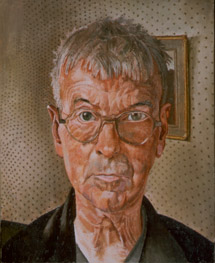
Why Stanley Spencer matters
Stanley Spencer, who lived from 1891 to 1959, is one of the most distinctive visionary painters in modern British art, known for placing biblical and resurrection themes inside the ordinary streets, gardens, and riverbanks of his native village of Cookham. For a collector, he represents a rare combination: an artist fully absorbed into the canon of twentieth century British painting, with holdings at Tate, the Museum of Modern Art, and the National Gallery of Canada, whose market nonetheless remains small, UK-centered, and driven by the rare appearance of major set-piece paintings rather than steady turnover.
- Born
- 1891-06-30, Cookham, Berkshire, England
- Nationality
- British
- Media
- Painting, Drawing
- Movement
- Modern British art, Figurative painting
- Education
- Maidenhead Technical Institute, 1907 (no exams sat); Slade School of Fine Art, University College London, 1908 to 1912, under Henry Tonks (no degree documented); honorary Doctor of Letters, University of Southampton, 1958
- Signature motifs
- Cookham village life, Christian themes in everyday settings, Resurrection imagery
- Representation
- "Stanley Spencer Gallery, Cookham (estate-adjacent custodian; no confirmed commercial gallery representation)"
By the numbers
- GBP 5.4MAuction highSunflower and Dog Worship, Christie's London, 2011-06-28; a higher aggregate figure near USD 9.72M is cited by some market trackers but unconfirmed at the work level
- 1959KnightedKnight Bachelor
- 1950Royal AcademicianElected RA; also awarded CBE the same year
- Estate; Stanley Spencer Gallery, CookhamRepresented byNo confirmed current commercial gallery representation
Biography
Stanley Spencer was born on 30 June 1891 in Cookham, Berkshire, and spent much of his life in the village that became the setting for nearly all of his major paintings. He was educated at home by his sisters Annie and Florence, took informal drawing lessons locally, and in 1907, through the patronage of Lady Boston, was sent to the Maidenhead Technical Institute, where his father insisted he sit no exams. In 1908 he entered the Slade School of Fine Art in London, studying under Henry Tonks alongside contemporaries including Mark Gertler, Paul Nash, and Ben Nicholson, and won student prizes there before leaving in 1912.
He served during the First World War, an experience that later shaped the murals he painted for the Sandham Memorial Chapel in Burghclere. His first one man exhibition opened at the Goupil Gallery in London in February 1927, centered on The Resurrection, Cookham, which The Times praised in an unsigned review as one of the most important paintings by any English artist of the century. He exhibited at the Venice Biennale in 1932 and 1938, and was given retrospectives at Temple Newsam House, Leeds, in 1947 and at the Tate Gallery in 1955. In 1950 he was elected a Royal Academician and appointed CBE. In 1958 the University of Southampton awarded him an honorary Doctor of Letters, and he was knighted in 1959. He died of cancer on 14 December 1959 at the Canadian Red Cross Memorial Hospital on the Cliveden estate near Taplow, Buckinghamshire, and his ashes are buried in Cookham churchyard.
Critical reception
Contemporary critics recognized Spencer as an original from the start: an unsigned Times review of his 1927 Goupil Gallery show, centered on The Resurrection, Cookham, praised its fusion of Pre-Raphaelite detail with a modern, near-Cubist freedom of form. Later institutional reassessments, including the Smithsonian Institution's touring retrospective Stanley Spencer: An English Vision (1997 to 1998), reaffirmed his standing; the Hirshhorn Museum's then director James Demetrion wrote in Smithsonian Magazine that Spencer's figure paintings ranked among the most powerful of the century. Subsequent retrospectives at the Royal Academy (1980), Tate Britain (2001), the Courtauld Gallery and Pallant House Gallery (both 2013), and recurring exhibitions at the Stanley Spencer Gallery in Cookham have kept his reputation as a singular chronicler of English village life and Christian imagery largely undisputed, even as scholars continue to debate how to read the erotic and psychologically strained later work alongside the devotional early paintings.
Market
Spencer's market is small, UK-weighted, and defined by a short list of major exhibition-scale paintings rather than frequent turnover. The best-documented result is Sunflower and Dog Worship, which sold for GBP 5,400,000 at Christie's London on 28 June 2011, in the same sale that saw Workmen in the House sell for GBP 4,700,000. Some market trackers, including MutualArt, cite an overall auction record for the artist near USD 9.72 million, but the underlying work, sale house, and exact date behind that figure could not be confirmed from available sources, so it is noted here only as a caveat rather than a verified record. Because top prices depend on the rare appearance of a major set piece, and because there is no confirmed catalogue raisonne, provenance research and institutional loan history carry more weight than they would for artists with denser trading records.
Top auction results
| Work | Price | Sale |
|---|---|---|
| Sunflower and Dog Worship | GBP 5,400,000 | Christie's, London, 2011-06-28 |
Selected exhibitions
| Years | Exhibition | Venues |
|---|---|---|
| 1927 | First one man exhibition, centered on The Resurrection, Cookham | Goupil Gallery, London |
| 1932 | Venice Biennale | Venice Biennale, Italy |
| 1938 | Venice Biennale | Venice Biennale, Italy |
| 1947 | Retrospective | Temple Newsam House, Leeds |
| 1955 | Retrospective | Tate Gallery, London |
| 1980 | Retrospective | Royal Academy of Arts, London |
| 1997 to 1998 | Stanley Spencer: An English Vision | Hirshhorn Museum and Sculpture Garden, Washington, D.C. (Smithsonian Institution tour) |
| 2025 to 2026 | Love and Landscape: Stanley Spencer in Suffolk | Gainsborough's House, Suffolk |
Museum collections
- Tate, London
- Museum of Modern Art, New York
- Metropolitan Museum of Art, New York
- National Gallery of Canada, Ottawa
- Stedelijk Museum, Amsterdam
- Stanley Spencer Gallery, Cookham
Awards and honors
- Prize at the Slade School of Fine Art (exact award title not confirmed by sources) (1912)
- CBE (1950)
- Royal Academician, Royal Academy of Arts (1950)
- Honorary Doctor of Letters, University of Southampton (1958)
- Knight Bachelor (1959)
Authentication and provenance
No catalogue raisonne.
No published catalogue raisonne has been confirmed. Scholarship and exhibition history are anchored by the Stanley Spencer Gallery in Cookham, which holds the largest public collection of his paintings and drawings, and by loan records at Tate and other public collections.
Primary reference: https://stanleyspencer.org.uk/stanley-spencer-the-artist/
What collectors should know
Spencer's market offers museum-grade standing with limited liquidity: strong institutional holdings at Tate, the Museum of Modern Art, the Metropolitan Museum of Art, and the Stanley Spencer Gallery underline his historical importance, but the number of paintings that reach auction in any given year is small, and there is no confirmed catalogue raisonne to anchor authentication. There is also no identified commercial gallery currently representing his estate; the Stanley Spencer Gallery in Cookham functions as the principal public custodian of his work and the most useful reference point for exhibition history and scholarship. Collectors should treat any single auction result, including the 2011 high for Sunflower and Dog Worship, as reflecting the rarity of major exhibition pieces coming to market rather than a stable, frequently priced market.
Further reading and resources
Data current as of 2026-07-09.

