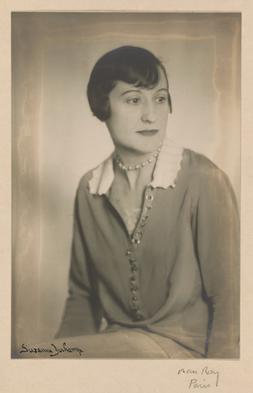
Why Suzanne Duchamp matters
Suzanne Duchamp was a French Dada painter, collagist, and draughtswoman who worked at the center of Paris Dada and belonged to one of the most consequential artist families of the twentieth century, sister to Marcel Duchamp, Raymond Duchamp-Villon, and Jacques Villon. For most of the century after her death she was treated as a secondary figure next to her brothers. That has begun to change: 2025 brought the first comprehensive museum retrospective devoted to her work alone, at Kunsthaus Zurich, traveling to Schirn Kunsthalle Frankfurt. For a collector, she is a live case study in how a historically overlooked woman artist can be revalued by major museums well before, or even without, a corresponding move in the auction market.
- Born
- 1889-10-20, Blainville-Crevon, France
- Nationality
- French
- Media
- Painting, Collage, Drawing
- Movement
- Dada, Tabu
- Education
- École des Beaux-Arts, Rouen, from 1905 (no degree documented)
- Signature motifs
- Collage and mixed-media assemblage, Wordplay in titles, Oscillation between abstraction and figuration
- Representation
- "No current gallery representation confirmed in available sources"
By the numbers
- No confirmed record priceAuction marketArtprice records 254 lots; documented individual sales run to the low thousands of dollars (Artnet)
- Kunsthaus Zurich, 2025First retrospectiveFirst comprehensive museum retrospective devoted to the artist
- MoMA, Centre Pompidou, Yale University Art GalleryMuseum collections
- No current galleryRepresented byNo gallery or estate representative confirmed in available sources
Biography
Suzanne Duchamp, born Suzanne Marie Germaine Duchamp on 20 October 1889 in Blainville-Crevon, Normandy, was the fourth child of the notary Eugene Duchamp and Lucie Duchamp, and granddaughter of the engraver Emile Frederic Nicolle. She began studying painting at the Ecole des Beaux-Arts in Rouen in 1905, at age sixteen, and held her first major public exhibition at the Salon des Independants in Paris around 1911. Through her brothers she moved early into Paris's avant-garde circles, and her work is credited by scholars as significant to the development of Paris Dada and modernism.
In 1919 she married the Swiss artist Jean Crotti, and the same year produced Multiplication brisee et retablie, a characteristic early Dada work. With Crotti she went on to co-found Tabu, a shared avant-garde movement, and she appeared in Dada publications alongside Francis Picabia, Man Ray, and her brother Marcel. Around 1922 she made an unexpected break with strict Dada methods and turned toward a more figurative, often ironic style, a direction she continued to develop for the rest of her career. She remained active as an artist until the end of her life.
Jean Crotti died in Paris on 30 January 1958. Suzanne Duchamp died on 11 September 1963 at her apartment in Neuilly-sur-Seine, France, at age seventy-three. She is buried in the Duchamp family tomb in the Cimetiere Monumental de Rouen. In 1967 Marcel Duchamp organized a family exhibition, Les Duchamp, that included her work alongside that of her brothers and was later shown at what is now the Centre Pompidou's Musee National d'Art Moderne in Paris.
Critical reception
Duchamp's contemporaries recognized her early. Francis Picabia, writing within the Paris Dada circle, praised her as doing more intelligent things than merely painting, a characterization reproduced in Artnet News coverage of her Kunsthaus Zurich retrospective. Kunsthaus Zurich's own retrospective materials describe a body of work that moves between geometric abstraction, Dada collage, and figuration and resists easy categorization. Current museum scholarship, echoed by Kunsthaus Zurich and Schirn Kunsthalle Frankfurt, frames her as a Paris Dada figure whose fifty-year practice, including her wordplay-driven titles and her use of found and machine-made materials, was long underweighted relative to her brothers' and is now being reassessed on its own terms.
Watch
Market
Suzanne Duchamp's auction market is thin and, on current public evidence, does not have a clearly documented all-time record. Artprice records 254 public auction appearances for her, almost entirely paintings, but does not disclose her top price outside a paid subscription. The individual prices that are documented in the open press are modest: Artnet News reported that a circa-1930 gouache sold for about EUR 1,500 at a small Berlin auction house, and that a 1940 painting sold for USD 1,000 at an Illinois-area auction house in 2004. No source available to this profile names a specific work, price, house, and date that can be confirmed as her all-time auction high, so that figure is left unstated here rather than estimated.
Selected exhibitions
| Years | Exhibition | Venues |
|---|---|---|
| 1911 | Salon des Indepenants | Paris (first major public exhibition, age 21) |
| 1967 | Les Duchamp: Jacques Villon, Raymond Duchamp-Villon, Marcel Duchamp, Suzanne Duchamp | Musee National d'Art Moderne, Paris (family exhibition organized by Marcel Duchamp) |
| 2025 | Suzanne Duchamp | Kunsthaus Zurich (first comprehensive retrospective) |
| 2025 to 2026 | Suzanne Duchamp: Retrospective | Schirn Kunsthalle Frankfurt, 10 October 2025 to 11 January 2026 |
Museum collections
- Museum of Modern Art, New York
- Yale University Art Gallery, New Haven
- Centre Pompidou, Musee National d'Art Moderne, Paris
- Musee des Beaux-Arts de Rouen
- Art Institute of Chicago
- Kunsthaus Zurich
Authentication and provenance
No catalogue raisonne.
No catalogue raisonne of Suzanne Duchamp's work has been published and no certificate-of-authenticity program has been identified. No current gallery or estate representative could be confirmed in available sources.
Primary reference: https://en.wikipedia.org/wiki/Suzanne_Duchamp
What collectors should know
There is no published catalogue raisonne for Suzanne Duchamp, no certificate-of-authenticity program, and no confirmed current gallery or estate representative; museum lenders such as MoMA, the Centre Pompidou, the Art Institute of Chicago, and Yale University Art Gallery are the strongest available signal of institutional standing. Her name also appears in some auction catalogues as Suzanne Duchamp-Crotti, or inverted as Duchamp-Crotti, Suzanne; these all refer to the same artist and should be treated as equivalent when searching sale or provenance records. Because her auction history is limited in volume and, on public evidence, modest in price, and because a first-ever museum retrospective only opened in 2025, collectors should treat any individual sale result with caution and weigh museum attention and provenance heavily rather than relying on a thin price history.
Further reading and resources
Data current as of 2026-07-10.

