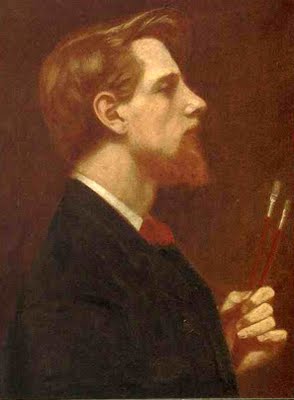
Why Thomas Cooper Gotch matters
Thomas Cooper Gotch is a central figure of the Newlyn School, the Cornish artists' colony that shaped British painting at the turn of the twentieth century, and he is one of the clearest examples within that circle of a painter who moved from plein-air realism toward a distinctive, symbolic style built around allegorical images of children and women. His work sits in national and international museum collections, from Tate to the Art Gallery of New South Wales, giving him a durable institutional footprint even though his auction market is thin and infrequent.
- Born
- 1854-12-10, Kettering, Northamptonshire, England
- Nationality
- British
- Media
- Painting, Printmaking, Watercolour
- Movement
- Newlyn School, Pre-Raphaelite-associated
- Education
- Kettering Grammar School (general schooling); Heatherley's Art School, London, 1876 to 1877; Royal Academy of Fine Arts, Antwerp, 1877 to 1878; Slade School of Fine Art, London, 1878 to 1880 (under Alphonse Legros); the atelier of Jean-Paul Laurens, Paris, circa 1880 to 1883
- Signature motifs
- Allegorical child imagery, Symbolic female figures, Newlyn coastal genre scenes
- Representation
- Lander Gallery
By the numbers
- No confirmed recordAuction marketSotheby's London estimated The Message at GBP 82,500 to 115,000 in 2000; a realized price could not be verified
- 1880 to 1931Royal Academy exhibitorannual exhibitor until his death
- Royal British Colonial Society of ArtistsPresident1913 to 1928
- Newlyn SchoolAssociated movementCornwall artists' colony
Selected works
Click any work to view it full screen.
Biography
Thomas Cooper Gotch was born on 10 December 1854 at the Mission House in Kettering, Northamptonshire, England, the son of a shoemaker, Thomas Henry Gotch, and Mary Ann Gale Gotch. He left Kettering Grammar School in 1872 to work in his father's business before turning to art. His formal training ran through several schools over roughly seven years: Heatherley's Art School in London (1876 to 1877), the Royal Academy of Fine Arts in Antwerp (1877 to 1878), and the Slade School of Fine Art in London (1878 to 1880), where he studied under Alphonse Legros. He married the painter Caroline Yates in 1881, and the couple studied together in Paris in the atelier of Jean-Paul Laurens, circa 1880 to 1883.
Gotch settled in Newlyn, Cornwall, and became one of the defining figures of the Newlyn School, exhibiting at the Royal Academy in London almost every year from 1880 until his death. His style shifted over the 1890s from Newlyn's characteristic outdoor realism toward a more decorative, symbolic manner built on allegorical figures of children and women, a change that brought him wider recognition, including medals at the Paris Salon (1895 and 1896) and at the Berlin International Exhibition (1896), as well as an honourable mention at the 1900 Exposition Universelle in Paris. He was elected to the Royal Society of British Artists in 1885, was elected to the Royal Institute of Painters in Water Colours in 1912, and served as President of the Royal British Colonial Society of Artists from 1913 to 1928.
Gotch died on 1 May 1931 of a heart attack while in London for an exhibition, and was buried in Sancreed churchyard in Cornwall. Some reference sources list his place of death simply as Cornwall rather than London, a minor discrepancy in the record that does not affect the agreed date of death.
Critical reception
Gotch's reputation rests on his transition from the naturalistic outdoor painting associated with the early Newlyn School to a more symbolic, decorative manner centered on children and idealized female figures, a shift that museums and later critics have described as drawing on Pre-Raphaelite and early Italian Renaissance sources. His painting Alleluia was purchased for the nation under the Chantrey Bequest and entered what is now Tate, a marker of the esteem this later style earned in his lifetime. Contemporary regional press response to individual works was not always favorable; some Cornish newspaper critics found his allegorical child imagery, such as The Child Enthroned, uneasy or overworked, even as national institutions and international juries in Paris and Berlin rewarded the same body of work with medals. Later exhibitions in Cornwall, including a 2001 retrospective at the Royal Cornwall Museum, have reaffirmed his standing as a key figure of the Newlyn School.
Market
Gotch's auction market is small and infrequent relative to his museum standing. Sotheby's London listed The Message, a watercolour, at an estimate of GBP 82,500 to 115,000 in its 2000 sale of British paintings, drawings, and watercolours, but a confirmed realized price and exact sale date could not be verified in available sources. Smaller, better-documented results include a Sworders sale at GBP 3,500 for a lot whose title and date are not otherwise documented. No reliable ranked list of his top auction results is available as of 2026. His work otherwise surfaces periodically at UK regional and specialist sales, and is currently offered by dealers including Lander Gallery in Cornwall, though this is not documented as an official representative of the artist's estate.
Top auction results
| Work | Price | Sale |
|---|---|---|
| The Message (2000) | Sotheby's, London |
Selected exhibitions
| Years | Exhibition | Venues |
|---|---|---|
| 1880 to 1931 | Annual exhibitor | Royal Academy, London |
| 1888 | An Artist of the Newlyn School | Manchester City Art Gallery |
| 1895 | Opening exhibition | Newlyn Art Gallery, Cornwall |
| 1896 | Berlin International Exhibition | Berlin |
| 1900 | Exposition Universelle | Paris |
| 1910 | Retrospective exhibition | Newcastle |
| 2001 | T. C. Gotch: The Last of the Pre-Raphaelites | Royal Cornwall Museum, Truro |
| 2005 | Faces of Cornwall | Penlee House Museum and Gallery, Penzance |
Museum collections
- Tate, London
- Victoria and Albert Museum, London
- Walker Art Gallery, Liverpool
- Penlee House Museum and Gallery, Penzance
- Royal Cornwall Museum, Truro
- Art Gallery of New South Wales, Sydney
Awards and honors
- Elected, Royal Society of British Artists (1885)
- Medal, Berlin International Exhibition (1896)
- Honourable mention, Exposition Universelle, Paris (1900)
- Elected, Royal Institute of Painters in Water Colours (1912)
- President, Royal British Colonial Society of Artists (to 1928) (1913)
Authentication and provenance
No catalogue raisonne.
No published catalogue raisonne has been confirmed and no certificate-of-authenticity program is documented for the artist. Works are generally verified through exhibition history, provenance, and auction-house cataloguing rather than a central archive.
Primary reference: https://artuk.org/discover/artists/gotch-thomas-cooper-18541931
What collectors should know
Gotch's market is defined by scarcity rather than volatility: sales are infrequent, results are thinly documented, and no verified realized price could be confirmed as his all-time auction record, so collectors should treat any individual sale, including the widely cited 2000 Sotheby's estimate, as a data point rather than a trend line. There is no published catalogue raisonne, so provenance, exhibition history, and consistency with documented Royal Academy and Newlyn-period work carry the weight that a central archive would otherwise carry. Dealers currently offering his work are not documented as official representatives of his estate, so buyers should look to museum exhibition records and established auction houses when building a provenance picture.
Further reading and resources
Data current as of 2026-07-16.

