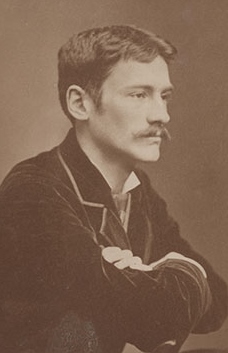
Why Thomas Dewing matters
Thomas Wilmer Dewing was one of the defining American Tonalist painters, known for quiet, atmospheric pictures of solitary women that helped define a genteel, aesthetic strain of American art at the turn of the twentieth century. For a collector, he represents a historical, museum-anchored market: a founding member of the influential Ten American Painters, deeply collected by the Smithsonian and other institutions, but traded today in a thin, quiet secondary market rather than an active contemporary one.
- Born
- 1851-05-04, Boston, Massachusetts, USA
- Nationality
- American
- Media
- Painting, Pastel
- Movement
- Tonalism, American Aestheticism
- Education
- Lowell Institute and the School of the Museum of Fine Arts, Boston; Academie Julian, Paris, under Gustave Boulanger and Jules Lefebvre, beginning 1876; sources vary on the exact year of his return to the United States, 1877 or 1878.
- Signature motifs
- Solitary female figures in tonalist interiors, Muted, atmospheric color harmonies
- Representation
- Hirschl & Adler Galleries (secondary market)
By the numbers
- USD 3.4MAuction high (unconfirmed)Figure cited by Antiques and The Arts Weekly without a named work, auction house, or sale date; not independently verified. A separate database, MutualArt, documents a verified level up to USD 1.81M for a painting, also without full lot detail.
- Academician, 1888National Academy of DesignFollowing the 1887 Thomas B. Clarke Prize
- Founding member, 1898Ten American Painters
- Hirschl & Adler GalleriesRepresented bySecondary-market listing
Selected works
Click any work to view it full screen.
Biography
Thomas Wilmer Dewing was born on May 4, 1851, in Boston, Massachusetts. He was schooled at home in part by an older sister, then apprenticed as a teenager to lithographers in Boston. He went on to study at the Lowell Institute and the School of the Museum of Fine Arts in Boston before traveling to Paris, where he enrolled at the Academie Julian in 1876, studying figure painting under Gustave Boulanger and Jules Lefebvre. Sources vary on the exact year of his return to the United States, placing it in either 1877 or 1878. Back in Boston, he taught at the newly opened Museum School before relocating to New York, where he taught at the Art Students League.
Dewing built his reputation on ethereal, tightly composed paintings of women in interiors and misty landscapes, rendered in the muted, harmonized palette associated with Tonalism. His painting The Days won the Thomas B. Clarke Prize at the National Academy of Design's 1887 annual exhibition, and he was elected a full Academician the following year. In 1898 he became a founding member of the Ten American Painters, a group of artists who seceded from the Society of American Artists to mount smaller, independent annual exhibitions, in which he regularly participated. Secondary sources also credit him with exposition medals in Paris (1889), Chicago (1893), Buffalo (1901), and St. Louis (1904), though the class of each medal is not specified in the available record.
He found two especially important patrons in industrialist Charles Lang Freer and collector John Gellatly, both of whom later gave large holdings of his work to the Smithsonian Institution, forming the core of his presence at the Freer Gallery of Art and the Smithsonian American Art Museum. Dewing largely stopped painting after about 1920. He died in New York City on November 5, 1938, at the age of eighty-seven; one secondary, user-contributed source lists a death date of October 5, 1938, but the November date is the one carried by Wikipedia, the National Park Service, and the Smithsonian's Archives of American Art.
Critical reception
Dewing attracted serious critical attention during his lifetime from major art writers, including Royal Cortissoz, who wrote on him in Harper's New Monthly Magazine in 1895, Charles H. Caffin, who profiled him in Harper's Monthly Magazine in 1908, and Ezra Tharp, who wrote on him in Art and Progress in 1914. The recurring theme across this criticism was Dewing's ability to suggest mood and refinement through restraint, pairing spare, often single-figure compositions with a narrow, harmonized tonal range. His standing was reaffirmed institutionally by the 1996 to 1997 retrospective Thomas Wilmer Dewing: Beauty Reconfigured, organized by the Brooklyn Museum and traveled to the National Museum of American Art, which read his work as central to American Aestheticism and the Tonalist movement rather than as a minor footnote to it.
Market
Dewing's market is small and infrequent compared to his institutional standing. A frequently repeated figure puts his auction high at USD 3.4 million, a number cited by Antiques and The Arts Weekly, but that source does not name the work, the auction house, or the sale date, and no primary sale record corroborating it has been located. A separate market database, MutualArt, documents a verified level up to USD 1.81 million for a painting, again without full lot detail disclosed in the public listing. Outside these headline figures, results tracked by Heritage Auctions and aggregators like Invaluable run far lower: Heritage's own recorded high for the artist is USD 27,500, sold on December 5, 2013. Hirschl & Adler Galleries in New York currently lists Dewing paintings in its inventory, making it the clearest present-day source of secondary-market supply.
Selected exhibitions
| Years | Exhibition | Venues |
|---|---|---|
| 1887 | National Academy of Design Annual Exhibition (The Days, awarded the Thomas B. Clarke Prize) | National Academy of Design, New York |
| 1898 to 1938 | Ten American Painters, annual exhibitions | New York galleries, various (founding member) |
| 1926 | Thomas Wilmer Dewing: A Pastel Exhibition | Milch Galleries, New York |
| 1996 to 1997 | Thomas Wilmer Dewing: Beauty Reconfigured | Brooklyn Museum; traveled to the National Museum of American Art, Smithsonian Institution |
Museum collections
- Smithsonian American Art Museum, Washington, D.C.
- Freer Gallery of Art, Smithsonian Institution, Washington, D.C.
- Yale University Art Gallery, New Haven
Awards and honors
- Thomas B. Clarke Prize, National Academy of Design, for The Days (1887)
- Elected Academician, National Academy of Design (1888)
- Founding member, Ten American Painters (1898)
Authentication and provenance
No catalogue raisonne.
No published catalogue raisonne has been identified for this artist. Works are commonly verified against Smithsonian and Freer Gallery collection records, exhibition history, and established secondary-market dealers such as Hirschl & Adler Galleries.
Primary reference: https://americanart.si.edu/artist/thomas-wilmer-dewing-1247
What collectors should know
There is no published catalogue raisonne for Dewing, so provenance, exhibition history, and dealer verification through sources such as Hirschl & Adler and the Smithsonian's collection and archival records carry extra weight. His auction market is thin and its headline figures are uncertain: the widely cited USD 3.4 million record lacks a confirmed work, house, or date, and the best independently documented level (up to USD 1.81 million on MutualArt) also lacks full lot detail, while confirmed recent results run far lower, in the five to six figure range. Collectors should treat any single Dewing sale, and any single "record" figure, as a data point from a thin, imperfectly documented market rather than as part of a dense pricing curve.
Further reading and resources
Data current as of 2026-07-10.

