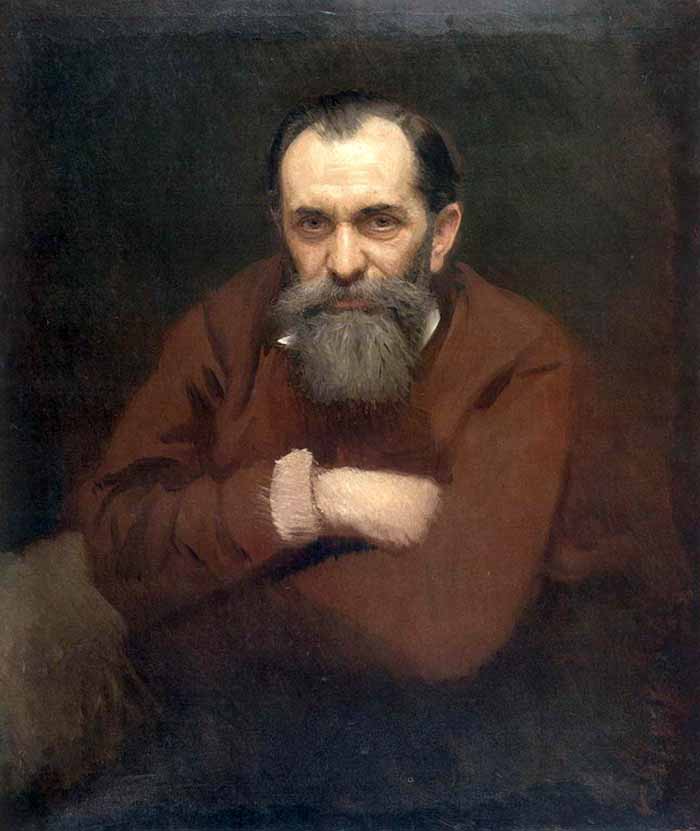
Why Vasily Perov matters
Vasily Perov is one of the founding figures of Russian Realism and a founding member of the Peredvizhniki, the Society for Traveling Art Exhibitions, whose genre paintings turned an unsparing eye on clergy, officials, and peasants in the late Russian Empire. For a collector or student of nineteenth-century Russian art, he represents the moment painting in Russia shifted from academic convention toward direct, socially engaged observation of ordinary life, a shift whose evidence sits almost entirely inside Russia's national museums rather than the private market.
- Born
- 1834-01-02, Tobolsk, Russian Empire
- Nationality
- Russian
- Media
- Painting, Genre painting, Portraiture
- Movement
- Russian Realism, Peredvizhniki (The Wanderers)
- Education
- Arzamas Art School under Alexander Stupin, c. 1846 to 1849 (intermittent); Moscow School of Painting, Sculpture and Architecture, 1853 to 1861, graduated class artist 1st degree with the large gold medal
- Signature motifs
- Genre scenes of everyday Russian and clerical life, Portraits of literary and cultural figures
By the numbers
- PeredvizhnikiFounding memberThe Wanderers, a Russian Realist exhibiting society
- Imperial Academy of Arts, 1866AcademicianFor Troika and The Arrival of a New Governess in a Merchant House
- Imperial Academy of Arts, 1870ProfessorFor The Fowler and The Wanderer
- Works exhibited1867 Paris Exposition UniverselleExact number and titles not independently confirmed
Selected works
Click any work to view it full screen.
Biography
Vasily Grigorevich Perov was born on 2 January 1834 in Tobolsk, in what was then the Russian Empire. He trained intermittently from about 1846 to 1849 at Alexander Stupin's art school in Arzamas, his first formal instruction in painting. In 1853 he was admitted to the Moscow School of Painting, Sculpture and Architecture, where he studied until 1861 under teachers including Apollon Mokritsky and Sergei Zaryanko. He graduated in 1861 with the large gold medal and the rank of class artist, 1st degree, for his diploma painting Sermon in a Village, an award that carried the right to state-funded travel abroad. He used that fellowship to travel abroad before returning to Russia to continue his career.
Through the 1860s and 1870s, Perov built a reputation on genre scenes that examined poverty, clerical hypocrisy, and everyday hardship, among them Troika, The Arrival of a New Governess in a Merchant House, and The Last Tavern at the City Gates. He was a founding member of the Peredvizhniki, the exhibiting society that organized traveling shows across the Russian Empire outside the control of the Imperial Academy. The Academy nonetheless recognized him, naming him Academician in 1866 for Troika and The Arrival of a New Governess, and Professor in 1870 for The Fowler and The Wanderer. In 1872 he painted his well known portrait of the writer Fyodor Dostoevsky, commissioned by the collector Pavel Tretyakov and now held at the State Tretyakov Gallery.
Perov died on 10 June 1882 (29 May 1882 by the Julian calendar then used in Russia) in the village of Kuzminki, near Moscow, of tuberculosis. He was first buried at the Danilov Monastery cemetery and later reinterred at the Donskoy Cemetery in Moscow.
Critical reception
Perov's reputation was established early and has remained largely stable within art history as a founder of Russian critical realism. His works were shown at the 1867 Paris Exposition Universelle, where, according to a Russian-language secondary account, the French critic Theophile Thore-Burger remarked on how distinctly Russian his subjects and manner of interpretation were, a response consistent with the broader reception of his Academy exhibitions and his rapid elevation to Academician in 1866 and Professor in 1870. Modern museum and reference sources consistently describe him as a central figure of the Peredvizhniki movement, valued for turning genre painting into a vehicle for social observation of clergy, officials, and the rural and urban poor.
Market
Perov's market is shaped by the fact that the great majority of his significant paintings are permanently held in Russian state museums, principally the State Tretyakov Gallery and the State Russian Museum, leaving a thin pool of works in private hands. As of 2026, no verified realized auction price for a work by Perov could be confirmed. Russian press reports from late 2022 described his painting Bear Hunt in Winter (1879) being offered at a Moscow auction with a starting or reserve price of about 900,000 US dollars, but available sources describe this only as an asking price, not a confirmed sale. Other documented lots have carried ruble-denominated estimates, and at least one recorded lot went unsold. Collectors should treat any reported figure for this artist with care until it can be traced to a completed hammer price from a named auction house.
Selected exhibitions
| Years | Exhibition | Venues |
|---|---|---|
| 1861 | Diploma exhibition | Moscow School of Painting, Sculpture and Architecture, Moscow (Sermon in a Village, graduation work) |
| 1867 | Exposition Universelle | Paris (works shown; exact number and titles not independently confirmed) |
| 1867 | Annual exhibition, Imperial Academy of Arts | Saint Petersburg |
| 1872 | World Exhibition | London |
| 1873 | World Exhibition | Vienna |
| 1878 | Exposition Universelle | Paris |
| 1882 to 1883 | First posthumous exhibition | Moscow and Saint Petersburg |
Museum collections
- State Tretyakov Gallery, Moscow
- State Russian Museum, Saint Petersburg
- Pushkin State Museum of Fine Arts, Moscow
- State Historical Museum, Moscow
- Hermitage Museum, Saint Petersburg
Awards and honors
- Large silver medal, Imperial Academy of Arts, for Arrival of the District Police Officer to the Investigation (1858)
- Minor gold medal, Imperial Academy of Arts, for First Rank (1860)
- Grand gold medal and pensioner travel fellowship abroad, Imperial Academy of Arts, for Sermon in a Village (1861)
- Academician, Imperial Academy of Arts, for Troika and The Arrival of a New Governess in a Merchant House (1866)
- Professor, Imperial Academy of Arts, for The Fowler and The Wanderer (1870)
Authentication and provenance
No catalogue raisonne.
No catalogue raisonne has been identified for Perov. His paintings are catalogued and their attribution is anchored primarily through the holdings, archives, and provenance records of the State Tretyakov Gallery and other Russian state museums that hold the majority of his major works.
Primary reference: https://www.tg-m.ru/catalog/en/artists/3033
What collectors should know
There is no catalogue raisonne for Perov, and attribution rests heavily on the documentation held by the State Tretyakov Gallery and other Russian state institutions that hold his principal works. Because so much of his output is locked into permanent museum collections, the private and auction market for his paintings is unusually thin for an artist of his historical stature, and reported high asking prices in the press should not be mistaken for confirmed sales. Anyone considering a Perov attributed to the secondary market should expect close scrutiny of provenance, given both the small surviving pool of authenticated works and the long history of reproductions and copies associated with popular Peredvizhniki subjects.
Further reading and resources
Data current as of 2026-07-13.

