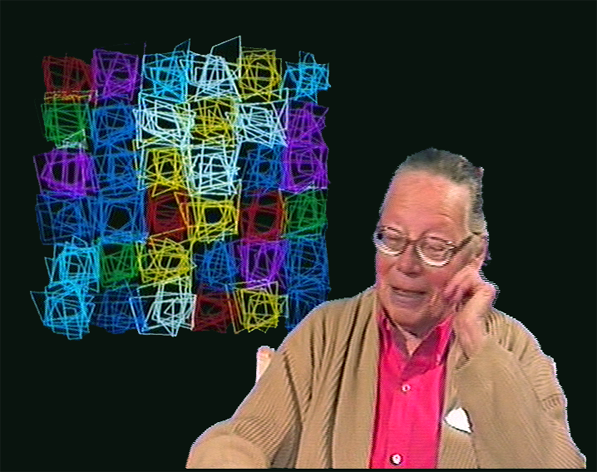
Why Vera Molnar matters
Vera Molnar was one of the first artists anywhere to use a computer as a working tool, beginning with hand-simulated algorithmic drawing systems in the 1950s and moving to actual computer-plotted work once she gained access to mainframe equipment in Paris in 1968. She spent most of her career as a foundational but under-recognized figure, only receiving the full weight of institutional validation late in life and after her death, through inclusion in the 2022 Venice Biennale, a 2024 Centre Pompidou retrospective marking her centenary, and a 2026 Kunstmuseum Basel exhibition built partly around a donated print archive. For collectors, she is a case study in a market still being repriced: a historically significant pioneer whose institutional standing has grown faster than her public auction record.
- Born
- 1924-01-05, Budapest, Hungary
- Nationality
- Hungarian-French
- Media
- Computer-generated art, Painting, Drawing, Prints
- Movement
- Generative art, Computer art, Geometric abstraction
- Education
- Budapest College of Fine Arts, diploma in art history and aesthetics, 1947 (studies 1942 to 1947); postgraduate fellowship study in Rome, 1947
- Signature motifs
- Algorithmic and generative compositions, Grid and square-based abstraction, Plotter drawings
- Representation
- Galerie La Ligne, Zurich (estate, represented since 2006), Oniris Galerie, Rennes, Galerie Berthet-Aittouarès, Paris, Van Doren Waxter, New York
By the numbers
- USD 138,600Auction highSotheby's New York, April 2022; work title not publicly specified
- 59th Biennale, 2022Venice BiennaleThe Milk of Dreams; oldest artist in the exhibition at age 98
- 2022SIGGRAPH Distinguished Artist AwardLifetime Achievement in Digital Art
- Galerie La Ligne; Oniris; Van Doren WaxterRepresented byEstate representation
Biography
Vera Molnar was born Veronika (Vera) Gacs on 5 January 1924 in Budapest, Hungary. She studied painting, art history, and aesthetics at the Budapest College of Fine Arts from 1942 to 1947, graduating with a diploma in art history and aesthetics. On an artists' fellowship, she continued her studies in Rome later in 1947, then settled permanently in Paris, where she lived and worked for the rest of her life.
In Paris, Molnar developed what she called a "machine imaginaire," a set of systematic, rule-based procedures for generating drawings by hand before she had access to any actual computer. In 1968 she gained access to a mainframe computer and plotter at a research center affiliated with the University of Paris, becoming one of the first women to use computers directly in a fine art practice. She spent the following decades refining generative, grid- and square-based abstraction, moving fluidly between hand-drawn and machine-generated work. She was a founding figure in French and international computer art circles and taught aesthetics and art history at the Universite de Paris I, Sorbonne, from 1985 to 1990.
Molnar continued to work prolifically into her late nineties, adapting her practice to new tools including NFTs. In 2022, at age 98, she was the oldest artist included in "The Milk of Dreams," the main exhibition of the 59th Venice Biennale. She died on 7 December 2023 in Paris, at age 99, twenty-eight days before what would have been her hundredth birthday.
Critical reception
Vera Molnar, born 1924 in Hungary, is one of the pioneers of computer and algorithmic arts.
Critics and institutions have converged, especially since 2022, on describing Molnar as a foundational figure in computer and generative art rather than a peripheral one. Writing in the research journal Leonardo in 2022, art historian Francesca Franco called her "one of the pioneers of computer and algorithmic arts," a framing echoed across major art press obituaries in 2023 that described her as a founding figure, sometimes termed the "godmother," of generative art. That reappraisal has been backed by institutional action: her inclusion in the main Venice Biennale exhibition in 2022, the ACM SIGGRAPH Distinguished Artist Award the same year, a Centre Pompidou retrospective built from the museum's own holdings in 2024, and a Kunstmuseum Basel exhibition in 2026 drawn in part from a significant donation of her prints to the museum's department of prints and drawings. The consistent critical thread is that her decades of quiet, systematic work anticipated later digital art by a full generation.
Market
Molnar's auction market is thin relative to her institutional stature, and prices vary widely by medium and format. The highest confirmed price for a single work at a traditional auction house is USD 138,600, achieved at Sotheby's New York in April 2022; the exact day of sale and the title of the work are not documented in public price records. A separate Phillips London sale tied to the exhibition "Vera Molnar: Ex Machina, A History of Generative Art" realized GBP 100,800, above its estimate, though again without a publicly specified work title. In July 2023, Sotheby's ran a Dutch-format sale of a 500-piece generative NFT collaboration with Martin Grasser that sold out for roughly 631 ETH, then worth about USD 1.2 million in aggregate; this was a multi-lot total, not a single-work price, and individual pieces within it sold for far less than the April 2022 record. More conventional works, including plotter drawings and prints, have traded from a few thousand euros up to roughly EUR 100,000, with a 1974 print reported to have sold for about EUR 94,000.
Top auction results
| Work | Price | Sale |
|---|---|---|
| Untitled generative work (title not publicly specified in the sale record) (2022) | USD 138,600 (USD 138,600) | Sotheby's, New York, 2022-04 |
Selected exhibitions
| Years | Exhibition | Venues |
|---|---|---|
| 2022 | The Milk of Dreams (59th Venice Biennale) | Venice Biennale, Venice |
| 2024 | Parler a l'oeil (Speak to the Eye) | Centre Pompidou, Paris |
| 2026 | Vera Molnar. Possibilities | Kunstmuseum Basel |
| 2024 | A la recherche de Vera Molnar | Ludwig Museum, Budapest |
| 2021 | Pas froid aux yeux | Musee des Beaux-Arts de Rennes |
| 2023 | Vera Molnar, 99 ans | Galerie Berthet-Aittouares, Paris |
| 2026 | Zero10 solo presentation | Art Basel (Oniris with Interface Gallery), Basel |
| 2005 | Solo exhibition, d.velop digital art award (ddaa) | Kunsthalle Bremen |
Museum collections
- Centre Pompidou, Musee National d'Art Moderne, Paris
- Museum of Modern Art, New York
- Tate Modern, London
- Victoria and Albert Museum, London
- National Gallery of Art, Washington, D.C.
- Museum of Fine Arts, Houston
- Kunstmuseum Basel, Kupferstichkabinett
Awards and honors
- d.velop digital art award (ddaa), Digital Art Museum (2005)
- Chevalier des Arts et des Lettres, France (2007)
- Order of Merit of the Republic of Hungary (2011)
- Ordre national de la Legion d'honneur, France (2012)
- AWARE Outstanding Merit Award (Prix d'Honneur) (2018)
- ACM SIGGRAPH Distinguished Artist Award for Lifetime Achievement in Digital Art (2022)
Authentication and provenance
No catalogue raisonne.
No published catalogue raisonne has been confirmed for Vera Molnar. Some auction listings reference internal registration numbers tied to gallery and estate archives, but no complete public catalogue exists. Works are typically verified through the artist's estate-affiliated galleries, including Galerie La Ligne, Oniris, and Van Doren Waxter.
Primary reference: https://www.oniris.art/en/artists/vera-molnar/
What collectors should know
There is no published catalogue raisonne for Vera Molnar, and some auction references to "registration" numbers appear to reflect internal gallery or estate record-keeping rather than a completed public catalogue; verification runs primarily through her estate-affiliated galleries, including Galerie La Ligne, Oniris, Berthet-Aittouares, and Van Doren Waxter. Her auction history is genuinely thin, with very few high-value repeat sales, so any single record price, including the current USD 138,600 high, should be read as a data point from a small sample rather than a stable benchmark. Prices for her plotter drawings, prints, and paintings vary considerably by medium, period, and provenance. The strongest signal of durability is the pace of museum attention since her death, which has been unusually fast for a market this size, and collectors should weigh that institutional momentum against the current scarcity of comparable public sales.
Further reading and resources
Data current as of 2026-07-16.

