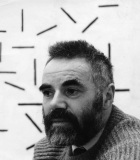
Why Victor Pasmore matters
Victor Pasmore is one of the pivotal figures in twentieth-century British art, a painter who began as a leading naturalistic landscapist and then, in his forties, remade himself as one of Britain's foremost abstract and Constructivist artists. For a collector, his significance rests on that rare double credential: institutional depth on both sides of his career, held today across Tate, the Royal Academy, MoMA, and the Musée des Beaux-Arts in Bordeaux, paired with a market that remains comparatively thin and specialist relative to his historical standing.
- Born
- 1908-12-03, Chelsham, Surrey, England
- Nationality
- British
- Media
- Painting, Printmaking, Constructed relief
- Movement
- Euston Road School, Abstract art, Constructivism
- Education
- Summer Fields School and Harrow School; part-time evening study in painting at the Central School of Art, London, beginning in 1927
- Signature motifs
- Linear motif abstraction, Constructed reliefs, Spiral and biomorphic forms
- Representation
- "Victor Pasmore Gallery, Central Bank of Malta (institutional)", "Eames Fine Art, London"
By the numbers
- GBP 329,000Auction highLinear Motif in Black and White, Christie's London, June 2017
- CBE (1959), CH (1981)HonorsCommander of the Order of the British Empire and Companion of Honour
- British Pavilion, 1960Venice Biennale
- Victor Pasmore Gallery, Central Bank of Malta (institutional); Eames Fine Art, LondonRepresented by
Biography
Edwin John Victor Pasmore was born on 3 December 1908 in Chelsham, Surrey, England. He was educated at Summer Fields School and then Harrow School, but received no formal academic training in art. When his father died in 1927, Pasmore took an administrative job with the London County Council and studied painting part time in evening classes at the Central School of Art, London, beginning in 1927.
Through the 1930s he built a reputation as a sensitive, naturalistic painter of the Thames and English landscape, and in 1937 he was a founding member of the Euston Road School alongside William Coldstream and Claude Rogers. By the late 1940s, however, Pasmore had turned decisively toward abstraction, producing spare geometric compositions, spiral and biomorphic forms, and later three-dimensional constructed reliefs that placed him at the center of British Constructivism. He held senior teaching posts, including Director of Painting at Camberwell School of Art and Head of the Department of Fine Art at King's College, Durham University (later Newcastle University), where he developed the influential Basic Design course with Richard Hamilton. In 1970 he designed the Pavilion in Peterlee, a public commission intended to unite architecture, painting, and sculpture.
Pasmore represented Britain at the 1960 Venice Biennale and, with Patrick Heron, at the 1964 to 1965 Sao Paulo Biennial. In 1966 he established a second home in Gudja, Malta, where he continued to work for the rest of his life. He was made CBE in 1959 and CH in 1981, and was elected a Royal Academician in 1984. Victor Pasmore died on 23 January 1998 in Gudja, Malta, at the age of 89.
Critical reception
Pasmore's career is treated by institutions and critics as a case study in genuine artistic reinvention: a painter celebrated in the 1930s and 1940s for lyrical, Whistlerian river landscapes who then, in his forties, became one of Britain's most rigorous abstractionists. Tate credits him with occupying a distinctive place in twentieth century British art for combining both achievements in a single career. His constructed reliefs and Basic Design teaching with Richard Hamilton at Newcastle are widely credited with shaping how postwar British art schools taught abstraction, and his late work continues to be reassessed through retrospectives such as Towards a New Reality (2016 to 2017) and Marlborough's Line and Space (2021).
Market
Pasmore's secondary market is small relative to his museum profile, and results are dominated by works on paper, prints, and a limited number of major paintings and reliefs. His recorded auction high is Linear Motif in Black and White, which sold for GBP 329,000 including fees at Christie's London in June 2017. Other significant results cluster well below that level, including The Studio of Ingres at Sotheby's in June 1997 and Linear Image: The New Vitruvius at Christie's in June 2018, both in the low hundreds of thousands of pounds. There is no indication in the record of a subsequent sale surpassing the 2017 Christie's result.
Top auction results
| Work | Price | Sale |
|---|---|---|
| Linear Motif in Black and White (2017) | GBP 329,000 | Christie's, London, 2017-06 |
Selected exhibitions
| Years | Exhibition | Venues |
|---|---|---|
| 1954 | First retrospective | Institute of Contemporary Arts, London |
| 1958 | Three Modern Masters of British Painting: Pasmore, Matthew Smith and Francis Bacon | Arts Council of Great Britain, touring |
| 1959 | documenta II | Kassel, Germany |
| 1960 | 30th Venice Biennale | British Pavilion, Venice, then touring to Paris, Brussels, Amsterdam, Bochum, Belgrade, Oslo, and Copenhagen |
| 1964 to 1965 | 8th Bienal de Sao Paulo | Sao Paulo, representing Britain alongside Patrick Heron |
| 1965 | Major retrospective | Tate Gallery, London |
| 2016 to 2017 | Victor Pasmore: Towards a New Reality | Djanogly Gallery, Nottingham; Pallant House Gallery, Chichester |
| 2021 | Victor Pasmore: Line and Space | Marlborough Gallery, London |
Museum collections
- Tate, London
- Royal Academy of Arts, London
- Museum of Modern Art, New York
- Musée des Beaux-Arts, Bordeaux
Awards and honors
- CBE (Commander of the Order of the British Empire) (1959)
- CH (Companion of Honour) (1981)
- Elected Royal Academician (1984)
Authentication and provenance
No catalogue raisonne.
No catalogue raisonne of Pasmore's work has been published. The Victor Pasmore Gallery, an institutional space established in 2014 by the Central Bank of Malta with the Victor Pasmore Foundation, and dealers such as Eames Fine Art, London, are the primary points of reference for authentication questions.
Primary reference: https://www.tate.org.uk/art/artists/victor-pasmore-1744
What collectors should know
Pasmore's market is illiquid and specialist, with a modest number of significant paintings and reliefs reaching auction in any given cycle, so individual sale results should be read as data points from a thin sample rather than a smooth trend line. There is no published catalogue raisonne, which places extra weight on provenance and on the Victor Pasmore Gallery in Malta and dealers such as Eames Fine Art, London, as reference points for authentication questions. His deep and geographically spread museum holdings, from London to New York to Bordeaux, remain the strongest evidence of his enduring institutional standing.
Further reading and resources
Data current as of 2026-07-11.

