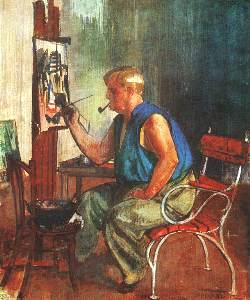
Why Vilmos Aba-Novak matters
Vilmos Aba-Novak was one of interwar Hungary's most celebrated and most contested painters, an artist whose monumental frescoes and expressionist canvases carried Hungarian modernism onto the international stage. He won the Grand Prize at the 1940 Venice Biennale and the Grand Prix at the 1937 Paris World Exhibition, honors that placed him among the most internationally decorated Hungarian artists of his generation. For a collector, he represents a case where deep institutional and national recognition sits alongside a market that remains concentrated almost entirely inside Hungary, with the highest reported prices achieved at Budapest galleries rather than the major international auction houses.
- Born
- 1894-03-15, Budapest, Hungary
- Nationality
- Hungarian
- Media
- Painting, Fresco, Printmaking
- Movement
- Hungarian modernism, "Expressionism (Novecento-influenced)"
- Education
- Budapest College of Fine Arts, 1912 to 1914; drawing-teacher diploma, 1918; graphic studio of Viktor Olgyai, Budapest College of Fine Arts, 1921 to 1924; fellowship, Hungarian Academy in Rome, 1928 to 1930
- Signature motifs
- Circus and fairground scenes, Monumental church frescoes, Mediterranean harbor scenes
- Representation
- Kieselbach Gallery, Budapest (current market handler, not confirmed as exclusive estate representative), Virag Judit Gallery, Budapest (current market handler, not confirmed as exclusive estate representative)
By the numbers
- HUF 120,000,000Auction highHarbour, 1930 (Kikoto, 1930), Virag Judit Galeria, Budapest, 2016; gallery-reported, not independently verified against an outside database.
- Grand Prize, 1940Venice Biennale
- Grand Prix, 1937Paris World Exhibition
- Kieselbach Gallery; Virag Judit GalleryRepresented byHungarian market handlers
Selected works
Click any work to view it full screen.
Biography
Born Novak Vilmos on 15 March 1894 in Budapest, the artist adopted the name Aba-Novak around 1912, the year he also completed his studies at the Toldi realgimnazium. He studied at the Budapest College of Fine Arts from 1912 to 1914, took a summer course in oil painting with Adolf Fenyes at the Szolnok artists' colony in 1913, and earned a drawing-teacher diploma in 1918. From 1921 to 1924 he continued as an advanced student in Viktor Olgyai's graphic studio at the College of Fine Arts, and from 1928 to 1930 he held a fellowship at the Hungarian Academy in Rome, an experience that exposed him directly to the Italian Novecento movement and shaped the monumental, muralistic style for which he became known.
Aba-Novak built his reputation on large-scale church frescoes and murals, including the Gate of Heroes decoration in Szeged, as well as circus and fairground scenes and Mediterranean harbor views painted during and after his time in Rome. From 1930 to 1937 he ran a private art school in Budapest, and from 1939 he taught as a professor at the Academy of Fine Arts.
He died in Budapest on 29 September 1941, at age 47. Hungarian sources report the cause as stomach cancer, though this detail is not confirmed by the major English-language encyclopedias. He was buried at Farkasreti Cemetery in Budapest on 1 October 1941.
Critical reception
Aba-Novak was, in Britannica's phrase, one of the most original and controversial talents in modern Hungarian painting, praised for fusing Expressionist intensity with the monumental figuration of the Italian Novecento movement he encountered during his 1928 to 1930 fellowship in Rome. His large-scale church frescoes, including the Gate of Heroes in Szeged, and his circus and fairground paintings were read at the time as an attempt to build a modern, muralistic national style. He accumulated a dense run of official honors in the 1930s, including the 1932 gold medal at the Padua Church Art Exhibition, the Grand Prix at the 1937 Paris World Exhibition, and the Grand Prize at the 1940 Venice Biennale, evidence that Hungarian and international institutions of the period regarded him as a leading figure. His reputation has persisted domestically, marked by continued museum and gallery attention in Hungary.
Market
Aba-Novak's market is small, concentrated almost entirely inside Hungary, and thin at the top end. Virag Judit Galeria's own published auction records list a high of HUF 120,000,000 for a work titled Harbour, 1930, sold in Budapest in November 2016, though this specific sale could not be independently corroborated against an outside auction database and the exact sale date is unconfirmed. A separately confirmed international result is Dorotheum's realization of EUR 68,275 for a work by the artist, though the exact sale date was not confirmed. The gap between the gallery-reported Hungarian high and the confirmed international result means collectors should treat any single sale, in either market, as one data point rather than a stable benchmark.
Top auction results
| Work | Price | Sale |
|---|---|---|
| Harbour, 1930 (Kikoto, 1930) (2016) | HUF 120,000,000 | Virag Judit Galeria, Budapest, Hungary |
Selected exhibitions
| Years | Exhibition | Venues |
|---|---|---|
| 2026 | Dolce Vita | Hungarian National Gallery, Budapest |
| 1962 | Retrospective | Hungarian National Gallery, Budapest |
| 1940 | XXII Venice Biennale (Grand Prize awarded) | Venice Biennale |
| 1937 | Paris World Exhibition (Exposition Universelle) | Paris |
| 1936 | Hungarian Exhibition | Vienna |
| 1935 | Traveling exhibition | Carnegie Institute, Pittsburgh; Silberman Gallery, New York |
| 1934 | Solo presentation | Knoedler Gallery, London |
| 1922 to 1927 | Recurring solo and featured exhibitions | Ernst Museum, Budapest |
Museum collections
- Hungarian National Gallery, Budapest
- Hungarian Jewish Museum and Archives, Budapest
- Mora Ferenc Museum, Szeged
Awards and honors
- Grand Prize, Venice Biennale (1940)
- Grand Prix, Paris World Exhibition (Exposition Universelle) (1937)
- Gold medal, Padua Church Art Exhibition (1932)
Authentication and provenance
No catalogue raisonne.
No published catalogue raisonne has been confirmed for this artist. Works are principally authenticated and brought to market through specialist Hungarian galleries, chiefly Kieselbach Gallery and Virag Judit Gallery, which publish provenance research on individual paintings rather than a single centralized estate authority.
Primary reference: https://www.britannica.com/biography/Vilmos-Aba-Novak
What collectors should know
No catalogue raisonne has been confirmed for Aba-Novak, and works are chiefly authenticated and traded through specialist Hungarian galleries such as Kieselbach Gallery and Virag Judit Gallery rather than a single centralized estate authority. Some Western auction catalogues, including Dorotheum and Hampel, list his death year as 1942, while Hungarian sources and Britannica confirm 1941; collectors should rely on the Hungarian-sourced date and treat the 1942 figure as a cataloguing error. Because the highest price reported for the artist comes from a Budapest gallery's own records rather than a major international auction house, and could not be independently corroborated here, while confirmed international-house results run considerably lower, provenance and comparable-sale research should draw on both Hungarian and international market data rather than relying on any single figure.
Further reading and resources
Data current as of 2026-07-13.

