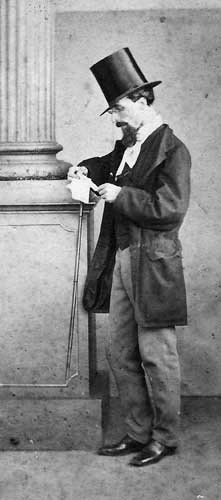
Why Vincenzo Cabianca matters
Vincenzo Cabianca was one of the leading figures of the Macchiaioli, the circle of Italian painters who gathered at Florence's Caffe Michelangiolo in the 1850s and 1860s to develop a bold, patch based approach to light and shadow, roughly parallel in spirit to French Impressionism but distinctly Italian in subject and technique. For collectors, he represents a category of nineteenth century Italian painting that is held in major public collections, including the Musee d'Orsay, but that trades almost entirely on the secondary auction market rather than through any living gallery or estate structure.
- Born
- 1827-06-21, Verona, Italy
- Nationality
- Italian
- Media
- Painting
- Movement
- Macchiaioli
- Education
- Accademia di Verona, under Giovanni Caliari, before 1845; Accademia di Venezia, 1845 to 1847
- Signature motifs
- Sunlight and shadow effects, Tonal patch ("macchia") technique, Italian landscape and genre scenes
By the numbers
- EUR 74,400Auction highConfirmed sale, Christie's, June 9, 2005; title and sale city not independently confirmed. MutualArt separately cites an unverified high near USD 1.21M with no lot details, so this may not be the true record.
- MacchiaioliMovementCore member, Caffe Michelangiolo circle, Florence
- Musee d'Orsay, ParisMuseum collection
Selected works
Click any work to view it full screen.
Biography
Vincenzo Cabianca was born in Verona, Italy, on June 21, 1827, into modest circumstances. He began his artistic training at the Accademia di Verona under Giovanni Caliari before moving on to the Accademia di Venezia, where he studied from 1845 to 1847.
By the 1850s Cabianca had settled in Florence and become one of the core members of the Macchiaioli, the group of painters, including Telemaco Cecioni, Giovanni Fattori, and Silvestro Lega, who met at the Caffe Michelangiolo and rejected academic convention in favor of broad patches, or "macchie," of tone and color to capture the effect of natural light. He traveled to Paris in 1861, then lived in Parma until 1868, after which he moved to Rome, where he remained for the rest of his life. He died in Rome on March 21, 1902.
Critical reception
Cabianca's contemporaries recognized him as one of the most radical members of the Macchiaioli. The critic and fellow Macchiaioli painter Telemaco Cecioni called him "the most declared, violent and uninhibited macchiaiolo," a description that points to his heavy use of tonal contrast and strong sunlight effects. The writer Angelo de Gubernatis, describing the Macchiaioli generally as "enemies of all conventionalism and accurate researchers of effects," singled out Cabianca's particular interest in the behavior of sunlight, and the biographer Gottardo Garollo characterized him simply as a painter of the "effects of the Sun." Later scholarship has continued to treat him as a central, if sometimes more provocative, figure within the group, alongside better known names such as Fattori and Lega.
Market
Cabianca's market operates almost entirely through auction houses and secondary market dealers. No gallery or estate is documented as representing him or managing his legacy, which is typical for a painter who died more than a century ago, and no catalogue raisonne of his work has been identified, so buyers rely on provenance history and auction house cataloguing rather than a single authenticating body.
The highest price with a confirmed house, currency, and sale date found across the auction databases reviewed is EUR 74,400 (about USD 90,507 at the time), reportedly paid at Christie's on June 9, 2005, for a landscape recorded in market databases under the title "Paesaggio." The exact sale city and the precision of that title have not been independently confirmed beyond the market database reporting them. Separately, MutualArt's summary page cites a realized price as high as USD 1,214,951 for a Cabianca painting, but without a lot title, sale date, or auction house attached to that figure, so it cannot be verified or treated as the confirmed record. Typical results for Cabianca otherwise fall in the low four to low five figure range.
Top auction results
| Work | Price | Sale |
|---|---|---|
| Paesaggio (Landscape, title as recorded in market database) (2005) | USD 90,507 (EUR 74,400) | Christie's, Italy (exact city not independently confirmed), 2005-06-09 |
Selected exhibitions
| Years | Exhibition | Venues |
|---|---|---|
| 1860s | Caffe Michelangiolo circle exhibitions | Florence and Tuscany (Macchiaioli group shows) |
Museum collections
- Musee d'Orsay, Paris
Authentication and provenance
No catalogue raisonne.
No catalogue raisonne has been identified for Cabianca and no certificate-of-authenticity program is documented. Attribution relies on auction house cataloguing, provenance history, and comparison to documented paintings rather than a single authenticating body.
Primary reference: https://en.wikipedia.org/wiki/Vincenzo_Cabianca
What collectors should know
Cabianca's work is held in institutional collections, including the Musee d'Orsay in Paris, as well as other Italian public collections associated with the Macchiaioli, though the full list of holding institutions has not been independently itemized here. There is no current gallery, foundation, or estate that represents him, and no catalogue raisonne exists to anchor attribution. Prospective buyers should treat the reported auction record with some caution, since the title and sale city behind the EUR 74,400 Christie's result have not been independently verified beyond a single market database, detailed comparable data from Artprice, Artnet, and AskART are not fully public, and a considerably higher, unverified realized price cited by MutualArt cannot currently be tied to a specific work or sale. As with much nineteenth century Italian painting, condition, exhibition history, and a documented chain of provenance matter more to value than any single headline price.
Further reading and resources
Data current as of 2026-07-10.

