Why Viola Frey matters
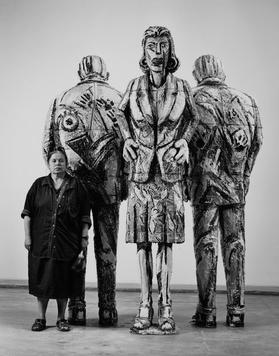
Viola Frey was a central figure in the rise of California Funk Art and in the broader argument, fought largely through clay, that ceramics belonged inside the conversation about contemporary sculpture rather than off to the side of it. She is best known for larger-than-life glazed ceramic figures, often men in suits or women modeled on flea-market figurines, that used scale and everyday material to ask questions about gender, authority, and consumer culture. For a collector, she matters as a foundational woman sculptor in postwar American ceramics whose work sits in the permanent collections of the country's leading museums, even though her auction market remains thin and comparatively under-tracked.
- Born
- 1933-08-15, Lodi, California, USA
- Nationality
- American
- Media
- Ceramic sculpture, Painting, Drawing
- Movement
- California Funk Art, Contemporary ceramics
- Education
- BFA in Painting, California College of Arts and Crafts, Oakland, 1956 (some institutional sources cite 1955); graduate studies in painting and ceramics, Newcomb College, Tulane University, New Orleans, circa 1955 to 1957, degree not consistently confirmed; Honorary Doctorate of Fine Art, California College of the Arts, 2000
- Signature motifs
- Larger-than-life glazed ceramic figures, Bricolage assemblage, Painted plates
- Representation
- Gavlak Gallery, James Harris Gallery, Artists' Legacy Foundation, estate steward
By the numbers
- USD 125,000Auction high (documented)Glazed ceramic figure grouping, Jackson's International Auctioneers, exact sale date not confirmed in available records
- Gavlak Gallery; James Harris GalleryRepresented byArtists' Legacy Foundation stewards the estate
- 190+Lifetime exhibitionsIn the final two decades of her career, per Artists' Legacy Foundation; not independently re-verified
- 1961 to 2004Career spanExhibited in museums and galleries from 1961 until her death; start year not independently re-verified
Biography
Viola Frey was born on August 15, 1933, in Lodi, California, to a family of grape farmers. After graduating from Lodi High School in 1951, she studied briefly at Stockton Delta College before transferring to the California College of Arts and Crafts (CCAC) in Oakland, where she majored in painting and completed her BFA around 1956. She then enrolled in graduate studies at Newcomb College, Tulane University, in New Orleans, where she reportedly studied with Mark Rothko and George Rickey, though that detail is not independently confirmed in the sources reviewed here; whether she formally completed a master's degree there is disputed among institutional sources, and some accounts state she left Tulane in 1957 without one.
Frey settled in the San Francisco Bay Area and taught for roughly three decades at CCAC (later California College of the Arts), retiring in 1999. Her mature work combined monumental, hand-built glazed ceramic figures with paintings, drawings, and "bricolage" assemblages built from found objects, gathering the visual noise of thrift-shop figurines, mass media, and domestic bric-a-brac into a personal vocabulary. Her best-known outdoor work, Decline and Fall of Western Civilization, was installed at Esprit Park in San Francisco in 1992. In 2000 she co-founded the Artists' Legacy Foundation with fellow artists Squeak Carnwath and Gary Knecht, an organization created to support working artists and, after her death, to steward her own estate.
Viola Frey died on July 26, 2004, at her home in Oakland, California. The Los Angeles Times and the New York Times reported the cause as colon cancer, and the Los Angeles Times noted she continued working in her studio in her final days; the East Bay Times described the cause simply as cancer. Obituaries in the Los Angeles Times and the New York Times gave her age at death as 70; the East Bay Times gave 71. Her birth and death years, 1933 to 2004, are consistent across the Whitney Museum, the Smithsonian American Art Museum, and her own foundation's records.
Critical reception
Frey's critical standing rests heavily on institutional recognition rather than a large body of press criticism. Her 1984 exhibition at the Whitney Museum of American Art placed her monumental figures inside one of the country's most closely watched contemporary programs, following a 1981 retrospective that originated at the Crocker Art Museum and traveled to museums in Oakland, St. Louis, and Huntsville. Museum writing about that period has framed her ambitions in material terms, arguing that content mattered more to her than refinement of craft. That framing, content over craft, has remained the throughline of how museums and scholars discuss her: the scale and glaze of her figures are treated as tools for cultural commentary on gender, class, and American materialism rather than as displays of technical virtuosity alone.
Market
Frey's auction market is small and unevenly documented compared with her museum standing. The highest price found in available auction records is USD 125,000, paid for a three-piece glazed ceramic figure grouping at Jackson's International Auctioneers and Appraisers in Cedar Falls, Iowa; the house described the sale at the time as a new world-record price for the artist, though the exact sale date is not confirmed in the sources reviewed here. More recent sales have come in lower: Bonhams sold Reclining Woman, Hand Outstretched (2002) for USD 114,800 at a Los Angeles sale on 25 September 2024. Different auction houses have described their own results as records at different points, which suggests the public sale history for Frey is not yet consolidated into a single, continuously tracked benchmark.
Top auction results
| Work | Price | Sale |
|---|---|---|
| Untitled (glazed ceramic figure grouping, three pieces) | USD 125,000 (USD 125,000) | Jackson's International Auctioneers and Appraisers, Cedar Falls, Iowa |
Selected exhibitions
| Years | Exhibition | Venues |
|---|---|---|
| 1981 to 1983 | Viola Frey: A Retrospective | Crocker Art Museum, Sacramento, originating venue; traveled to Oakland Museum of California, Saint Louis Art Museum, and Huntsville Museum of Art |
| 1984 | Viola Frey | Whitney Museum of American Art, New York |
| 1992 | Decline and Fall of Western Civilization | Esprit Park, San Francisco |
| 1994 | Viola Frey: Plates 1968 to 1994 | National tour, specific venues not fully documented |
| 2001 | Larger than Life: Ceramic Figures by Viola Frey | Boise Art Museum, Boise, Idaho |
| 2022 | Viola Frey: Faces, Masks, and Figurines | Nancy Hoffman Gallery, New York |
| 2025 | Viola Frey: Observed and Gathered | The Pit, Los Angeles |
| 2026 | Viola Frey: Foundations | Bedford Gallery, Walnut Creek, organized with the Artists' Legacy Foundation |
Museum collections
- Whitney Museum of American Art, New York
- Smithsonian American Art Museum, Washington, D.C.
- Metropolitan Museum of Art, New York
- Los Angeles County Museum of Art
- San Francisco Museum of Modern Art
- Museum of Fine Arts, Houston
- Philadelphia Museum of Art
- Musee d'Art Moderne de Paris
- Victoria and Albert Museum, London
Awards and honors
- Craftsmen's Fellowship Grant, National Endowment for the Arts (1978)
- Artist Fellowship Grant in Sculpture/Ceramics, National Endowment for the Arts (1986)
- Award of Honor for Sculpture, San Francisco Arts Commission (1986)
- Honorary Doctorate of Fine Art, California College of the Arts (2000)
Authentication and provenance
No catalogue raisonne.
No published catalogue raisonne has been confirmed. Frey co-founded the Artists' Legacy Foundation in 2000, and the foundation now serves as steward of her estate; some works sold at auction and on the secondary market are described as foundation-authenticated.
Primary reference: https://violafrey.org/bio/
What collectors should know
There is no confirmed catalogue raisonne for Viola Frey. Her estate is managed by the Artists' Legacy Foundation, which she co-founded in 2000, and some works entering the market are described as foundation-authenticated, making provenance through the foundation an important reference point. Her auction record is thin and the reported "record" price has shifted across different sales and different auction houses, so collectors should treat any single headline figure with caution rather than as an established trend line. Her deep presence in museum collections, including the Whitney, the Smithsonian American Art Museum, LACMA, and the Musee d'Art Moderne de Paris, is the strongest available signal of her long-term institutional standing.
Further reading and resources
Data current as of 2026-07-18.

