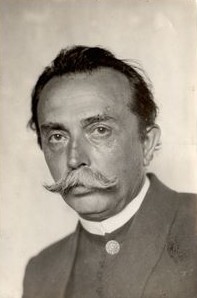
Why Vlastimil Hofmann matters
Vlastimil Hofmann, who worked under the Polish spelling Wlastimil Hofman, was a Prague-born painter who became one of the more internationally recognized Polish Symbolists of the early twentieth century, the first Polish artist admitted to the Vienna Secession in 1907. He was decorated repeatedly across three distinct Polish states, the interwar republic, and later communist Poland, a mark of unusually durable institutional standing for a painter of his generation. For collectors, he is also a useful case study in attribution risk: his name overlaps closely with an unrelated Czech Cubist architect, and his market is fragmented across small regional Polish and Czech auction houses rather than consolidated in a single index.
- Born
- 1881-04-27, Karlín, Prague, Austria-Hungary
- Nationality
- Polish
- Media
- Painting
- Movement
- Symbolism
- Education
- Academy of Fine Arts (School of Fine Arts), Kraków, c. 1896 to 1899, completed with distinction; Ecole des Beaux-Arts, Paris, from 1899, studio of Jean-Leon Gerome; further study under Leon Wyczolkowski at Kraków from 1901
- Signature motifs
- Symbolist allegory, Rural Polish folk subjects
By the numbers
- PLN 90,000Auction highKrakowianka z kura, 1923, Agra-Art, Krakow, 2024
- 1881 to 1970Life datesBorn Prague, died Szklarska Poreba, Poland
- First Polish member, 1907Vienna Secession
- Commander's Cross with Star, Order of Polonia Restituta, 1961Highest state honor
Selected works
Click any work to view it full screen.
Biography
Vlastimil Hofmann was born on 27 April 1881 in Karlín, then a district of Prague in Austria-Hungary. His family moved to Kraków in 1889, where he attended St Barbara's School and then the Jan III Sobieski gymnasium. He began art studies at the Kraków School of Fine Arts (later the Academy of Fine Arts) around 1895 to 1896, training under Florian Cynk, Jan Stanislawski, Leon Wyczolkowski, and Jacek Malczewski, and completed his studies there with distinction in 1899.
From 1899 he continued his training in Paris at the Ecole nationale superieure des Beaux-Arts, in the studio of Jean-Leon Gerome, for roughly one to three years depending on the source. From 1901 he returned to further study at his home academy in Kraków under Leon Wyczolkowski. He began using the Polish spelling of his given name, Wlastimil, and worked primarily as a Symbolist painter associated with traditionalist art, producing allegorical and rural subjects, including works such as "Krakowianka z kura" (Krakow Girl with a Hen) and "Symbolic Landscape with Thistles."
In 1907 he became the first Polish artist admitted to the Vienna Secession, and in 1921 he became the second Polish artist, after Olga Boznanska, admitted to the Societe nationale des beaux-arts in Paris. He competed in the art category of the 1928 Summer Olympics in Amsterdam and received a gold medal at the 1929 National Exhibition in Poznan. Across the following decades he received a series of Polish state honors, including the Gold Cross of Merit (1932), the Officer's Cross of the Order of Polonia Restituta (1937), the Order of the White Lion, 5th Class (1948), the Order of the Banner of Work, 2nd Class (1953), and the Commander's Cross with Star of the Order of Polonia Restituta (1961), reflecting continuous institutional recognition through the interwar republic and postwar communist Poland alike.
He settled in Szklarska Poreba in Lower Silesia, where he died on 6 March 1970. He is buried there with his wife in the parish cemetery beside the Corpus Christi Church. He should not be confused with Vlastislav Hofman (1884 to 1964), an unrelated Czech Cubist architect and stage designer of a similar name.
Critical reception
Hofmann's standing rests mainly on institutional recognition rather than a body of preserved critical writing: admission to the Vienna Secession in 1907, membership in the Societe nationale des beaux-arts in Paris in 1921, and a long run of Polish state honors spanning the interwar republic and communist Poland. Culture.pl, Poland's national culture portal, describes him as a painter representing the Symbolist movement and traditionalist art. No exact, verbatim critic quotations from named writers in major outlets could be confirmed in current research, so none are reproduced here.
Market
Hofmann's auction market is thin and fragmented across regional Polish and Czech houses rather than concentrated in major international sale rooms. The highest fully documented, titled result identified is "Krakowianka z kura" (Krakow Girl with a Hen), 1923, which sold for PLN 90,000 at Agra-Art in Kraków on 8 December 2024. A Czech gallery database lists what appears to be a substantially higher figure, around 9,300,000 CZK, under the artist's name, but that listing gives no work title, lot description, or sale date, so it cannot be confirmed as a genuine record and is not treated as one here. Other documented results span a wide range by currency and venue, including roughly 210,000 CZK for a work titled "Crossroads" at Arthouse Hejtmanek in Prague (2015) and 54,000 CZK for an unspecified work at Aukcni Galerie Platyz in Prague, illustrating how much individual results can vary by house and by work rather than tracing a single clear price curve.
Top auction results
| Work | Price | Sale |
|---|---|---|
| Krakowianka z kura (Krakow Girl with a Hen), 1923 | PLN 90,000 | Agra-Art, Krakow, Poland, 2024-12-08 |
Selected exhibitions
| Years | Exhibition | Venues |
|---|---|---|
| 1907 | Vienna Secession | Vienna Secession, Vienna |
| 1921 | Societe nationale des beaux-arts | Paris |
| 1928 | Olympic art competitions, 1928 Summer Olympics | Amsterdam |
| 1929 | National Exhibition | Poznan, Poland |
Awards and honors
- First Polish artist admitted to the Vienna Secession (1907)
- Member, Societe nationale des beaux-arts, Paris (1921)
- Gold Medal, National Exhibition, Poznan (1929)
- Gold Cross of Merit (1932)
- Officer's Cross, Order of Polonia Restituta (1937)
- Order of the White Lion, 5th Class (1948)
- Order of the Banner of Work, 2nd Class (1953)
- Commander's Cross with Star, Order of Polonia Restituta (1961)
Authentication and provenance
No catalogue raisonne.
No published catalogue raisonne has been identified for this artist. Given the naming overlap with the unrelated Czech Cubist architect Vlastislav Hofman (1884 to 1964), attribution should rely on documented provenance and sale history from named Polish and Czech auction houses rather than on name alone.
Primary reference: https://culture.pl/en/artist/vlastimil-hofman
What collectors should know
There is no published catalogue raisonne for Hofmann, and no current gallery or estate representation could be confirmed; his work is sold primarily through established Polish and Czech auction houses such as Agra-Art, DESA Unicum, and Aukcni Galerie Platyz, rather than through a single dealer. Buyers should be careful with attribution given the close naming overlap with the unrelated Czech architect Vlastislav Hofman, and should expect meaningful price variation between individual auction results rather than a smooth, well-documented market curve. Provenance tied to a named, established auction house is the most reliable verification available for this artist at present.
Further reading and resources
Data current as of 2026-07-16.

