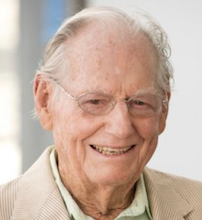
Why Wayne Thiebaud matters
Wayne Thiebaud is one of the most recognizable American painters of the postwar era, the artist whose luminous cakes, pie counters, and gumball machines became a visual shorthand for mid-century American abundance. For a collector, he is a useful case study in how a long, disciplined career, deep museum representation, and a clear and instantly legible body of work can build a durable market that has continued to set records well into and beyond the artist's lifetime.
- Born
- 1920-11-15, Mesa, Arizona, USA
- Nationality
- American
- Media
- Painting, Printmaking, Drawing
- Movement
- Bay Area Figurative, Pop Art
- Education
- California State University, Sacramento (Sacramento State College), BA 1951, MA 1952
- Signature motifs
- Cakes and confections, Counter displays, Steep San Francisco cityscapes, California river landscapes
- Representation
- Berggruen Gallery
By the numbers
- USD 19.1MAuction highFour Pinball Machines, Christie's New York, 2020
- 70+ yearsCareer spanfirst solo show 1951 to final works 2021
- 1994National Medal of Arts
- Berggruen GalleryRepresented by
Biography
Thiebaud was born Morton Wayne Thiebaud on 15 November 1920 in Mesa, Arizona, and built his early skills in commercial art, working as a cartoonist, sign painter, and illustrator, with a summer apprenticeship in the animation department at Walt Disney Studios. He came to fine art on a delayed timeline, earning a BA in 1951 and an MA in 1952 from Sacramento State College, now California State University, Sacramento.
In 1960 he joined the faculty of the University of California, Davis, where he taught for more than four decades and shaped generations of students. His breakthrough came in 1962, when his thickly painted depictions of cakes, pastries, and counter displays were shown in New York and quickly associated with the emerging Pop Art moment. Thiebaud himself resisted the label, aligning more closely with the Bay Area Figurative tradition and with a lineage of still-life painting that ran back through Chardin and Morandi. The heavily worked pigment, which he often described in terms of frosting, and the high-keyed shadows became his signature.
Over the following decades he expanded well beyond confections into steep, vertiginous San Francisco cityscapes and the patchwork river and delta landscapes of California's Central Valley. He received the National Medal of Arts in 1994. Thiebaud worked into his final years and died on 25 December 2021 in Sacramento, California, at the age of 101.
Critical reception
Critical writing on Thiebaud has long worked to separate him from the Pop Art label that attached to him in 1962. Scholars and curators, including those behind the 2000 Fine Arts Museums of San Francisco and Whitney retrospective and the 2023 Fondation Beyeler survey, tend to position him within the Bay Area Figurative milieu and a deeper European still-life tradition rather than within Pop's cooler, mass-media sensibility. The recurring theme is that his subjects, the cakes and counters, are vehicles for a serious painter's preoccupations: light, the physicality of pigment, and the formal problems of composition and color. Critics frequently note the tension between the cheerful, democratic subject matter and the rigor of the underlying technique, the way a slice of pie becomes an exercise in halation and shadow. His cityscapes and landscapes have drawn comparison to a distinctly American sense of space, and his decades of teaching at UC Davis are routinely cited as part of his influence on later generations of West Coast painters.
Watch
Market
Thiebaud's market is anchored by his confection and counter paintings of the 1960s, the works most closely tied to his critical reputation. His auction high is Four Pinball Machines, a 1962 canvas that sold for USD 19,134,728 at Christie's New York on 10 July 2020, roughly doubling his previous record. The result is notable for arriving late in his life and was followed by further strong prices, including Candy Counter (1969), which sold for USD 14,697,000 at Sotheby's New York in May 2023. The strongest works trade in the eight figures, while the broader market spans prints, drawings, and later landscapes at far more accessible levels.
Top auction results
| Work | Price | Sale |
|---|---|---|
| Four Pinball Machines (1962) | USD 19,134,728 (USD 19,134,728) | Christie's, New York, 2020-07-10 |
| Candy Counter (1969) | USD 14,697,000 (USD 14,697,000) | Sotheby's, New York, 2023-05-18 |
Selected exhibitions
| Years | Exhibition | Venues |
|---|---|---|
| 2023 | Wayne Thiebaud | Fondation Beyeler, Riehen/Basel (first individual exhibition in the German-speaking world) |
| 2020 to 2021 | Wayne Thiebaud 100: Paintings, Prints, and Drawings | Crocker Art Museum, Sacramento, then traveling |
| 2000 to 2001 | Wayne Thiebaud: A Paintings Retrospective | Fine Arts Museums of San Francisco, then Whitney Museum of American Art and others |
Museum collections
- Museum of Modern Art, New York
- Whitney Museum of American Art, New York
- San Francisco Museum of Modern Art
- Hirshhorn Museum and Sculpture Garden, Washington, D.C.
- Los Angeles County Museum of Art
- Crocker Art Museum, Sacramento
- Phoenix Art Museum
Awards and honors
- National Medal of Arts (1994)
- American Academy of Arts and Letters, Gold Medal for Painting (2001)
Authentication and provenance
No catalogue raisonne.
No catalogue raisonne and no certificate-of-authenticity program. Works are verified through the artist's archive, the Berggruen Gallery, and standard auction, exhibition, and literature provenance.
Primary reference: https://www.berggruen.com/artists/wayne-thiebaud
What collectors should know
Thiebaud's market rewards subject and period. The early 1960s confection and counter paintings command the strongest prices and the deepest demand, while later landscapes, cityscapes, prints, and works on paper offer a broad range of entry points. The absence of a catalogue raisonne places added weight on provenance, exhibition history, and verification through the artist's archive and his gallery. His extensive museum representation, spanning MoMA, the Whitney, SFMOMA, and the Hirshhorn among others, is the strongest signal of long-term durability, and his record of setting new highs after the age of 99 underlines how established and liquid the top of his market has become.
Further reading and resources
Data current as of 2026-06-20.

