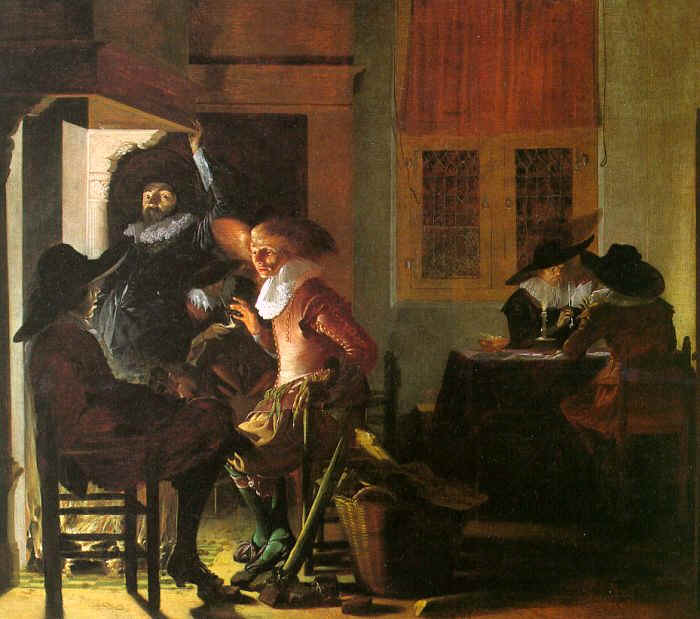
Why Willem Cornelisz Duyster matters
Willem Cornelisz Duyster was a Dutch Golden Age genre painter working in Amsterdam in the 1620s and early 1630s, best known for guardroom scenes and merry-company subjects that captured the off-duty life of soldiers and burghers with unusual psychological nuance. His career was brief, cut short by his death in 1635, and his surviving output is correspondingly small and closely intertwined with that of his contemporary Pieter Codde. For collectors, Duyster is a connoisseur's artist: a name held in the permanent collections of the National Gallery in London, the Rijksmuseum, the Louvre, and the Musee des Beaux-Arts de Lyon, whose market is defined by rarity and by the attribution questions that come with a small, tightly studied seventeenth-century oeuvre.
- Nationality
- Dutch
- Media
- Painting
- Movement
- Dutch Golden Age painting
- Education
- No confirmed formal training documented. Amsterdam's guild records for this period were lost. The National Gallery, London notes he may have trained with Pieter Codde, presented as a possibility, not a confirmed fact.
- Signature motifs
- Guardroom scenes, Merry-company genre scenes, Military genre subjects
By the numbers
- c. 1620s to 1635Active periodAmsterdam
- 1635DeathAttributed to plague; exact date not documented, buried in Amsterdam 31 January 1635 per Art UK
- National Gallery, LondonMuseum collectionsTwo paintings, per Art UK and the National Gallery
- None (Old Master)Current representationWorks trade through auction houses and Old Master dealers, not a gallery or estate
Biography
Willem Cornelisz Duyster was born in Amsterdam around 1599; the exact day and month of his birth are not recorded, and some sources give 1598 or 1599. Little is documented about his early training. Amsterdam's guild records for the period were lost, and the National Gallery, London notes only that he may have trained with the painter Pieter Codde, a possibility rather than a settled fact; the two painters are known to have had direct contact, though the specific nature and dating of that contact is not fully confirmed in the sources reviewed here.
Duyster specialized in guardroom scenes, small pictures showing soldiers relaxing, drinking, gambling, and quarreling away from combat, along with merry-company genre scenes of burghers at leisure. His style has been connected to that of Dirck Hals, Anthonie Palamedesz, Jacob van Velsen, and Thomas de Keyser, painters working similar territory in Amsterdam in the same years. He worked almost entirely in and around Amsterdam for his whole documented career.
Duyster died in 1635, in his mid-thirties, in Amsterdam. Multiple sources attribute his death to the plague. Art UK records that he was buried in Amsterdam on 31 January 1635; one auction house source names the Zuiderkerk as his burial site, though that detail rests on a single source and should be treated with some caution.
Critical reception
Modern assessment of Duyster rests on his technical facility and on the sense that his premature death cut off a still-developing talent. Art UK's entry on the artist observes that "his delicate skill at painting textiles, his ability to characterize individuals, and his power to express subtle psychological relationships between them, suggest that if he had not been carried off by the plague in his mid-thirties he might well have rivalled Terborch." The National Gallery, London situates him within a small circle of Amsterdam genre specialists, alongside Pieter Codde, Dirck Hals, and Anthonie Palamedesz, and treats his guardroom and merry-company scenes as an important, if lesser-known, strand of Dutch Golden Age genre painting. Scholarly literature on Duyster remains modest in volume, reflecting both the small size of his oeuvre and the persistent difficulty of separating his hand from Codde's in works where attribution is not fully secure.
Market
Duyster's market is thin and dominated by scholarly and museum interest rather than by a deep, transparent price history. Public auction databases such as Artnet, AskART, MutualArt, and Invaluable track his sales, but full realized-price histories sit behind paid subscriptions, and no auction house has published a clear statement naming an all-time record for the artist. MutualArt's own listing cites realized prices reaching USD 267,507 for a painting and USD 2,519 for a work on paper, though this reflects a single platform's coverage rather than a cross-checked record. A notable recent offering is A Musical Party, which appeared in a Sotheby's London Old Master sale with a pre-sale estimate of GBP 150,000 to 200,000; the exact sale date and the realized price are not confirmed in the sources reviewed here. Prices for smaller or more uncertainly attributed works can fall far lower, illustrating how widely Duyster's prices can swing depending on size, condition, subject, and certainty of attribution.
Top auction results
| Work | Price | Sale |
|---|---|---|
| A Musical Party | GBP 150,000 to 200,000 (pre-sale estimate; exact sale date and realized price not confirmed in available sources) | Sotheby's, London |
Selected exhibitions
| Years | Exhibition | Venues |
|---|---|---|
| 1976 | Art in Seventeenth-Century Holland | Not specified in sourced dossier |
| 1996 | Die sichtbare Welt: Niederlandische Bilder des 16. und 17. Jahrhunderts | Not specified in sourced dossier |
| Ongoing | Permanent collection display | National Gallery, London |
| Ongoing | Permanent collection display | Rijksmuseum, Amsterdam |
| Ongoing | Permanent collection display | Musee du Louvre, Paris |
| Ongoing | Permanent collection display | Musee des Beaux-Arts de Lyon |
Museum collections
- National Gallery, London
- Rijksmuseum, Amsterdam
- Musee du Louvre, Paris
- Musee des Beaux-Arts de Lyon
Authentication and provenance
No catalogue raisonne.
No catalogue raisonne is confirmed for Willem Cornelisz Duyster. Amsterdam's guild records from his working years were lost, and his oeuvre has historically overlapped with that of Pieter Codde, a closely associated painter working similar subjects, which complicates attribution. Works are authenticated through connoisseurship, provenance research, and comparison with securely documented paintings held by institutions such as the National Gallery, London.
Primary reference: https://www.nationalgallery.org.uk/artists/willem-duyster
What collectors should know
Duyster is a name for specialists rather than a liquid, frequently traded market. His documented oeuvre is small, no catalogue raisonne has been published, and attribution can be genuinely difficult given his close stylistic proximity to Pieter Codde; buyers should expect to lean on provenance, condition reports, and expert opinion rather than on a settled reference catalogue. Public price data is fragmented across subscription databases, so any single result, high or low, should be read in the context of the specific work's size, subject, and attribution certainty rather than as a stable benchmark. His presence in the permanent collections of the National Gallery, the Rijksmuseum, the Louvre, and the Lyon museum is the clearest evidence of his standing, and a useful anchor for evaluating any work offered on the market.
Further reading and resources
Data current as of 2026-07-11.

