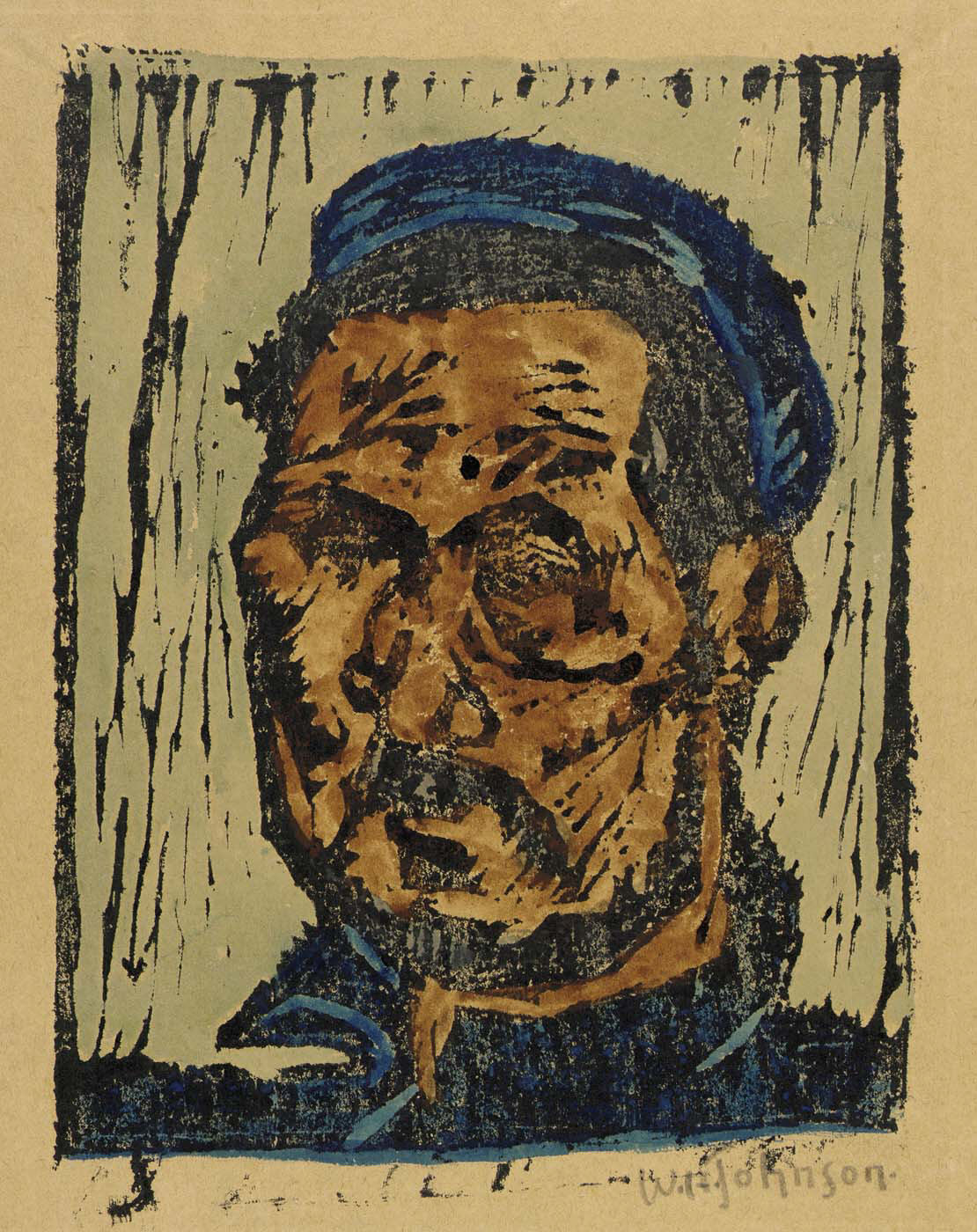
Why William H. Johnson matters
William H. Johnson is one of the most significant African American painters of the twentieth century, an artist whose career moved from academic training in New York, through French and Scandinavian modernism, to a distinctive, folk-influenced style built around Harlem street life, the rural South, and Black historical figures. For a collector, he represents a case where the market is thin not because the work is minor but because the great majority of his surviving output, more than a thousand works, has been in the Smithsonian American Art Museum's collection since 1967, leaving only a small fraction ever available at auction.
- Born
- 1901-03-18, Florence, South Carolina, USA
- Nationality
- American
- Media
- Painting, Printmaking
- Movement
- Harlem Renaissance, American Modernism, Folk art-influenced figuration
- Education
- National Academy of Design, New York, 1921 to 1926, no degree recorded; Cape Cod School of Art, Provincetown, summers between 1923 and 1926; independent study in Paris and southern France, 1926 to 1929, and in Denmark and Norway, 1930 to 1938.
- Signature motifs
- Harlem street and nightlife scenes, African American historical and freedom-fighter portraits, Rural South and family life, Flattened folk-influenced figuration
- Representation
- Estate stewarded by the Smithsonian American Art Museum, Michael Rosenfeld Gallery, New York (exhibiting dealer)
By the numbers
- USD 175,000Auction highJitterbug 1, The Potomack Company, April 2026
- 1,000+ worksEstate holdingsTransferred to the Smithsonian American Art Museum by the Harmon Foundation, 1967
- 1901 to 1970Life datesFlorence, South Carolina to Central Islip, New York
Selected works
Click any work to view it full screen.
Biography
William Henry Johnson was born on March 18, 1901, in Florence, South Carolina, and attended the Wilson School and rural grade schools there before moving to New York around age seventeen. In September 1921 he enrolled at the National Academy of Design, studying under Charles Louis Hinton, Charles Courtney Curran, George Willoughby Maynard, and, from 1923, Charles Webster Hawthorne, under whom he also studied for three summers at the Cape Cod School of Art in Provincetown. He won the Academy's Cannon Prize (1924) and Hallgarten Prize (1925), and when he did not win a Pulitzer travel scholarship in his final year, Hawthorne raised roughly $1,000 to send him to Europe.
Johnson moved to Paris in 1926 and studied and worked in France until 1929, absorbing the modernism of Cezanne, Soutine, and the Expressionists, and seeking out the African American expatriate painter Henry O. Tanner. In 1929 the Harmon Foundation awarded him its gold medal for distinguished achievement among Black artists, bringing him early national attention. He married the Danish textile artist Holcha Krake and lived and worked in Denmark and Norway from about 1930 to 1938, returning to the United States as war approached in Europe.
Settling in Harlem, Johnson developed the bold, flattened, self-consciously folk-inflected style for which he is best known, painting scenes of Harlem nightlife, café society, and jitterbug dancers alongside portraits of Black historical and political figures. He held his first New York solo exhibition at the Alma Reed Gallery in 1941. His wife died in 1944, and by 1947, when he held his last exhibition in his lifetime in Copenhagen, his health had seriously declined. Later that year he was hospitalized for a severe mental breakdown and admitted to Central Islip State Hospital on Long Island, New York, where, according to the Smithsonian American Art Museum and Artnet, he remained institutionalized for the rest of his life. He died at Central Islip State Hospital on April 13, 1970. In 1967 the Harmon Foundation, winding down its operations, transferred Johnson's life's work, more than 1,000 paintings, watercolors, and prints, to what is now the Smithsonian American Art Museum, which organized his first museum retrospective in 1971.
Critical reception
Johnson's reputation has shifted meaningfully over time. When the Harmon Foundation exhibited his work from 1929 onward, critics debated his early reliance on European and Euro-American academic standards, even as reviewers recognized real talent; a contemporary Danish critic reviewing his last Copenhagen show in 1947 is said to have compared his handling of color to Matisse and praised his depiction of Black working communities of the American South and their leaders, though the specific critic and publication could not be confirmed in available sources. After his death, and especially following the Smithsonian's 1971 retrospective and its major traveling exhibitions Homecoming (1991) and William H. Johnson's World on Paper (2006 to 2007), scholarship increasingly framed his later, folk-influenced Harlem and history paintings as a deliberate and sophisticated embrace of vernacular Black visual culture rather than a retreat from his academic training. Michael Rosenfeld Gallery's dedicated 2020 solo booth at ADAA's The Art Show, and the Smithsonian's continuing Fighters for Freedom tour, reflect a sustained institutional and market reassessment of his historical importance.
Market
Johnson's auction market is small in volume because the bulk of his output sits permanently in the Smithsonian American Art Museum rather than in private hands. His current auction record is Jitterbug 1, which sold for USD 175,000 at The Potomack Company in Alexandria, Virginia, on April 29, 2026; this figure is drawn from a secondary market report rather than a primary auction-house record and should be treated as provisional pending direct confirmation. Works on paper trade separately and at lower levels: Swann Galleries has recorded a print-specific result of USD 81,250 for the color pochoir and screenprint On a John Brown Flight. Collectors should expect an uneven, low-frequency market rather than a smooth price trend, given how few works come to sale in any given year.
Top auction results
| Work | Price | Sale |
|---|---|---|
| Jitterbug 1 (2026) | USD 175,000 | The Potomack Company, Alexandria, Virginia, 2026-04-29 |
Selected exhibitions
| Years | Exhibition | Venues |
|---|---|---|
| 1929 to 1933 | Harmon Foundation exhibitions of African American art | Harmon Foundation, New York (traveling) |
| 1941 | First solo exhibition in New York | Alma Reed Gallery, New York |
| 1947 | Exhibition of historical and political paintings, the last shown in his lifetime | Copenhagen, Denmark |
| 1971 | First museum retrospective | National Collection of Fine Arts, now the Smithsonian American Art Museum, Washington, D.C. |
| 1991 | Homecoming: The Art and Life of William H. Johnson | Organized and circulated by the Smithsonian American Art Museum |
| 2006 to 2007 | William H. Johnson's World on Paper | Smithsonian American Art Museum, traveling to the Amon Carter Museum, the Philadelphia Museum of Art, and the Montgomery Museum of Fine Arts |
| 2020 | Solo gallery booth presentation | Michael Rosenfeld Gallery, ADAA The Art Show, Park Avenue Armory, New York |
| 2022 to 2026 | Fighters for Freedom: William H. Johnson Picturing Justice | Traveling exhibition drawn from the Smithsonian American Art Museum collection, including the Albany Museum of Art, the Patricia & Phillip Frost Art Museum, and the Dayton Art Institute |
Museum collections
- Smithsonian American Art Museum, Washington, D.C.
- Museum of Modern Art, New York
- Whitney Museum of American Art, New York
- Florence County Museum, Florence, South Carolina
Awards and honors
- Cannon Prize, National Academy of Design (1924)
- Hallgarten Prize, National Academy of Design (1925)
- Harmon Foundation Gold Medal for Distinguished Achievement Among Negroes in Fine Art (1929)
Authentication and provenance
No catalogue raisonne.
No catalogue raisonne has been published. Johnson's estate, more than 1,000 works transferred by the Harmon Foundation in 1967, is held and stewarded by the Smithsonian American Art Museum, which functions as the primary scholarly authority on his oeuvre.
Primary reference: https://americanart.si.edu/artist/william-h-johnson-2486
What collectors should know
There is no catalogue raisonne for Johnson, and the Smithsonian American Art Museum, as steward of the artist's estate since 1967, is the primary reference point for attribution and scholarship rather than any dealer or foundation certification program. Because the vast majority of his known output is in that single institutional collection, the private market is genuinely thin, so any individual auction result, including the current $175,000 record, should be read against a very small comparison set rather than treated as a stable trend line. Buyers should also weigh that supply skews toward works on paper and prints, with major paintings rarely appearing outside museum contexts.
Further reading and resources
Data current as of 2026-07-16.

