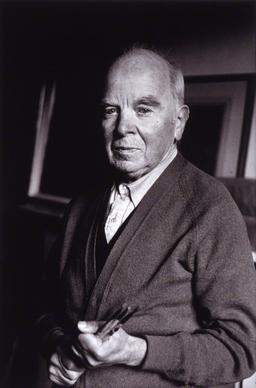
Why William Roberts matters
William Roberts occupies a specific and durable place in twentieth-century British art: a painter associated with the original Vorticist circle in the years before the First World War, and later a long-serving Royal Academician whose large, geometric multi-figure paintings chronicled English working and social life for six decades. For a collector, he is a case study in a market shaped almost entirely by institutional custodianship rather than commercial gallery promotion. The bulk of his estate passed to Tate, no catalogue raisonne has been confirmed, and the auction market is thin, punctuated by a small number of major sales far above the typical range for his work.
- Nationality
- British
- Media
- Painting, Drawing
- Movement
- Vorticism, Modern British
- Education
- Evening classes, St Martin's School of Art; Slade School of Fine Art (University College London), London County Council scholarship, c. 1910 to 1913; no formal degree conferred
- Signature motifs
- Cubist-influenced angular figuration, Large multi-figure group compositions
- Representation
- No current commercial representation; estate custodianship held by Tate, Secondary market: Jenna Burlingham Gallery, Osborne Samuel, The Mayor Gallery
By the numbers
- GBP 457,250Auction highThe Masks, Sotheby's London, 15 June 2011
- Elected 1966Royal AcademicianAssociate of the Royal Academy from 1958
- 1923First solo exhibitionChenil Gallery, Chelsea, London
- Estate custodianship: TateRepresented byNo current commercial gallery representation
Biography
William Patrick Roberts was born in 1895 in Hackney, London. He left school at fourteen and was apprenticed to a poster design and advertising firm, attending evening classes at St Martin's School of Art while he worked. In 1910 he won a London County Council scholarship to the Slade School of Fine Art, where he studied under Henry Tonks and Wilson Steer. He left the Slade in 1913 after winning the Melville Nettleship Prize for figure composition and a further prize for drawing.
Roberts became associated with the Vorticist circle around Wyndham Lewis in the years before the First World War, developing an angular, machine-influenced figuration that later led critics to call him the "English Cubist." He served during the First World War and was commissioned to paint The First German Gas Attack at Ypres, now on permanent display at the Canadian War Museum in Ottawa. His best-known image of the Vorticist group, The Vorticists at the Restaurant de la Tour Eiffel: Spring 1915, was painted decades later, in 1961 to 1962, and is held by Tate.
He held his first solo exhibition at the Chenil Gallery in Chelsea in 1923 and showed at the Venice Biennale in 1928. From the mid-1920s until about 1960 he taught at the Central School of Arts and Crafts in London. From 1958 he exhibited almost exclusively at the Royal Academy Summer Exhibition, where his dense, large-scale group paintings became a fixture, and he was elected an Associate of the Royal Academy that same year. In 1961 he received an award from the Calouste Gulbenkian Foundation, and in 1965 the Arts Council of Great Britain organized a retrospective of more than two hundred of his paintings at the Tate Gallery, which also toured to Newcastle and Manchester. He was elected a full Royal Academician in 1966 and declined the offer of an OBE around the same period.
Roberts continued to live and work at 14 St Mark's Crescent, Primrose Hill, until his death on 20 January 1980, in London; Wikipedia specifies the Royal Free Hospital as the place of death. After the death of his son John in 1994, according to published accounts roughly 475 paintings and drawings found in the family home were placed with Tate for safekeeping, with a portion since allocated to Tate in lieu of inheritance tax.
Critical reception
Roberts's reputation was made early and revived late. A Times review of the New English Art Club's 1913 exhibition praised his student painting Travelling Cradle as one of the strongest works in the show, noting the cohesion and control of its figures. His public profile then receded for decades; after 1958 he exhibited almost nowhere but the Royal Academy. The 1965 Arts Council retrospective at the Tate Gallery reintroduced him to a wider audience, with The Times observing that critical opinion on his work had swung between enthusiasm and neglect over the years, while describing the more than two hundred paintings then on view. Critics and curators have since read his work through the lens of the Vorticist circle and its aftermath, treating his hard-edged, densely populated compositions as a distinct, socially observant strand of British modernism, separate from the movement's more purely abstract wing.
Market
Roberts's market has no living-artist infrastructure behind it. There is no commercial gallery or foundation actively promoting his work, and no catalogue raisonne has been confirmed. His estate is chiefly held and administered by Tate, which took in a large body of work from his home after 1994. On the secondary market, his work is handled periodically by UK specialist dealers including Jenna Burlingham Gallery, Osborne Samuel, and The Mayor Gallery.
His documented auction high is The Masks, sold for GBP 457,250 at Sotheby's London on 15 June 2011. Two other paintings, The Restaurant (GBP 373,250, Sotheby's London, 15 June 2011) and The Leave Train (GBP 377,000, Christie's London, November 2016), round out his highest verified results. These few major paintings sit well above the bulk of his auction activity, illustrating a market driven by a small number of institutional-quality works rather than a broad, liquid trading range.
Top auction results
| Work | Price | Sale |
|---|---|---|
| The Masks | GBP 457,250 | Sotheby's, London, 2011-06-15 |
Selected exhibitions
| Years | Exhibition | Venues |
|---|---|---|
| 2025 | Celebrating 100 Years, Part 1 | The Mayor Gallery, London |
| 2022 | Masterpiece London | Osborne Samuel, Mayfair, London |
| 1965 to 1966 | William Roberts retrospective | Arts Council of Great Britain retrospective, Tate Gallery, London, touring to Newcastle and Manchester |
| 1958 to 1980 | Royal Academy Summer Exhibition | Royal Academy of Arts, London (annual) |
| 1928 | Venice Biennale | Venice Biennale, Venice |
| 1923 | First solo exhibition | Chenil Gallery, Chelsea, London |
| 1913 | New English Art Club, Fiftieth Exhibition | New English Art Club, London |
Museum collections
- Tate, London
- Victoria and Albert Museum, London
- Canadian War Museum, Ottawa
- Arts Council Collection, London
- Ferens Art Gallery, Hull
- Leicestershire County Council Artworks Collection, Leicester
Awards and honors
- Melville Nettleship Prize for Figure Composition, Slade School of Fine Art (1913)
- Associate of the Royal Academy (A.R.A.) (1958)
- Calouste Gulbenkian Foundation Award (1961)
- Elected Royal Academician (R.A.); declined the offer of an OBE (1966)
Authentication and provenance
No catalogue raisonne.
No published catalogue raisonne has been confirmed. According to published accounts, roughly 475 paintings and drawings from the artist's estate passed to Tate for safekeeping after 1994, with a portion allocated to Tate in lieu of inheritance tax. Works are chiefly verified against Tate's holdings and documented provenance rather than a certificate-of-authenticity program.
Primary reference: https://www.tate.org.uk/art/artists/william-roberts-1855
What collectors should know
Collectors researching William Roberts should first confirm which artist they mean. The name is shared by the Welsh painter Will Roberts (1907 to 2000) and by a separately recorded artist listed as William Roberts, born 1941, on Artprice; neither should be confused with the Vorticist-era William Patrick Roberts covered here. Because no catalogue raisonne exists and the estate sits mainly with Tate rather than a dealer or foundation, provenance research and comparison to Tate's published holdings are the most reliable path to verifying a work. Auction supply is thin and uneven: a handful of major paintings, led by the 2011 sale of The Masks, sit well above the bulk of results, so any single sale should be read in that context rather than as a stable benchmark.
Further reading and resources
Data current as of 2026-07-10.

