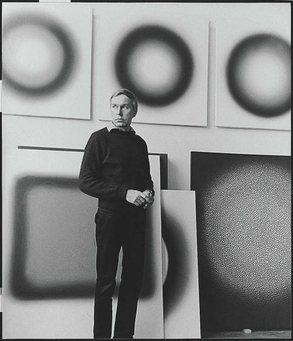
Why Wojciech Fangor matters
Wojciech Fangor is the Polish painter most responsible for bringing an Eastern Bloc artist into the front rank of postwar international abstraction. In 1970 he became the first Polish artist to hold a solo exhibition at the Solomon R. Guggenheim Museum in New York, the culmination of a body of pulsating, illusionary "positive-negative" color-field paintings that placed him alongside the Op Art and color-field painters of his American and Western European peers. For a collector, he is a case study in an artist whose critical and museum standing is well established internationally, while the deepest auction liquidity for his work still runs through the Polish domestic market.
- Born
- 1922-11-15, Warsaw, Poland
- Nationality
- Polish
- Media
- Painting, Sculpture, Graphic art, Poster design
- Movement
- Op Art, Color Field, Postwar Polish avant-garde
- Education
- Academy of Fine Arts in Warsaw, diploma 1946. Private study under Tadeusz Pruszkowski and Felicjan Szczesny Kowarski during World War II.
- Signature motifs
- Illusionary "positive-negative" pulsating circles and rings, Spatial color-field abstraction
- Representation
- "GNYP Gallery, Berlin and Antwerp", "Fangor Foundation, estate archive"
By the numbers
- PLN 7,316,000Auction highM22, Desa Unicum, Warsaw
- First Polish artistGuggenheim solo, 1970First Polish artist to hold a solo exhibition at the Solomon R. Guggenheim Museum, New York
- Order of Polonia Restituta, 2001State honor
- GNYP Gallery; Fangor Foundation (estate archive)Represented by
Selected works
Click any work to view it full screen.
Biography
Fangor was born on 15 November 1922 in Warsaw. Before the Second World War he attended the private grammar school of the Masovian School Society and the Mikolaj Rey Grammar School in Warsaw, and began training as a painter under Tadeusz Kozlowski in 1936. During the German occupation he studied privately with Tadeusz Pruszkowski and, after Pruszkowski's death, with Felicjan Szczesny Kowarski, who lived for several years at the Fangor family estate in Klarysew. Fangor received his diploma from the Academy of Fine Arts in Warsaw in 1946.
In the early 1950s, working within the state-mandated Socialist Realist idiom of communist Poland, he won a second prize at the 1951 II National Exhibition of Fine Arts in Warsaw for the paintings Lenin in Poronin and Korean Mother, and shared a first prize at the CBWA's first national poster exhibition with Tadeusz Trepkowski and Henryk Tomaszewski. By the late 1950s he had turned decisively toward abstraction. In 1958, with architect Stanislaw Zamecznik, he created Studium Przestrzeni (Space Study) at Warsaw's Salon Nowej Kultury, an installation integrating his abstract paintings into an architectural environment of pillars, for which he received an award from Poland's Minister of Culture and Art. His paintings appeared in a group show at the Stedelijk Museum, Amsterdam, soon after.
Fangor's international profile grew through the 1960s. He held his first United States solo exhibition at the Gres Gallery in Washington, D.C., in 1961, the same year his work appeared in the Museum of Modern Art's group exhibition 15 Polish Painters. A Ford Foundation fellowship brought a 1962 solo show at the Institute of Contemporary Art, Washington, D.C., and his work was included in MoMA's landmark 1965 exhibition The Responsive Eye, which introduced Op Art to a wide American public. In 1970 the Solomon R. Guggenheim Museum in New York gave him a solo exhibition, making him the first Polish artist honored with a one-person show there. He went on to teach at the Bath Academy of Art (1965 to 1966) and at Fairleigh Dickinson University in New Jersey (1967 to 1983), with lectures at the Harvard Graduate School of Design in 1967 and 1968.
Fangor returned to live in Poland in the late 1990s. He died on 25 October 2015 at age 92 in Jozefow, near Warsaw, according to the Fangor Foundation, with the Art Newspaper, ArtReview, and Artforum independently confirming his death that same week.
Critical reception
Fangor's reputation rests on his shift from an academically trained Socialist Realist painter into one of the most distinctive colorists associated with Op Art and color-field abstraction. Critics including Karen Wilkin have discussed his circular, pulsating canvases in relation to the postwar dialogue between European and American abstraction, and the art historian Magdalena Dabrowski has written about his exploration of color and space as a distinct visual language, noting that his sense of form owes as much to sculptors and architects as to painters. Museums have reinforced this reading through retrospectives at the Centre for Contemporary Art at Ujazdowski Castle (2003), Zacheta National Gallery of Art (2004), and the National Museum in Krakow (2012), alongside the historic 1970 Guggenheim show that first established him internationally.
Market
Fangor's auction market is anchored in Poland. His current auction record is M22, which sold for PLN 7,316,000 (including buyer's premium) at Desa Unicum in Warsaw, reported by Polish art-market press as the highest price ever paid at auction for a work of art sold in Poland; the exact calendar date of that sale is not confirmed in public reporting. His international auction presence is smaller but active: in 2025 the 1971 canvas SU 12 sold for USD 330,200 at Rago Auctions, a result that illustrates how far the Polish and international markets for his work have historically diverged, with Poland now setting the higher benchmark. There is no confirmed all-time global comparison across every sale venue, so collectors should treat the Desa Unicum figure as the best-documented record rather than an exhaustive one.
Top auction results
| Work | Price | Sale |
|---|---|---|
| M22 | PLN 7,316,000 | Desa Unicum, Warsaw, Poland |
Selected exhibitions
| Years | Exhibition | Venues |
|---|---|---|
| 1958 | Studium Przestrzeni (Space Study) | Salon Nowej Kultury, Warsaw (with Stanislaw Zamecznik) |
| 1961 | 15 Polish Painters | Museum of Modern Art, New York |
| 1965 | The Responsive Eye | Museum of Modern Art, New York |
| 1970 | Solo exhibition | Solomon R. Guggenheim Museum, New York |
| 2003 | Major exhibition | Centre for Contemporary Art, Ujazdowski Castle, Warsaw |
| 2004 | Retrospective | Zacheta National Gallery of Art, Warsaw |
| 2012 | Retrospective | National Museum in Krakow |
| 2018 | Wojciech Fangor: The Early 1960s | Heather James Fine Art, New York (traveling) |
Museum collections
- Museum of Art, Radom, Poland
- Zacheta National Gallery of Art, Warsaw
- National Museum in Wroclaw
- Centre for Contemporary Art, Ujazdowski Castle, Warsaw
- National Museum in Krakow
- Solomon R. Guggenheim Museum, New York
Awards and honors
- Order of Polonia Restituta (Knight's Cross) (2001)
- Gold Medal for Merit to Culture, Gloria Artis (2004)
- Award of the Minister of Culture of the Republic of Poland (2003)
- Alfred Jurzykowski Foundation Award (1978)
- Second prize, II National Exhibition of Fine Arts, Warsaw (1951)
Authentication and provenance
No catalogue raisonne.
No published catalogue raisonne has been confirmed. The Fangor Foundation is the primary archival authority for the estate and coordinates exhibitions and provenance questions; works are verified through the Foundation and documented ownership history.
Primary reference: https://fangorfoundation.org/wojciech/biography/
What collectors should know
Fangor has no published catalogue raisonne, and the Fangor Foundation functions as the primary steward of the estate's archive and exhibition record, so provenance research benefits from consulting the Foundation directly. His auction market currently splits between a Polish record set at Desa Unicum and a smaller, separately priced international market exemplified by Rago Auctions' 2025 sale, and collectors should not assume the two markets move together. His institutional standing, anchored by the 1970 Guggenheim solo show and inclusion in MoMA's 1961 and 1965 group exhibitions, is the strongest evidence of long-term durability, while the relative thinness of his international auction record means individual sale results deserve close, work-by-work scrutiny.
Further reading and resources
Data current as of 2026-07-09.

